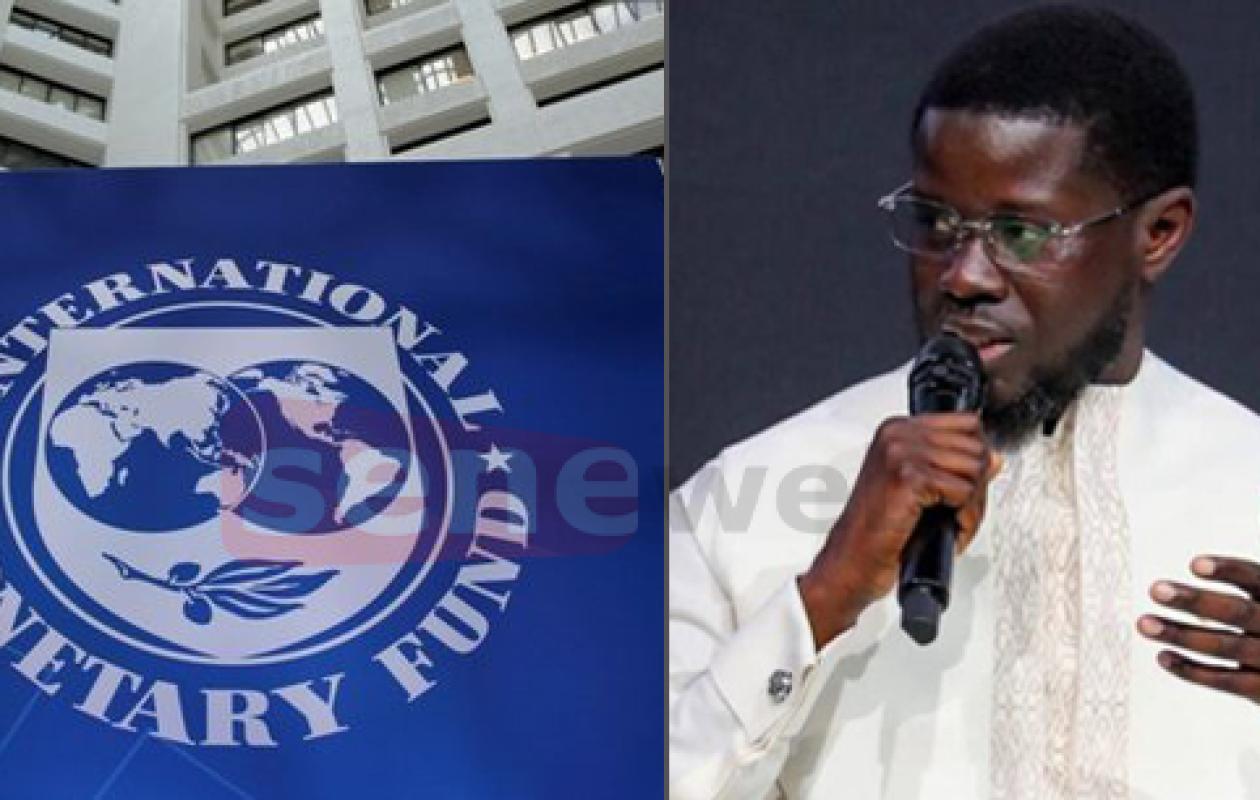
Dette extérieure : Le coup de poker financier de Dakar pour séduire le FMI
Just days before a new mission from the International Monetary Fund is expected in Dakar, Senegal has chosen to prepay two installments on its external debt in foreign currency. The move may seem technical, almost purely accounting-based, but it comes at a time when every decision related to Senegal's debt is being closely scrutinized by investors, rating agencies, and financial partners.
According to market information reported by Bloomberg and picked up by several economic media outlets, the State has paid in advance a coupon of 53.75 million euros on a bond maturing in 2037, as well as a payment of 38.8 million dollars related to a dollar bond whose final maturity is scheduled for 2031. In FCFA equivalent, the operation represents a little over 58 billion, or about 100 million dollars at the current exchange rate.
The timing gives this repayment particular significance. The IMF mission is expected in Dakar starting June 15, according to the Senegalese press, citing Le Quotidien, while other sources suggest an arrival before the end of the month. This visit is part of ongoing discussions regarding a new financial program, following the suspension of the previous agreement due to discrepancies revealed in public accounts.
In this context, the early payment is not simply a cash flow operation. It also serves as a message to creditors. Dakar seeks to demonstrate that, despite recent tensions surrounding public debt and difficult discussions with the IMF, the state retains the necessary liquidity to honor its external commitments on time, or even ahead of schedule.
The signal is all the more important given that Senegal's financial credibility has been weakened since the publication of the Court of Auditors' audit in February 2025. The IMF subsequently confirmed the existence of undeclared debts, estimated at around $7 billion in an initial estimate that was widely adopted, while Reuters later reported a broader scope, bringing public debt and associated liabilities to nearly 132% of GDP at the end of 2024. This difference in figures mainly reflects distinct calculation scopes, between central government debt, parapublic commitments, and domestic arrears.
For the markets, the central issue is therefore not solely the level of debt, but the state's ability to maintain a credible repayment trajectory. A highly indebted country can retain access to financing if it demonstrates that it is meeting its payment deadlines, whereas doubts about available liquidity can quickly drive up the interest rates demanded by investors.
This is not Senegal's first such move in 2026. In March, the country had already settled an external debt of approximately $471 million, an operation also interpreted as an attempt to dispel any suspicion of default. The early repayment in June is therefore part of a broader sequence of financial normalization, at a time when the government is seeking to restore confidence after a period of significant budgetary uncertainty.
This strategy, however, comes at a cost. Senegal's total debt service for the 2026 fiscal year is estimated at approximately 5.5 trillion CFA francs, or nearly $9.7 billion, according to data cited by the Ecofin Agency. In a budget already constrained by current expenditures, public investments, and social needs, each early payment also reduces available short-term cash.
The logic, therefore, is one of arbitrage. By repaying before the due date, the state uses some of its immediate liquidity to buy financial credibility. If the signal is well received, it can help reduce the perception of risk, facilitate discussions with the IMF, and improve the conditions for future fundraising. If, on the other hand, the markets judge the gesture insufficient in the face of the mounting debt, the effect will remain limited.
This operation serves as a reminder that debt management has also become a tool for financial communication. States are no longer content simply to repay or borrow. They seek to send signals, to organize the timing of their payments, and to demonstrate to creditors that they maintain control of their cash flow.
For Dakar, the message sent before the IMF mission is quite clear. The country wants to show that it is discussing a new program without being in a payment emergency. The challenge now will be to transform this one-off signal into a sustainable trajectory of fiscal credibility.













Commentaires (10)
Participer à la Discussion
Règles de la communauté :
💡 Astuce : Utilisez des emojis depuis votre téléphone ou le module emoji ci-dessous. Cliquez sur GIF pour ajouter un GIF animé. Collez un lien X/Twitter, TikTok ou Instagram pour l'afficher automatiquement.