UEMOA : la Cour de justice célèbre 30 ans au service de l’intégration régionale
Meeting in Ouagadougou to celebrate three decades of existence, the UEMOA Court of Justice intends to take stock of its actions and reflect on the prospects for community justice.
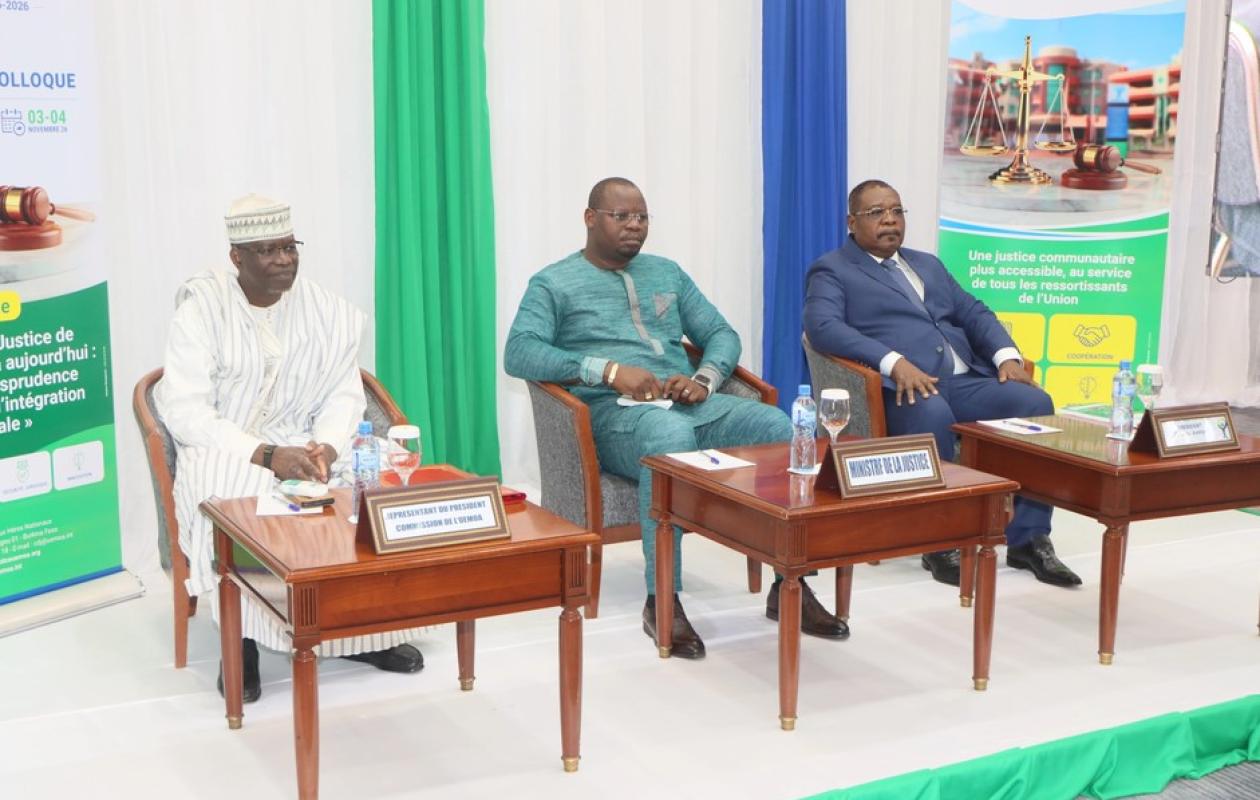
Thirty years after its creation, the Court of Justice of the West African Economic and Monetary Union (WAEMU) is taking stock of its history. On November 3, 2026, in Ouagadougou, Burkina Faso, stakeholders from the judicial, academic, and institutional sectors gathered for the opening of an international symposium dedicated to this anniversary. Under the theme "The WAEMU Court of Justice: From Yesterday to Today, 30 Years of Jurisprudence Serving Regional Integration," this two-day meeting aimed to both assess its achievements and provide a forum for reflection on the future of the community court. Established by the Treaty of Dakar in 1994, officially installed in 1995, and fully operational since 1996, the Court occupies a central place in the Union's institutional framework. Its primary mission is to ensure respect for the law in the interpretation and application of the Treaty.
In his address, the President of the WAEMU Commission, Abdoulaye Diop, whose speech was read by Commissioner Lassine Bouaré, recalled the reasons that led the Union authorities to create this institution. "When the highest authorities of the Union established the WAEMU Court of Justice in 1994, they understood the important role of this central body within the WAEMU institutional system, responsible for ensuring respect for community law. By this act, they laid the foundations for a structure dedicated to defending our values and rigorously applying the law."
During this meeting, the President of the Court of Justice, Kuami Gameli Lodonou, emphasized the need to compare past achievements with the current realities of the institution. He presented the symposium as both a retrospective and prospective exercise, designed to assess the decisions rendered over the past three decades.
“That is why this conference that brings us together today is intended as a time for reflection, a space for debate, but also an opportunity for collaborative development,” he declared. The president of the court also advocated for frank discussions on the merits and limitations of the current functioning of the community justice system.
One of the main achievements highlighted during the ceremony concerned the primacy of community law over national legislation. The President of the WAEMU Commission recalled that the Court had enshrined this principle in its Opinion No. 01/2003 of March 18, 2003. As a reminder, this decision establishes that primacy applies to both primary and secondary community law.
The principle takes precedence over the legislative and administrative standards of member states, judicial decisions, and even national constitutions. For Abdoulaye Diop, this jurisprudence guarantees the coherence of the community legal order and promotes the uniform application of law in the eight countries of the Union. "Also relying on Additional Protocol No. 1 relating to oversight bodies, it strongly reaffirmed, in ruling No. 005 of July 8, 2020, the absolute primacy of community law over national law and formally ordered national courts to comply with it," declared the President of the WAEMU Commission. He continued: “Moreover, in the context of a preliminary ruling, the Court, in another judgment, No. 003 of April 8, 2020, reminded national judges that they are the primary guarantors of the application of Union law and that when national rules contradict WAEMU directives or regulations, the national judge has an obligation to give precedence to the Union standard. More recently, in its judgment of June 4, 2025, the Court of Justice of the WAEMU reaffirmed that Union regulations apply uniformly and immediately in all Member States.” He then added: “To conclude this point, it should also be clarified that the primacy of the WAEMU Commission’s decisions rests on the principle of the Union’s legal integration, according to which acts of the Union’s executive branch take precedence over the regulations of Member States.”
For Kuami Gaméli Lodonou, the Court's 30th anniversary should allow integration stakeholders to reflect on preserving this achievement. He reiterated that the rule of law remains an essential element of the regional project and that community justice is its guarantee.
"The commemorative colloquium marking thirty years of existence of the Court of Justice is also a moment of gravity which challenges and calls upon all actors of regional integration to reflect, to decide but also and above all to act, in order to preserve in the interest of all, the regional pact which prevailed at the creation of the Union in 1994," he insisted.
Beyond its performance, the community court must also address several challenges related to its operation and accessibility. The digitalization of its procedures, access to justice for litigants, and legal certainty are among the main areas of focus mentioned by the President of the WAEMU Commission. Abdoulaye Diop believes, however, that the Court has the necessary resources to meet these concerns. He reaffirmed the Commission's commitment to supporting it in this development, in service of regional integration that benefits the people.
The President of the Court of Justice, for his part, placed citizens at the heart of the discussions. He reiterated that the ultimate beneficiaries of integration remain the citizens of the community. Improving regional justice must therefore take into account their expectations and their ability to assert their rights before the courts.
Subsequently, Kuami Gaméli LODONOU outlined the program for this symposium, which is structured around an opening conference, three thematic panels, and a closing panel. The opening conference will focus on the role of the Court of Justice in building a legal union within the community. The three panels will address the place of the WAEMU judge in the community legal order, the opening of litigation to individuals, and the dialogue between judges in proceedings before the regional court. The final panel will be devoted to the official presentation of the Court's new case law compilation and the summary report of the proceedings.
The meeting brings together figures from the academic and judicial worlds as well as representatives of community bodies.




















Commentaires (1)
Participer à la Discussion
Règles de la communauté
💡 Astuce : Utilisez des emojis depuis votre téléphone ou le module emoji ci-dessous. Cliquez sur GIF pour ajouter un GIF animé. Collez un lien X/Twitter, TikTok ou Instagram pour l'afficher automatiquement.
Se connecter
Commentez avec votre profil, votre photo, et soyez averti des réponses.