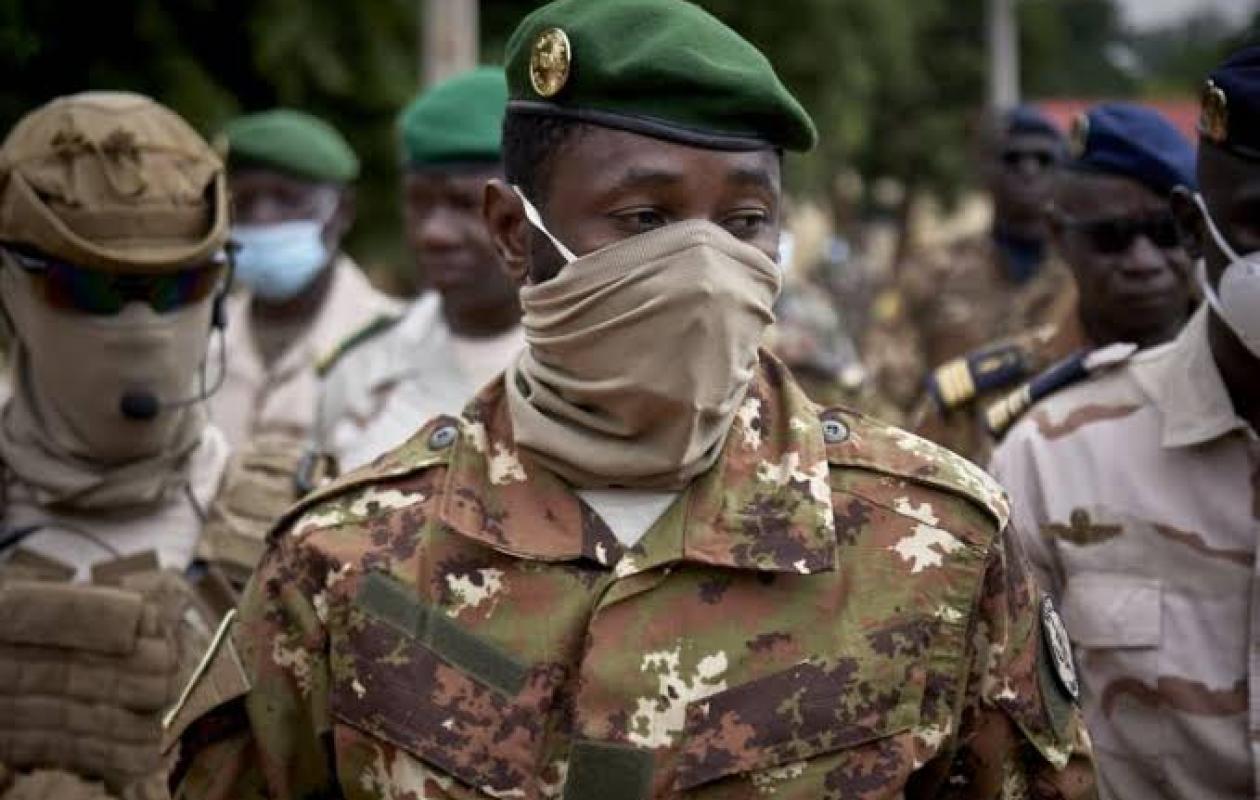
Au Mali, les rebelles harcèlent le pouvoir central qui peine à contrôler le pays
In the wake of new coordinated attacks by jihadists and their Tuareg allies across Malian territory, the ruling junta appeared on Sunday more threatened and isolated than ever in Bamako and in its neighbouring stronghold, the garrison town of Kati.
Just over two months after launching a major offensive that weakened the military in power, the jihadists of JNIM, affiliated with Al Qaeda, and the separatists of the FLA (Azawad Liberation Front), have launched new attacks from the north to the south of the country, demonstrating their ability to harass the central government over the vast and difficult-to-control Sahelian country.
On Saturday, rebels attacked several key locations in the north and center, as well as one of the country's largest prisons, a few dozen kilometers south of the capital.
In the Kidal region, the FLN claimed control of the town of Anéfis, where Russian paramilitaries remain entrenched in the military camp. Fighting was ongoing Sunday morning.
The FLA also reported further intense fighting on Sunday afternoon after ambushing a large convoy of Russian mercenaries and Malian soldiers traveling from Gao to Anefis.
"We have inflicted significant losses on the enemy. We will give a more complete assessment later," FLA spokesman Mohamed Ramadane told AFP.
Anéfis and Aguelhok are the last places where the Malian army is present in the Kidal region, since the attacks of April 25 and 26.
A real slap in the face for the military in power, Kidal, a strategic city in northern Mali, fell under the control of the Tuareg of the FLA during these offensives.
The rebels also attacked on Saturday morning the cities of Gao, a key to control of the north, and Sévaré in the center, which houses a major army base.
- "Overwhelm" the army -
"These coordinated attacks by JNIM and the FLA aim to overwhelm the Malian army and (the Russian paramilitaries of) the Africa Corps, and they seem to be succeeding," Rida Lyammouri, a researcher at the Moroccan think-tank Policy Center for the New South (PCNS), told AFP.
"For now, the objective seems to be the capture and securing of the north, before moving further south," notes a researcher associated with the strategic research institute (IRS) of the International Academy of Counter-Terrorism (IACT), based in Abidjan.
Having come to power through a double coup in 2020 and 2021, the military had promised to restore security and preserve the territorial integrity of this vast desert country plagued by a jihadist insurgency and the independence claims of Tuareg groups.
The junta of General Assimi Goïta turned its back on the former French colonizer, which had a military presence in Mali, to call upon the Russian paramilitaries of the Wagner group, which became Africa Corps.
Faced with this strategy of attrition of the central government's grip across the country, the junta is struggling to maintain control over its territory.
"The state controls Bamako and a few strategic pockets inside the country, that's all. The rest is floating," points out Bakary Sambe, director of the Timbuktu Institute based in Dakar.
- Capital not spared -
But the capital is not spared from the conflict and has been suffering for months from repeated blockades by jihadists, which are suffocating its economy and causing fuel shortages.
In September 2024, an unusually large-scale attack on Bamako's military airport and gendarmerie school left more than 70 dead and 200 wounded, according to security sources.
When they killed the powerful Defense Minister Sadio Camara at his home in Kati at the end of April, the jihadists demonstrated their ability to strike at the heart of power.
After Mr. Camara's death, the head of the junta himself took over the functions of the Minister of Defense and took several measures to secure the country.
Motorcycles, the preferred mode of transport for jihadists, have been banned outside major cities, and registration is now mandatory. Civilians are now prohibited from entering forests, suspected of serving as jihadist hideouts.
"These measures may reduce some of the capabilities of hostile armed actors in Bamako, but they are not enough to prevent a new series of attacks," Julien Hoffmann, an analyst on the Sahel, points out.
The junta, however, claims to control the country and attacks anyone who claims otherwise.
In early June, a journalist was jailed for "spreading false information" after claiming that the city of Kidal, a stronghold of Tuareg separatists, was under the control of the leader of the JNIM jihadists.














Commentaires (15)
Participer à la Discussion
Règles de la communauté
💡 Astuce : Utilisez des emojis depuis votre téléphone ou le module emoji ci-dessous. Cliquez sur GIF pour ajouter un GIF animé. Collez un lien X/Twitter, TikTok ou Instagram pour l'afficher automatiquement.
Se connecter
Commentez avec votre profil, votre photo, et soyez averti des réponses.