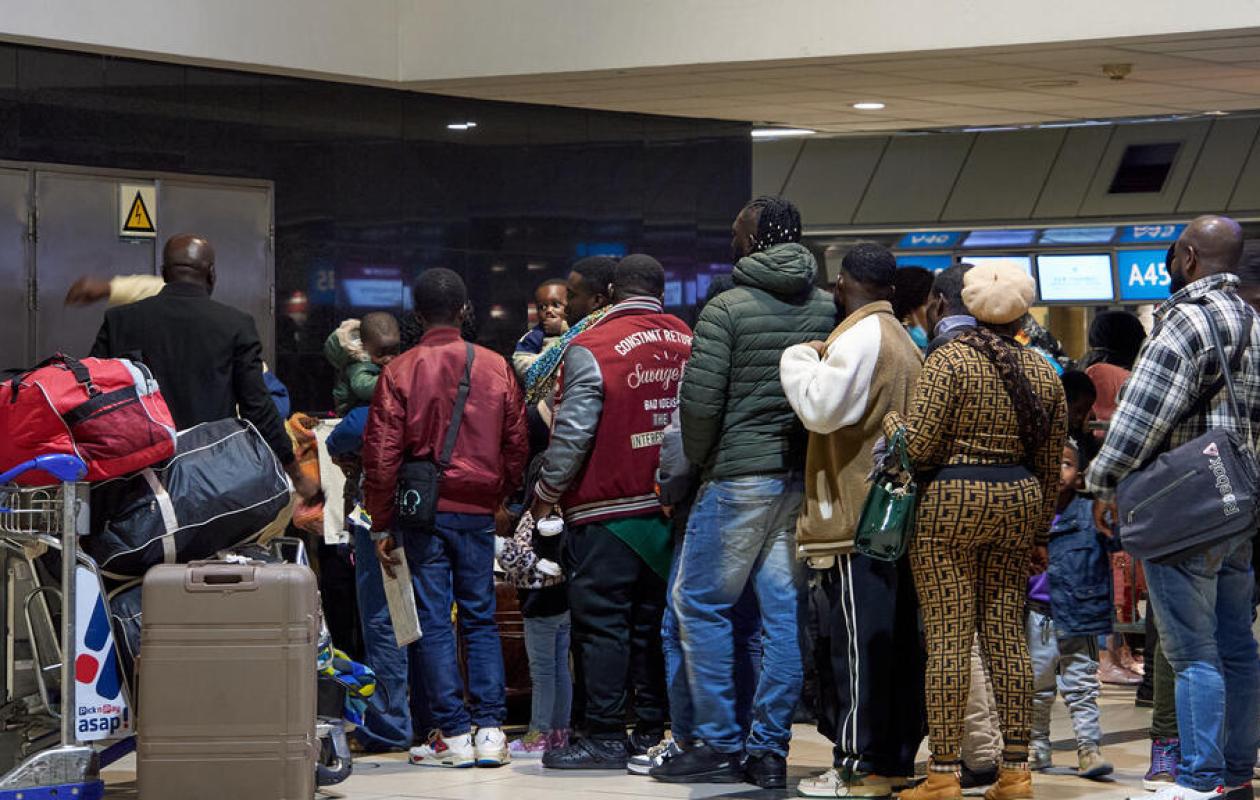
Chasse aux étrangers en Afrique du Sud : Des morts recensés, le Ghana et le Nigeria lancent des rapatriements d'urgence
Hundreds of foreign nationals, saying they fear for their lives in South Africa after being chased "like dogs" from their homes, have taken refuge in community halls on the country's southern coast, which is experiencing a new wave of virulent xenophobic protests.
Groups of residents went door-to-door ordering them to leave South Africa, several of them told AFP in Gansbaai, about 110 kilometers southeast of Cape Town.
"They told me: 'You are a foreigner, you have no business in South Africa, go away'," Thomas Vincent Baloyi, a Mozambican national, told AFP.
"I told them I had the papers to be here in South Africa. They didn't want to hear anything about it," adds the 32-year-old, who has spent 16 years in the country where he works in construction and gardening.
Mainly from Malawi and Mozambique, these men and women told AFP they fled their homes this weekend and spent their nights in the mountains and bush before going to community centers.
"They simply chased us away like dogs... it's not fair, I'm a human being," continued Thomas Vincent Baloyi. "We stayed in the bush until six in the morning."
Protests organized for weeks across South Africa, denouncing undocumented immigrants as scapegoats for mass unemployment and widespread crime, turned violent this weekend, particularly in the town of Mossel Bay, 250 kilometers further north along the coast. More than 50 homes were set on fire there.
Two people from Mozambique were killed there, according to South African police who confirmed on Wednesday that there had been murders "during activities related to anti-foreigner demonstrations", the first recorded since the start of this wave of gatherings against migrants.
According to the Mozambican government, five people died there "in direct connection with xenophobic attacks." This figure was disputed on Thursday by the head of Pretoria's security coordination unit during a press conference in the nearby city of George.
"No resentment (...) can justify murder, assaults, intimidation, arson, looting, xenophobic attacks," General Tebello Mosikili condemned.
No group will be allowed to "intimidate communities" or "target individuals based on their nationality," she insisted.
In the wake of this outbreak of violence, approximately 300 Mozambicans crossed the border to return to the country, according to Maputo.
Ghana has already repatriated 300 of its nationals by plane, and hundreds more are due to leave this weekend; Nigeria has also announced the organization of emergency repatriation flights, and Malawi is expected to provide details of its own procedure soon.
"They were forcibly removing people from their homes... whether you're undocumented or not, they say they don't want any foreigners in the township," municipal councilor Msa Nomatiti told AFP. More than 500 people had fled their homes by Monday, he said.
On Tuesday evening, small groups were still leaving the slums in the region, carrying their belongings in the dark night and under a light rain, an AFP team observed.
"Some of them lost their passports after being beaten and dragged out of their homes," explains Msa Nomatiti.
Around fifty people were gathered around large buckets of food in the tiny Gansbaai mosque, crowded with people and personal belongings, where they shared a single toilet and a single tap.
In the small coastal town of Kleinmond, 40 kilometers from Cape Town, nearly 100 foreigners, mostly from Malawi, have found refuge in a local community hall where large bags of clothing and blankets line the walls. Volunteers are serving hot meals, and donations from residents are beginning to pour in.
Landlords on Saturday ordered non-South African tenants to leave immediately because residents were going door-to-door looking for foreigners, Michael Markson, originally from Malawi, told AFP. "They're carrying machetes... dangerous tools. Like they're chasing someone away."
In the town of Stanford, less than 20 kilometers inland, another Malawian national, Talibo Mbewe, says he has been taking refuge in the community hall for two days. "The thieves have already taken all our belongings from our home, so we have nothing left," he testifies. "But it's better to go home empty-handed than to lose our lives."















Commentaires (8)
Participer à la Discussion
Règles de la communauté
💡 Astuce : Utilisez des emojis depuis votre téléphone ou le module emoji ci-dessous. Cliquez sur GIF pour ajouter un GIF animé. Collez un lien X/Twitter, TikTok ou Instagram pour l'afficher automatiquement.
Se connecter
Commentez avec votre profil, votre photo, et soyez averti des réponses.