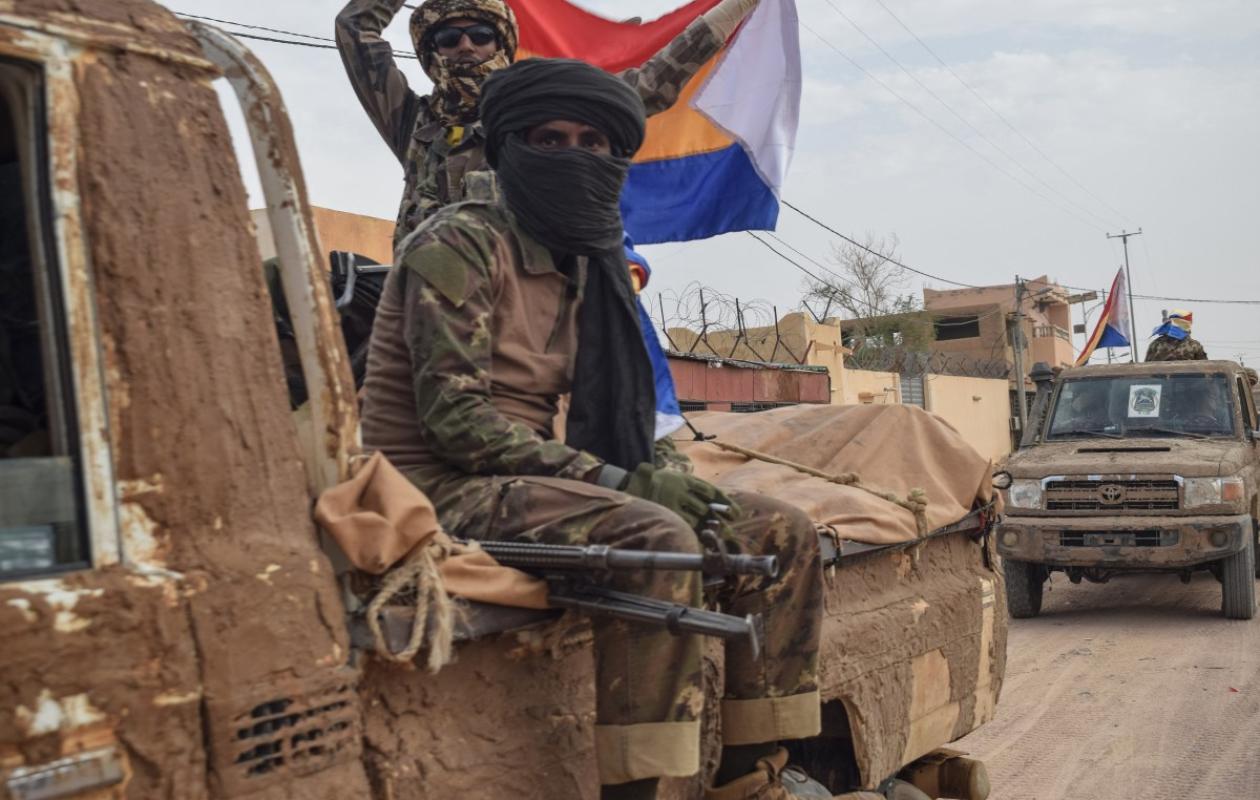
Crise malienne : Autonomie, djihadisme et enjeu stratégique expliqués par l'historien Abdoulaye Baldé
Between historical separatist claims in Azawad, the rise of terrorist groups, and economic isolation, Mali remains the scene of a complex, multidimensional crisis with sub-regional ramifications. How did the marginalization of the North transform into an armed rebellion? Why do the agendas of the separatists and the jihadists differ fundamentally despite alliances of convenience? In this interview with Seneweb, Abdoulaye Baldé, a doctoral candidate in the History of International and Strategic Relations at Cheikh Anta Diop University (UCAD) in Dakar, provides an unflinching analysis of the historical, geopolitical, and economic roots of the Malian conflict.
How did this idea of independence or autonomy in Northern Mali come about?
In the aftermath of independence, the populations of northern Mali felt neglected by the state. This marginalization led some of them to rise up against the central government. The first demonstrations took place as early as 1962, to which the government responded with harsh repression. Economically, this part of the country remains the poorest and most isolated.
A few years later, between 1970 and 1980, Mali was struck by successive droughts. This catastrophic situation exacerbated the distress of the northern populations. Furthermore, during the Algerian Civil War (the "Black Decade") between 1991 and 2002, northern Mali became a recruitment and training ground for both separatists and jihadists. The latter took advantage of the absence of the state to position themselves as an alternative force. The Algerian rebels obtained fuel and supplies from the south of their country and from northern Mali, forging strong ties with the local Tuareg community, as exemplified by Mokhtar Belmokhtar, founder of the Salafist Group for Preaching and Combat (GSPC).
Where did the emergence of the jihadist project in Mali come from?
The idea of this jihad originated in Afghanistan. Mokhtar Belmokhtar, who had fought in Afghanistan and then Libya, began to develop this ideology upon his return to Algeria. Driven out of Algerian territory, he settled in northern Mali, where he forged close alliances with the local Tuareg community.
Do jihadists and separatists pursue the same objectives?
No, their objectives are fundamentally different. The jihadists' aim is to impose Sharia law on the entire sub-Saharan region, starting with Mali. The choice of Mali is a response to a major geostrategic issue: the country occupies a central position, at the crossroads of seven borders.
Conversely, the separatists are only demanding autonomy, or even independence, for a territory they call Azawad. However, this claimed area represents 70% of Malian territory and encompasses the majority of its resources, making this demand unacceptable to Bamako.
Can we speak here of a form of "great replacement"?
We often hear about the "great replacement," a theory promoted by the European far right that fears the replacement of the native population by mass immigration. This concept does not apply to the African case, because the Tuareg are fully African and Malian, deeply rooted in their continent. Their historical lands are in this region, and they are descended from ancient intermingling with Arab populations.
The fact that Tuaregs are a minority in armed actions and that they massively recruit Black populations stems primarily from economic factors. The people living in these impoverished areas face extreme poverty. When jihadist groups offer them means of subsistence or financial compensation, many accept out of necessity. Testimonies from captured fighters confirm this: many joined for financial reasons or to ensure the safety of their families in insecure areas.
Last April, several strategic cities were attacked simultaneously. Despite the divergence of their agendas, what are these groups ultimately seeking?
For separatists, the ultimate goal remains autonomy or independence for their region. For jihadists, it is to establish an Islamic state governed by Sharia law throughout the entire territory and the sub-region. To achieve this, their strategy consists of confronting the Malian state by striking its key economic centers. The objective is to undermine the authority of the central government and instill a widespread sense of insecurity among the population in order to ultimately provoke a popular uprising.






















Commentaires (1)
Participer à la Discussion
Règles de la communauté
💡 Astuce : Utilisez des emojis depuis votre téléphone ou le module emoji ci-dessous. Cliquez sur GIF pour ajouter un GIF animé. Collez un lien X/Twitter, TikTok ou Instagram pour l'afficher automatiquement.
Se connecter
Commentez avec votre profil, votre photo, et soyez averti des réponses.