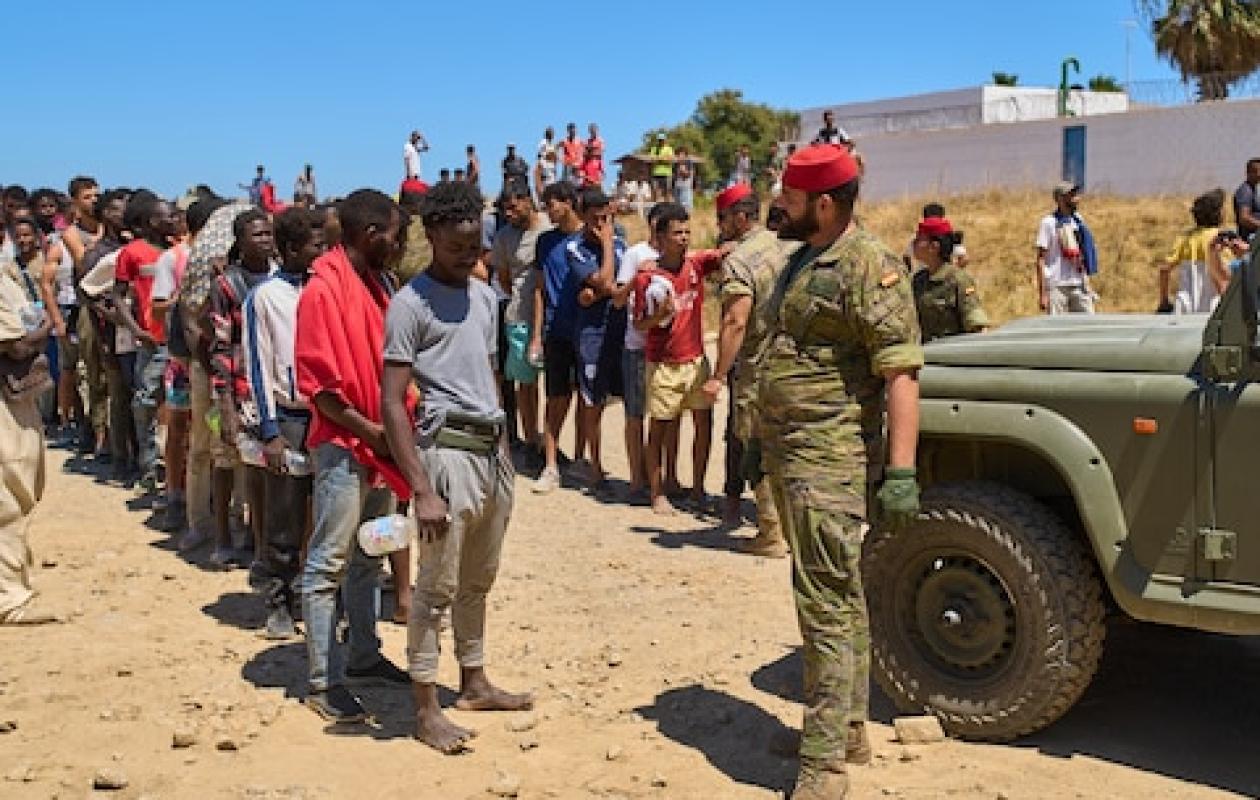
Des agents des renseignements marocains se seraient infiltrés à Ceuta parmi les migrants
In barely 24 hours, the Spanish enclave of Ceuta, on the southern Mediterranean coast, was confronted with an unprecedented influx of migrants determined to enter its territory. On July 31, their number was estimated at 60,000, before being revised downward to 49,000 by the Spanish government. All, or nearly all, have since been expelled from the enclave. This sudden wave of migration does not appear to be a coincidence, especially since, according to the online news outlet El Español, Moroccan intelligence agents were among the crowd.
Sources within the Guardia Civil confirm that they were spotted thanks to the camera system deployed at the enclave's border. El Español does not specify whether these agents were expelled or arrested, but according to the newspaper's sources, this is not the first time. The presence of Moroccan intelligence agents had already been confirmed during similar periods of migration surges in Ceuta and Melilla.
The presence of these agents only reinforces the theory that this action was initiated by the Kingdom of Morocco and is similar to the “hybrid attacks” carried out by Russia and Belarus on the eastern borders of the European Union. In November 2021, thousands of migrants, mostly from the Middle East, were pushed toward the Polish border by Belarusian soldiers. Amid the harsh early winter in Eastern Europe, the crisis resulted in approximately fifty deaths and more than 200 missing migrants.
According to Spanish law enforcement, these Moroccan agents were present to gather intelligence on the forces deployed along the border and to observe the reaction of the police and military personnel present. This was a way of "testing" the response of the targeted country and the reaction of its European partners, reminiscent of the planned hybrid attack in Minsk and Moscow, less than three months before the attack on Ukraine.
An illusory passage through Spain
It's not that Rabat is trying to retake Ceuta, a Spanish enclave since the 16th century, even though Morocco has officially claimed it since 1956. But relations between the Moroccan kingdom and Madrid are strained. Two factors reportedly triggered this maneuver, according to Spanish sources: Pedro Sánchez's state visit to Algeria, a rival of Morocco for control of Western Sahara, and a ruling by the Madrid Supreme Court concerning the return of migrants to the border, which was seen as a sign that Spain lacked the capacity to manage such a migratory flow.
For Rabat, this migration crisis stems in particular from the “malicious exploitation” of social media, the “spread of misleading information,” and “misinterpretations of Spanish legal provisions.” While Madrid did launch a regularization campaign for undocumented immigrants earlier this year, it ended on June 30 and did not apply to new arrivals.
Furthermore, Ceuta and Melilla have a special status within the Schengen Area, with systematic identity checks for all travel to mainland Spain. A valid visa is therefore required to leave the enclave for mainland Spain. This effectively nullifies all the fears of European countries that called for Spain's suspension from the Schengen Area, as Italy has indeed done.
Between 11 and 72 dead
The Moroccan Interior Ministry admits that 11 people have lost their lives. Madrid, for its part, has counted 72 victims. Many migrants attempted to cross the coast, sometimes using simple buoys, tires, or makeshift floats fashioned from plastic bottles, risking drowning or injury on the reefs.
The Moroccan Association for Human Rights (AMDH) reported “nearly 130 victims” and dozens of missing persons, and on Saturday called for an independent investigation into the causes of this unprecedented influx of migrants between the Moroccan city of Fnideq and the Spanish enclave. It condemned “the worrying silence of the country’s officials and institutions,” believing that this silence contributed to fueling the influx. A source close to the human rights movement told AFP that “the way things unfolded” suggested that these mass arrivals at the border could not have occurred without the “agreement of the Moroccan authorities.”






















Commentaires (8)
Participer à la Discussion
Règles de la communauté
💡 Astuce : Utilisez des emojis depuis votre téléphone ou le module emoji ci-dessous. Cliquez sur GIF pour ajouter un GIF animé. Collez un lien X/Twitter, TikTok ou Instagram pour l'afficher automatiquement.
Se connecter
Commentez avec votre profil, votre photo, et soyez averti des réponses.