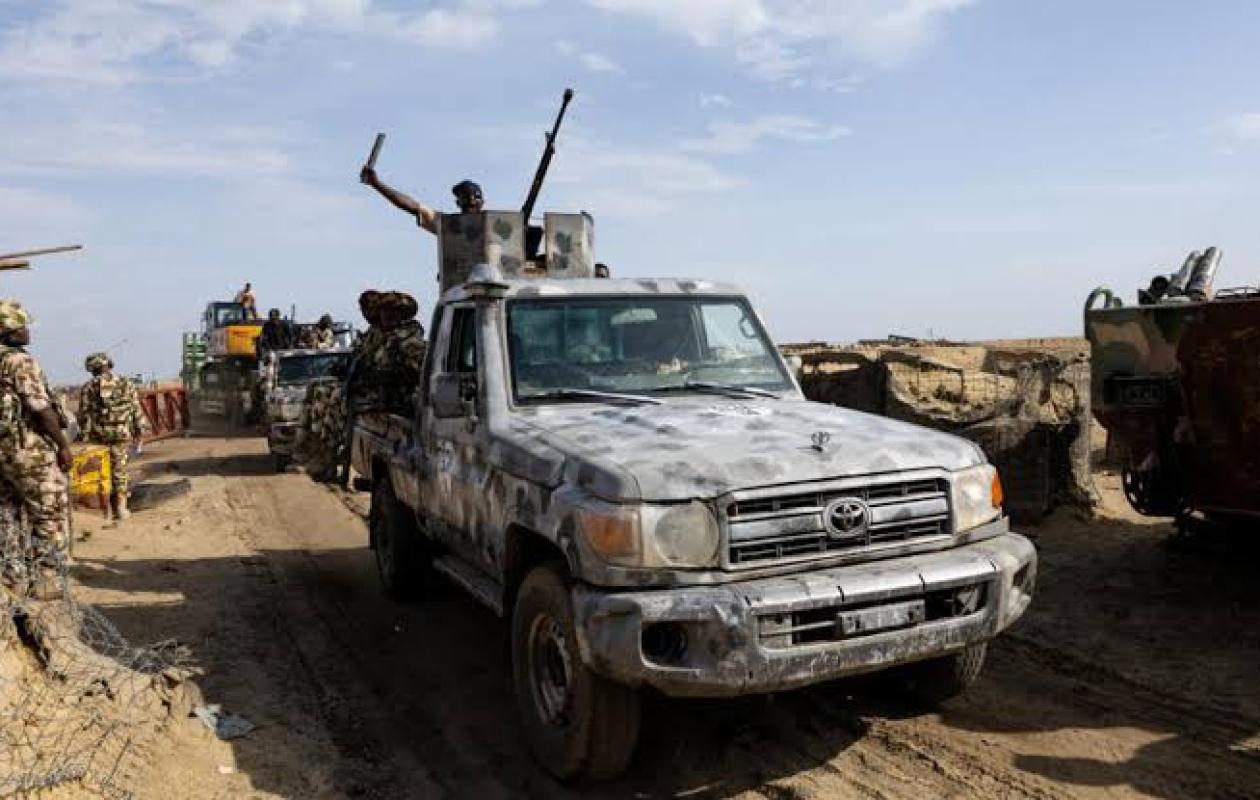
Des bombes aux réglages de motos : comment les jihadistes nigérians utilisent l'IA
Like the world's largest companies, Nigerian jihadists have "institutionalized" the use of AI, from battlefield strategy to the manufacture of bombs and stunt motorcycles, according to the author of a study.
Africa's most populous country has been mired in an insurgency since 2009, and the militants' technological advances are not new.
Jihadists in West Africa and around the world have long disseminated their propaganda using the internet and online messaging platforms. More recently, they have adapted recreational drones for combat.
But "the adoption of AI by terrorist groups has been much faster, more widespread and more systematic than we thought," Antonia Juelich, who recently published a study based on interviews with former jihadists from both the Islamic State West Africa Province (ISWAP) and the rival group Jama'at Ahl as-Sunnah lid-Da'wah wa'l-Jihad (JAS), better known as Boko Haram, told AFP on Monday.
"It's not just a few isolated commanders who discovered AI, they've really institutionalized it, with dedicated units" working with AI and organizing training on the use of chatbots, adds Ms. Juelich, a researcher at the University of Cambridge.
"Foreign trainers gathered the best elements in a room. They used a projector to show how it works on a big screen," a former ISWAP activist told the author.
While the internet has long served as an aid to jihadists, the "step-by-step instructions" provided by chatbots, as well as "the ability to ask specific questions", represent something new, according to Ms. Juelich.
ChatGPT, Claude, Gemini, Grok, Meta AI and DeepSeek were all identified by the study as being used by jihadists.
While expert-led training and the role of AI in the organization are reminiscent of certain business practices, the way jihadists use artificial intelligence varies, ranging from seeking help to modify a motorcycle in the style of Evel Knievel - the famous stuntman - to learning about new, unknown weapons seized in combat.
Faced with trenches dug by the army, "we saw in a movie how motorcycles can jump over bridges. We used AI to learn how to do it," explains a former ISWAP member quoted in the study.
After multiple repetitions, "the next time we attacked, we could jump."
For bomb-making, chatbots have introduced new types of explosive devices and have also made it possible to improve existing ones.
"AI told us which chemicals to use to make the explosion more powerful," confided a former Boko Haram commander.
Other uses include using AI to study battlefield tactics that could reduce casualties, according to a former ISWAP member.
Executives from AI companies have warned that their technology could pose existential risks to humanity, while promising safeguards built into their chatbots.
Some requests, such as how to blow up a motorcycle over a trench, are not necessarily malicious in nature. "But explosives do not fall into this category, and that is where the safeguards should be activated, which was not the case," laments Ms. Juelich.
His study covers the use of AI by jihadists from 2023 to 2024. One militant was still able to testify to the use of AI in 2025, which means that the safeguards may have evolved or improved since the defection of these fighters.
"But I am worried about the trajectory: terrorist groups are adopting AI and the safeguards are not strong enough," the researcher concludes.




















Commentaires (1)
Participer à la Discussion
Règles de la communauté
💡 Astuce : Utilisez des emojis depuis votre téléphone ou le module emoji ci-dessous. Cliquez sur GIF pour ajouter un GIF animé. Collez un lien X/Twitter, TikTok ou Instagram pour l'afficher automatiquement.
Se connecter
Commentez avec votre profil, votre photo, et soyez averti des réponses.