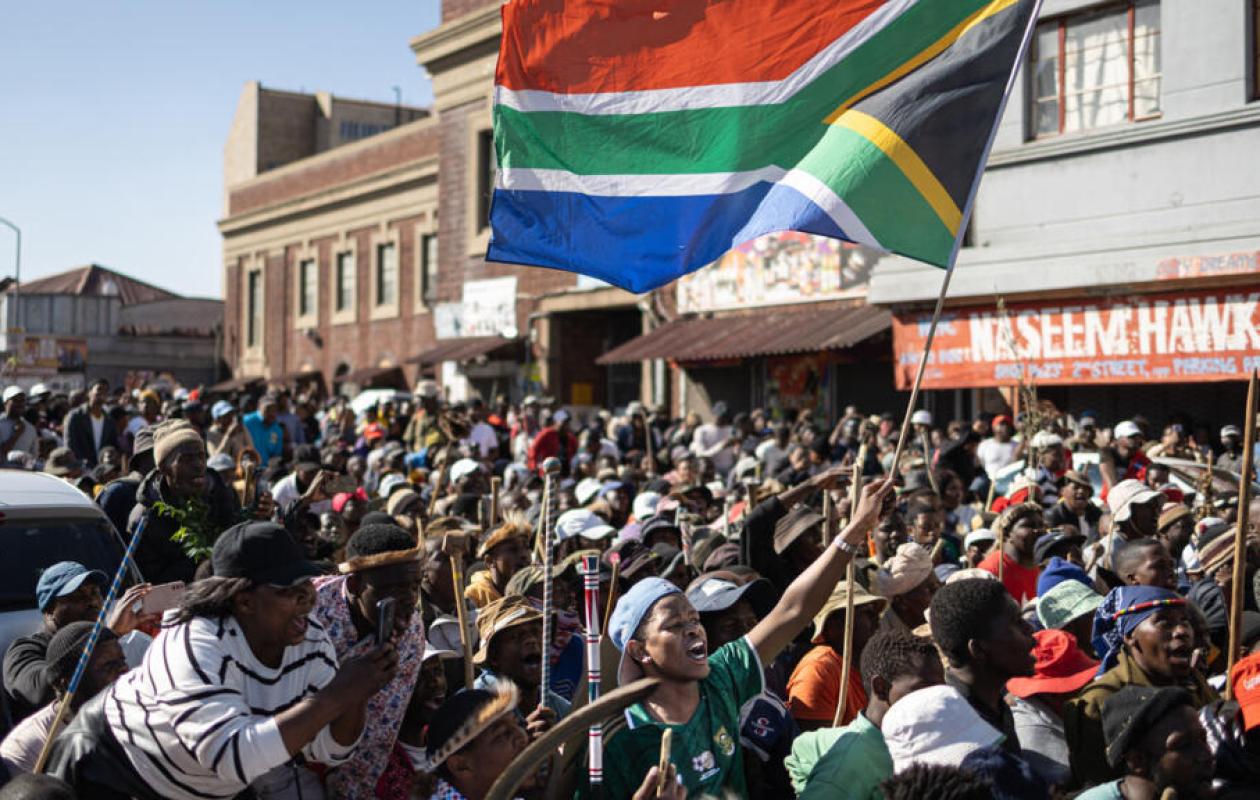
Des milliers de Sud-Africains dans la rue pour demander le départ des sans-papiers
Thousands of South Africans took to the streets on Tuesday, the first day of nationwide mobilization in a xenophobic campaign that has driven 25,000 immigrants into exile, accused among other things of taking jobs from South Africans.
For several weeks, the country has been living to the rhythm of a countdown as June 30 approaches, the date of an ultimatum set outside of any legal framework by highly structured citizen groups to order undocumented foreigners to leave the country.
The police, fearing unrest, are deployed in large numbers across the country and by midday reported a handful of arrests for isolated looting and attempted looting, stressing that the protests "remain largely peaceful" so far.
Thousands of people marched at midday in downtown Johannesburg, the country's economic heart, as well as in Durban, the large port city, led as they have been since the beginning of the movement by men brandishing traditional Zulu sticks and shields.
As a result of the day of action, many shops remained closed and car traffic was noticeably lighter than usual in several cities across the country, reflecting the anxiety of a population waiting to see how events would unfold.
In the Durban procession, protesters held up signs that read: "Stop hiding illegal foreigners. Stop employing them and renting them accommodation."
"I have difficulty renting accommodation because the rents are too high, and undocumented foreigners manage to pay them because they sell drugs to our population," accuses Brightness Gumbi, 48, who runs a small canteen in a township and participates in the Durban march.
South Africa has already experienced violent xenophobic outbursts, notably in 2008 and 2015, but in an unprecedented way, more than 25,000 nationals from several African countries, Malawi, Zimbabwe, Mozambique, Nigeria, Ghana, etc., have fled in recent weeks either on their own or on buses chartered by their country or by South Africa.
The current movement has resulted in sporadic violence that has left four dead, two Mozambicans, an Ethiopian and a Malawian, and some scenes of looting of shops owned by foreigners.
Leaders of groups opposed to illegal immigration have already indicated that they will continue their movement beyond June 30.
Some 3 million foreigners, or 5.1% of the population, live in the country of former president Nelson Mandela, according to official statistics, attracted by job prospects in the continent's largest economy.
The current movement is also part of the electoral context of the municipal elections of November 4, which are always fiercely contested.
"Political parties are outbidding each other (...) They are parading around, presenting themselves as anti-immigrant," political scientist Sandile Swana told AFP, citing among others the MK party of former president Jacob Zuma and Action SA.
In Johannesburg, Cape Town (south) and Pietermaritzburg (east), hundreds of foreign nationals were still gathered on Tuesday in makeshift camps or in front of their consulate in the hope of leaving the country, leaving behind their belongings, and sometimes a South African spouse.
Several hundred Malawians, recently transported from Durban to a transit camp on the border with Zimbabwe, were waiting to board a bus to return home.
Ghana and Nigeria have organized repatriation flights for several hundred compatriots, deploring the handling of the crisis by a country that is supposed to be a moral beacon for the continent since the end of apartheid.
Anti-immigrant organizations, such as "March and March," claim to oppose all forms of violence. They accuse undocumented immigrants, without providing any statistics, of "stealing" jobs from South Africans in a country where the unemployment rate is over 32%.
They also accuse them of clogging up the health system and contributing to the country's rampant crime and its 60 daily homicides.
This campaign has resulted in numerous threats and acts of intimidation in impoverished neighborhoods of major cities.
The testimonies gathered by AFP from those considering leaving converge: their employers dismissed them, for fear of being fined, and their landlords, put under pressure by sympathizers of the movement, evicted them.
Several hotspots have been identified in the country, notably in Johannesburg and Durban in the province of KwaZulu-Natal, the scene in July 2021 of deadly violence (more than 330 dead) in reaction to the imprisonment of Jacob Zuma for contempt of court.
"Whatever our concerns about illegal immigration (...), we will not let this province go up in smoke a second time, whether it be due to crime or xenophobia," warned KwaZulu-Natal leader Thami Ntuli on Sunday.




















Commentaires (19)
Participer à la Discussion
Règles de la communauté
💡 Astuce : Utilisez des emojis depuis votre téléphone ou le module emoji ci-dessous. Cliquez sur GIF pour ajouter un GIF animé. Collez un lien X/Twitter, TikTok ou Instagram pour l'afficher automatiquement.
Se connecter
Commentez avec votre profil, votre photo, et soyez averti des réponses.