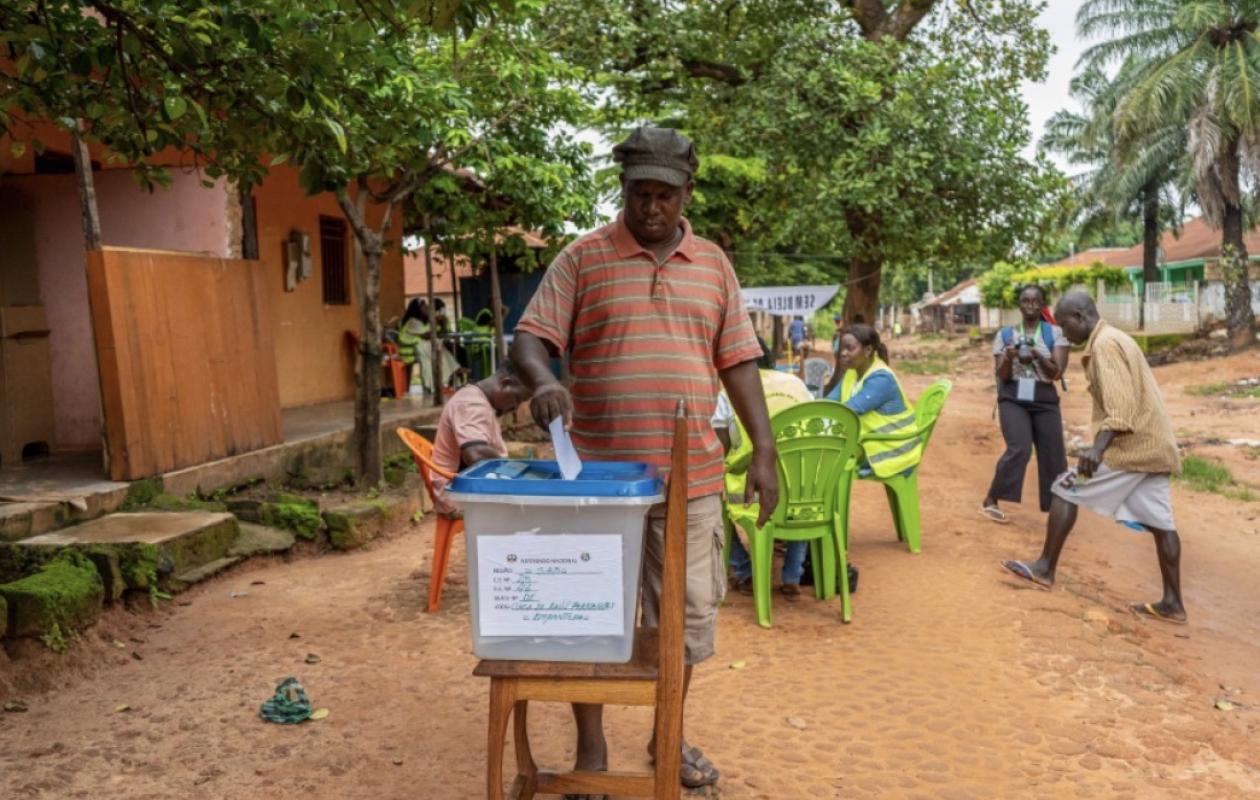
Guinée-Bissau: référendum sans grande affluence pour passer à un régime présidentiel fort
Following Zimbabwe, Guinea, Togo, Uganda and Chad in recent years, this is the latest example of an African country seeking to amend or change its Constitution to extend the term of office, remove age limits or strengthen the prerogatives of the executive branch.
The opposition has called for a boycott of the referendum, notably the PAIGC, the historic party that led the country to independence in 1974, which denounces the organization of a referendum "in a context of restriction of public freedoms", while the political climate is tense in the country.
The head of the junta and president of the transition, General Horta N'Tam, voted in his neighborhood on Sunday, urging "young people to turn out in large numbers to vote".
"What we are seeking after this referendum is to allow whoever wins the elections to finish their term in peace," he said.
During a press briefing, Idrissa Djalo, executive secretary of the National Electoral Commission (CNE), expressed his satisfaction that "no incidents have yet been reported." He stated that "voter turnout was significant (...) in some areas, and reasonable in others."
In the capital, Bissau, after a slow start due to heavy rain, voters flocked to several polling stations visited by AFP around midday. But by early afternoon, at five polling stations in the city center and outlying districts visited, the turnout had dropped significantly.
"Voters are arriving in dribs and drabs. The pace has been disrupted by the rain," said the head of a polling station in the city center.
In the regions of Tombali and Quinara, in the south of the country, the turnout was mixed or even low, according to the observation of a local journalist contacted by AFP.
The inclement weather of the rainy season makes travel difficult in some areas.
The proposed new Constitution aims primarily to replace the semi-parliamentary system with a strong presidential regime, granting the head of state the power to appoint and dismiss the prime minister and the government and to dissolve Parliament.
The stated objective of the transitional authorities is to stabilize the institutions before the presidential election.
N'djamba Seide, interviewed by AFP as he left a polling station in Bissau, said he was "motivated to come and vote" to "bring about changes to our Constitution" and "change" what "always causes problems in the country".
"The successive crises that the country has experienced have had a very negative impact on my yields. If all goes well, Guinea-Bissau will start with new prospects," reacted Halimatou Traoré, a trader in her thirties, after voting in Bissau.
This referendum precedes by a few months the presidential election scheduled for December 6 for a return to civilian power.
Guinea-Bissau has been ruled since November 26, the day before the expected announcement of the provisional results of the presidential and legislative elections, by military officers who suspended the electoral process.
The West African country has experienced five coups and a host of attempted coups since its independence from Portugal in 1974.
The National Transitional Council (CNT), the legislative body, unanimously adopted an amendment to the Constitution in January 2026, a month and a half after the coup that overthrew President Umaro Sissoco Embalo.
The new text proposes to abandon the old model where the Prime Minister came from the majority in Parliament, which had led to difficult cohabitations.
For Nelson Moreira, a member of the CNT, the draft of the new Constitution would make it possible to avoid conflicts between the presidency and the Prime Minister's office, which have undermined the stability of the country in the past.
But part of the political class and civil society vehemently contested the in-depth rewriting of the Constitution by an unelected transitional power.
"The presidential system that the junta wants to impose will concentrate all power in the hands of one man. This is dangerous for our democracy," Abubacar Ture, president of the Guinea-Bissau League for Human Rights, recently told the press.
AFP
















Commentaires (3)
Participer à la Discussion
Règles de la communauté
💡 Astuce : Utilisez des emojis depuis votre téléphone ou le module emoji ci-dessous. Cliquez sur GIF pour ajouter un GIF animé. Collez un lien X/Twitter, TikTok ou Instagram pour l'afficher automatiquement.
Se connecter
Commentez avec votre profil, votre photo, et soyez averti des réponses.