Libres politiquement, prisonniers économiquement : Les racines de la haine en Afrique du Sud
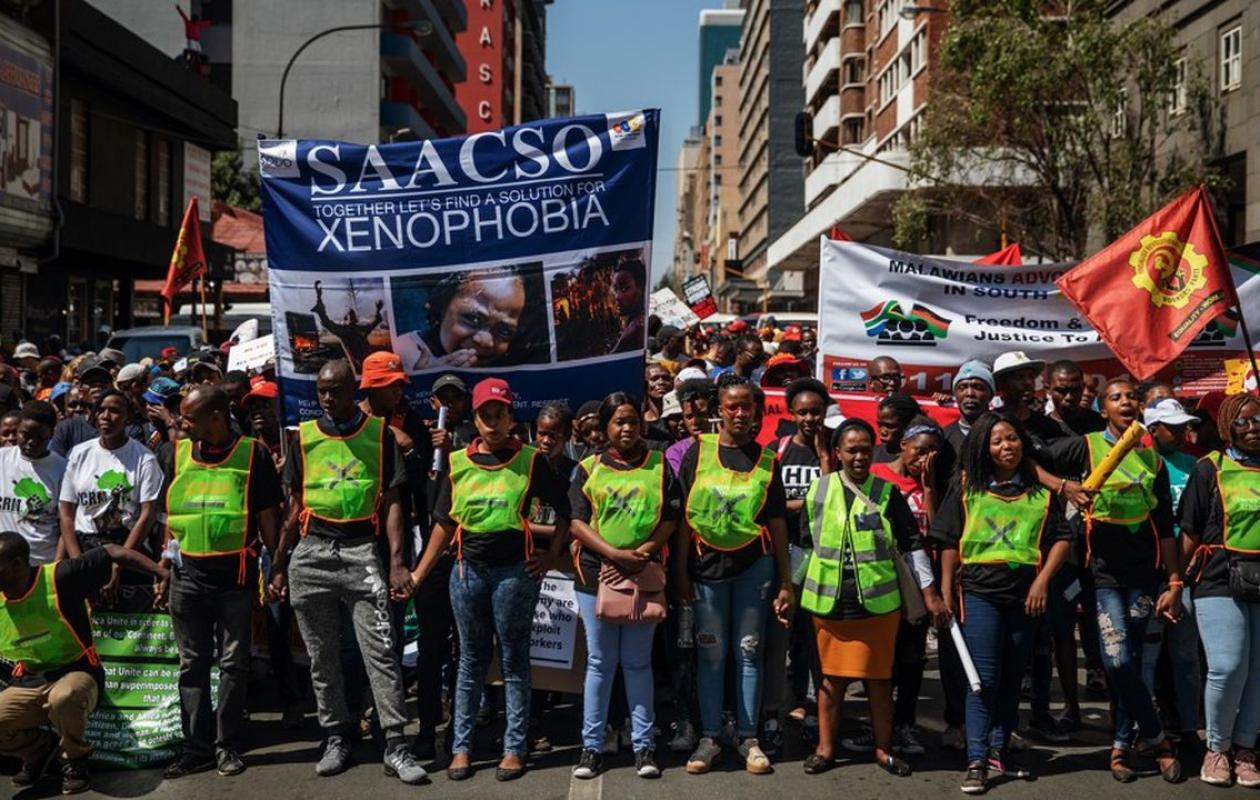
How did South Africa, one of the countries where Black people have suffered the most, come to turn against those same Black African brothers and sisters? South Africa has now become a living hell for African nationals. Xenophobia has reached unprecedented levels. Where we could once downplay these tensions by attributing them to isolated incidents, we are now faced with a systematic persecution that we cannot ignore. If these same scenes were unfolding in Europe or any other part of the world, we would not hesitate for a second to call it racism. But here, it is Black people attacking other Black people. It is Africans rejecting other Africans. What makes the situation even more disturbing is precisely the country in which it is taking place: South Africa, a country whose liberation was supported, championed, and defended by a large part of the continent.
It is not enough to describe the facts or comment on current events. We must go further, dig deeper. How can South Africans, barely a few decades after apartheid, turn against those who supported them in the darkest hours of their history? What role does the economic crisis play in this xenophobic resurgence? And how have some politicians turned xenophobic hatred into a veritable business? Finally, we will ask ourselves a fundamental question: as Africans, how should we respond to this reality? But to do so, let us begin by returning to the foundations of South African history.
It was in the 17th century that the first European settlers set foot in the Cape: the Dutch and the Germans, and later the British. They landed on this land with their rifles, their Bibles, and above all with a conviction that would poison the country for centuries: the idea that some peoples are born to dominate, and others are condemned to serve. Then came the decisive turning point: the discovery of diamonds, then gold. South Africa was transformed into a highly strategic territory, coveted and jealously contested. But any large-scale mining operation requires one thing: an abundant and cheap workforce. The machine was set in motion. Black populations were methodically dispossessed of their lands, relegated to reserves, and progressively reduced to the status of impoverished workers, serving an economy from which they were entirely excluded.
With the Nationalist Party's rise to power in 1948, led by Daniel François Malan, segregation, initially informal, was finally enshrined in law through these five foundational pieces of legislation. The first of these laws was the Population Registration Act of 1950. It compelled every South African to be officially registered according to a racial category: White, Black, Coloured, or Indian. The state observed you, labeled you, and then determined what you were allowed to do or, more often, what was forbidden. The second law was the Group Areas Act, passed the same year. It authorized the state to divide the territory into strictly racial zones, deciding where each group had the right to live. Entire families were then uprooted from their homes, expelled from neighborhoods where they had sometimes resided for generations, without recourse or compensation.
The third law is the Bantu Authorities Act of 1951. It laid the foundations for the bantustan system, territories presented as "homelands" for Black people. But behind this facade lay a far more cynical strategy: to signal to Black people that they were not true South African citizens, that they belonged to separate entities. In short, it was a way to gradually confiscate their citizenship in their own country. The fourth law is the Pass Laws Act: Black people were now required to carry passes at all times, a kind of internal passport to justify their presence in certain areas of the country. A man or woman could be arrested at any time, simply because they did not have the right document in the right place. Imagine what this means: being treated as a foreigner in the land of your ancestors, having to prove at every moment that you have the right to exist where you are in your own country. The fifth and final law was the Bantu Education Act of 1953. It established a deliberately impoverished educational system for Black children, designed not to educate them, but to create a docile workforce for the white economy. In some classrooms, students were taught to wash clothes rather than to solve equations or understand geometry.
It is precisely in this context that the townships were born and developed, these neighborhoods built from scratch to keep Black populations separate from white urban centers, while still keeping them close enough for them to commute to work each morning. So, every morning, Black people entered the city to fuel an economy from which they derived no benefit, and every evening, they returned to their outlying neighborhoods. The townships thus became spaces of extreme poverty, constant police surveillance, and accumulated frustration. But they also became, paradoxically, hotbeds of resistance. It is there that political consciousness was born and matured. It is there that young people saw injustice with their own eyes, unfiltered and direct. It is there that entire families understood that apartheid was not just a piece of legislation passed in Pretoria. It was a reality experienced daily, on public transportation, in schools, in factories.
And among those who would embody this resistance was one man: Nelson Mandela. Mandela joined the ANC (African National Congress) in 1944 and quickly established himself as one of the leading figures of its youth wing. Towards the end of the 1950s, the struggle had become more radical. Mandela and his comrades had founded Umkhonto we Sizwe, the armed wing of the ANC. They were arrested, tried, and then sentenced to life imprisonment in 1963. Mandela spent 27 years behind bars, alongside several other figures of the resistance. But it is important to correct a common misconception: Mandela was not the only face of the South African opposition. While he certainly possessed undeniable charisma and popularity, he operated within a constellation of equally determined activists.
Among them was Steve Biko, whose struggle had a particular dimension: psychological awakening. He was deeply convinced that, beyond segregation, injustice, and material inequality, the most profound harm inflicted by the white system on Black people was psychological: leading them to perceive themselves as inferior, to doubt themselves, and to divide themselves. His fight was to liberate the Black spirit before even liberating the body. He is, in fact, one of the founding fathers of the Black Consciousness Movement. There was also Winnie Mandela. During Mandela's ten thousand days of captivity, she was the one who carried the torch. Exposed, harassed, demonized, and attacked from all sides, she always stood tall. For a large part of South Africans, she was not simply the wife of the world's most famous prisoner. She was "the mother of the nation." We should also mention Archbishop Desmond Tutu, an essential moral voice in the struggle, and Miriam Makeba, "Mama Africa," who took the fight far beyond South African borders through her music, her voice, and her speeches before international bodies.
South Africa was in turmoil. Long-simmering anger reached its breaking point on June 16, 1976, with the Soweto massacre. Black students took to the streets to protest the compulsory learning of Afrikaans, the language of the oppressor. They were children, teenagers, ordinary schoolchildren. The regime responded with gunfire. The official death toll was several hundred, and some sources believe the true number is much higher.
Apartheid was officially abolished in 1994, under the combined pressure of Black uprisings within the country and the international community abroad. Yes, apartheid was abolished. But the reflexes it engendered did not disappear, neither among whites nor among Blacks. Democracy granted the right to vote. It restored legal dignity. It allowed a Black man, Nelson Mandela, to become president. But it did not erase inequalities at all. It did not redistribute land. It did not create jobs for all. It did not redress centuries of systematic humiliation. A large part of the Black South African population thus found itself politically free, but still economically imprisoned.
And this is precisely where we find South Africa today. Thirty years after the end of apartheid, has the country truly emerged from it, or has it simply changed its facade? Because when we look at the surface indicators, the picture seems almost reassuring: South Africa became the continent's leading economic power in 2025. Cape Town is among the most beautiful cities in the world, and the President of the Republic is a Black man. One might think that the ghosts of the past are definitively behind us. But let's pause for a moment. Because behind these facades, a stark reality emerges: in 2022, only 28% of the country's businesses were Black-owned. And let's remember: Black people represent 82% of the population. In other words, Black people are twelve times more numerous than White people, and fifty times less wealthy. A staggering gap that speaks volumes about the depth of the inherited inequalities.
Corrective policies have indeed been implemented, such as Black Economic Empowerment, designed to rebalance economic power in favor of Black people. But history teaches us that a people cannot be rebuilt simply by injecting money into their ranks or placing them in charge of a few institutions. If mindsets do not change and if the deep-rooted structures of the system remain intact, the results will not change. And in South Africa, this result has a name: economic poverty, but also mental poverty. The official figures are telling: approximately 50% of the country's adult population still lives in townships, representing nearly 35 million people.
If we have taken this long detour through history, it is precisely because what is happening today in South Africa is not an isolated incident, frozen in the present. It is the continuation of a national history that has always been marked by violence and opposition between Black and White South Africans, between South Africans themselves, and between South Africans and foreigners. At the heart of all these tensions, there has always been the same reality: competition for scarce resources, in a context of chronic insecurity for Black populations. Archbishop Desmond Tutu had already pointed this out in his time: he drew attention to the way some Black people treated their own brothers, in the name of ideological differences or the struggle for insufficient resources.
Furthermore, South Africa has two particularly influential tribes: the Zulus, historically recognized as a warrior people, and the Xhosa. Major historical figures such as Nelson Mandela, Miriam Makeba, Oliver Tambo, and Desmond Tutu were all Xhosa, and their methods of struggle, characterized by negotiation and non-violent resistance, contrasted sharply with the warrior tradition claimed by the Zulus. But be warned: this in no way means that the Zulus are collectively responsible for the violence we see today. South Africans of all ethnic backgrounds are among the perpetrators of unrest. Moreover, we emphasize another important historical fact: in South Africa, certain interest groups have regularly exploited Zulu militancy for their own ends, including against supporters of the ANC.
We are thus faced with a country where the same Black people, after wresting their freedom at the cost of decades of struggle, find themselves crammed into marginalized areas, forced to fight daily for access to ever-insufficient resources. But all this still doesn't directly answer our central question: what fuels xenophobia and explains the extreme violence we see today in South Africa?
Here's a telling statistic: in just ten years, South Africa's population has grown by nearly 8 million, including approximately 6 million of working age. Yet, over the same period, the economy has only managed to create slightly more than one million direct jobs. The result is undeniable: nearly 8 million officially unemployed, a broader unemployment rate approaching 42%, and a struggling youth population where more than four out of ten are jobless. But how can such a wealthy country have such a high level of unemployment? The answer lies in one word: apartheid. Apartheid confined a Black majority to townships far removed from economic centers, cut off from good schools, professional networks, capital, and property. Decades of segregation that continue to have repercussions even today.
Added to this is an economy that has never sufficiently invested in industrial employment. The country has declined in manufacturing, mining, and certain informal sectors, while new jobs have been concentrated in finance, services, and fields requiring qualifications that many lack, precisely because of the legacy of apartheid. We are therefore faced with a combination of two factors. On the one hand, the historical legacy of Black South Africans: some carry a warrior tradition that inclines them to resolve conflicts by force, while others have developed a deep hostility toward foreigners. On the other hand, structural unemployment that primarily affects Black South Africans, who are the least positioned to access real economic opportunities.
But one question remains: why aren't the South African government and political parties tackling this chaos more firmly? Lives have been lost. Ghana and Nigeria have had to repatriate their citizens. The accounts are chilling. Why isn't this phenomenon a top political priority for the country? The answer is as cold as it is simple: eradicating this problem is not cost-effective.
One of the fundamental blind spots of democracy as it was inherited after independence is that the objective of leaders, or those aspiring to become leaders, is not necessarily to govern fairly or to solve problems. It is to seize power and then maintain it. In this logic, anything that does not directly serve this objective is superfluous. However, in South Africa, foreigners do not vote. For a sitting president or a candidate on the campaign trail, this population carries no weight in the electoral balance. Why then mobilize energy and resources to defend their rights when those same resources can fuel the conquest or maintenance of power?
Ignoring a problem with little political return is already a form of cynicism. But the situation becomes truly perverse when the plight of foreigners is exploited for electoral gain. Faced with mass unemployment, a leader has a choice: tackle the root causes, which implies difficult, unpopular reforms and courageous decisions, or opt for the easy way out, a well-known tactic even in Western democracies: designate a scapegoat. Stir up popular anger and redirect it toward foreigners. This strategy costs little, generates popularity by creating the illusion of being on the side of the people, and allows the leader to quietly pursue their ambitions while the people attack the wrong target.
Several studies have highlighted that immigration has become a central campaign theme for a number of political parties, notably Action SA, the Patriotic Alliance, and even Operation Dudula, the anti-immigrant street movement that transformed into a political party. The mechanism is almost always the same: they start with a real and legitimate problem (massive unemployment, crime, overwhelmed hospitals, a housing shortage) and then give it a simple and tangible face: the undocumented immigrant. In short, the roots of xenophobia in South Africa today revolve around three main areas: a heavy historical legacy, a profound economic and social crisis, and the political exploitation of the distress of South Africans.
Now that we have established this diagnosis, one last question remains, perhaps the most difficult: how should we, the other Africans who suffer this violence, respond? What is the right stance? I believe that silence is not an option. But I also believe that the response cannot consist of creating a new stereotype, that of the xenophobic South African whom we should flee and demonize. If you have read this analysis carefully, you will have understood that the roots of what is happening there are deep and complex, and that there are actors who have a vested interest in maintaining this climate. Responding to barbarity with barbarity would only lower us to the level of what we condemn.
Heads of state like those of Mozambique and Ghana, I believe, are showing us the right path: a diplomatic, but firm, one. It is about reminding South Africa that its freedom was not born in isolation, that it was won, in part, thanks to the solidarity and sacrifices of the rest of the African continent—a continent it now seems to reject. Miriam Makeba, for example, after her passport was confiscated and she found no refuge anywhere, was welcomed to Guinea by Sékou Touré. She spent twenty-six years in exile there, and it was from that country that she continued to lead the fight for the liberation of her people. Botswana, Zambia, Egypt, Libya, Tunisia, Ghana, Senegal, Morocco, and many other countries, each in their own way, supported the struggle against apartheid. Some even welcomed ANC activists. Others offered passports, scholarships, rear bases, military training, funding, or diplomatic protection.
Supporting the ANC at that time wasn't about cloaking oneself in fine Pan-African rhetoric, as we hear all too often today. It was taking a real risk. It was opposing a powerful, militarily organized regime, backed by Western, particularly American, economic interests. Mozambique, Angola, Botswana, and several neighboring countries paid a heavy price for this solidarity, sometimes on their own soil. This is why the current xenophobia in South Africa is historically indefensible. Because many of those being persecuted today come precisely from these countries whose governments and peoples sacrificed everything for their freedom.












Commentaires (8)
Participer à la Discussion
Règles de la communauté
💡 Astuce : Utilisez des emojis depuis votre téléphone ou le module emoji ci-dessous. Cliquez sur GIF pour ajouter un GIF animé. Collez un lien X/Twitter, TikTok ou Instagram pour l'afficher automatiquement.
Se connecter
Commentez avec votre profil, votre photo, et soyez averti des réponses.