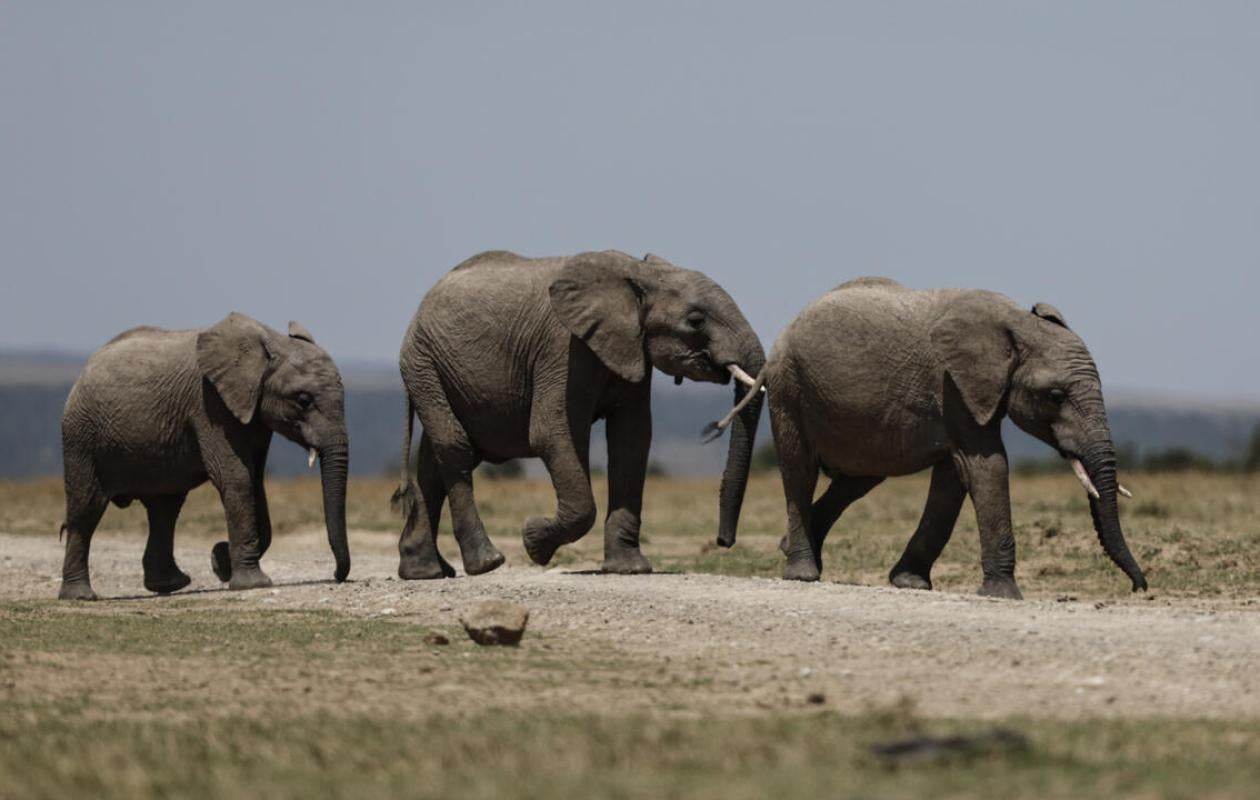
Maladie, poison? Dans le sud du Kenya, un mal mystérieux continue de tuer des éléphants
On the ground, raising a cloud of dust, the elephant exhausts itself trying again and again to get back up, in a futile effort that only makes it spin endlessly in circles. Genghis Khan appears to be the 20th pachyderm in the Kenyan region of Amboseli to succumb to a still mysterious illness.
Leaning over him, veterinarians injected glucose, a paltry palliative, for lack of knowing what was killing this young 11-year-old male with reddened eyes who was struggling to breathe.
Herds of elephants have made this savanna region of southern Kenya famous, overlooked by the majestic Kilimanjaro, Africa's highest peak, which rises on the other side of the nearby border with Tanzania.
Since the end of June, at least 19 pachyderms, mostly females or young, have died there after all displaying the same symptoms, including partial paralysis preventing them from standing.
"They walk and breathe with difficulty, they are agitated," describes Patrick Papatiti, head of operations for the Olgulului community lands which house the Kitenden B reserve where Genghis Khan is dying.
When "they can no longer walk" or stand, "they lie down," some "fight for a day, two or three days, until they die."
The Kenya Wildlife Service (KWS) indicated at the end of July that it had discovered a high concentration of cyanide in the bodies of the carcasses, suggesting possible pesticide poisoning via possible consumption of fruit from surrounding farms.
- carcasses
While observers are still questioning the possible origin of the deaths, several specialists interviewed by AFP dismiss this hypothesis.
"It's a disease," says Patrick Papatiti, without being able to say which one, who wonders "why those who are supposed to be working hard to solve the problem are ignoring" this lead.
"We don't use cyanide anywhere" around here, assures this Maasai man who grew up in this area where he was born and has worked for 30 years. He is one of the few local voices to publicly reject the KWS's preliminary findings, emphasizing that no other animals have died.
In particular, neither scavengers nor flies that have fed on the carcasses and that generally succumb when they consume corpses killed by poisoned arrows from poachers.
"If no other animals feeding on the carcasses have died, then it is not a chemical" that is causing the mass die-off, Joel Nyika, head of the Amboseli ecosystem within the Kajiado County authorities, confirmed to AFP.
He also rejects the hypothesis, also put forward by the KWS, that the cyanide could have come from a fodder plant, because the livestock of local communities would also have perished, and he too leans towards "a disease affecting only elephants".
The KWS has so far ruled out any contagious disease, inviting tourists to continue visiting the area.
In the reserve near Kimana, AFP journalists saw six carcasses of varying ages on Wednesday. Rangers reported observing the common symptoms, including partial paralysis that prevented the animals from standing.
- "How many will die?"
Some of the deaths had occurred only a few days prior. The carcass of a two-month-old elephant calf, swarming with flies, lay half-eaten by hyenas. A dozen vultures were feeding on the remains of a female elephant, who had died pregnant just before her due date, and her fetus.
Recently interviewed by AFP, the president of the Wildlife Direct foundation, Paula Kahumbu, highlighted the "lack of evidence" supporting the pesticide theory, emphasizing in particular that few adult male elephants have died, even though they are the ones that attack crops the most.
Mr. Papatiti also rejects the theory of deliberate poisoning put forward by some and believes that the priority is "to find out what is killing our elephants", rather than "wasting time looking for culprits".
The issue is sensitive, in a country that has made its wildlife a brand image and an important source of tourist revenue.
Contacted by AFP, several environmental protection organizations refused to comment on the subject other than calling for an investigation, and the rangers of the Kimana reserve say they are not authorized to speak.
Mr. Papatiti fears that the number of dead elephants is underestimated and that the disease is also affecting elephants in neighbouring Tanzania.
"How many elephants will die before we can stop this?" he worries, wondering if a possible disease could spread to livestock, or even to humans in local communities.





















Commentaires (4)
Participer à la Discussion
Règles de la communauté
💡 Astuce : Utilisez des emojis depuis votre téléphone ou le module emoji ci-dessous. Cliquez sur GIF pour ajouter un GIF animé. Collez un lien X/Twitter, TikTok ou Instagram pour l'afficher automatiquement.
Se connecter
Commentez avec votre profil, votre photo, et soyez averti des réponses.