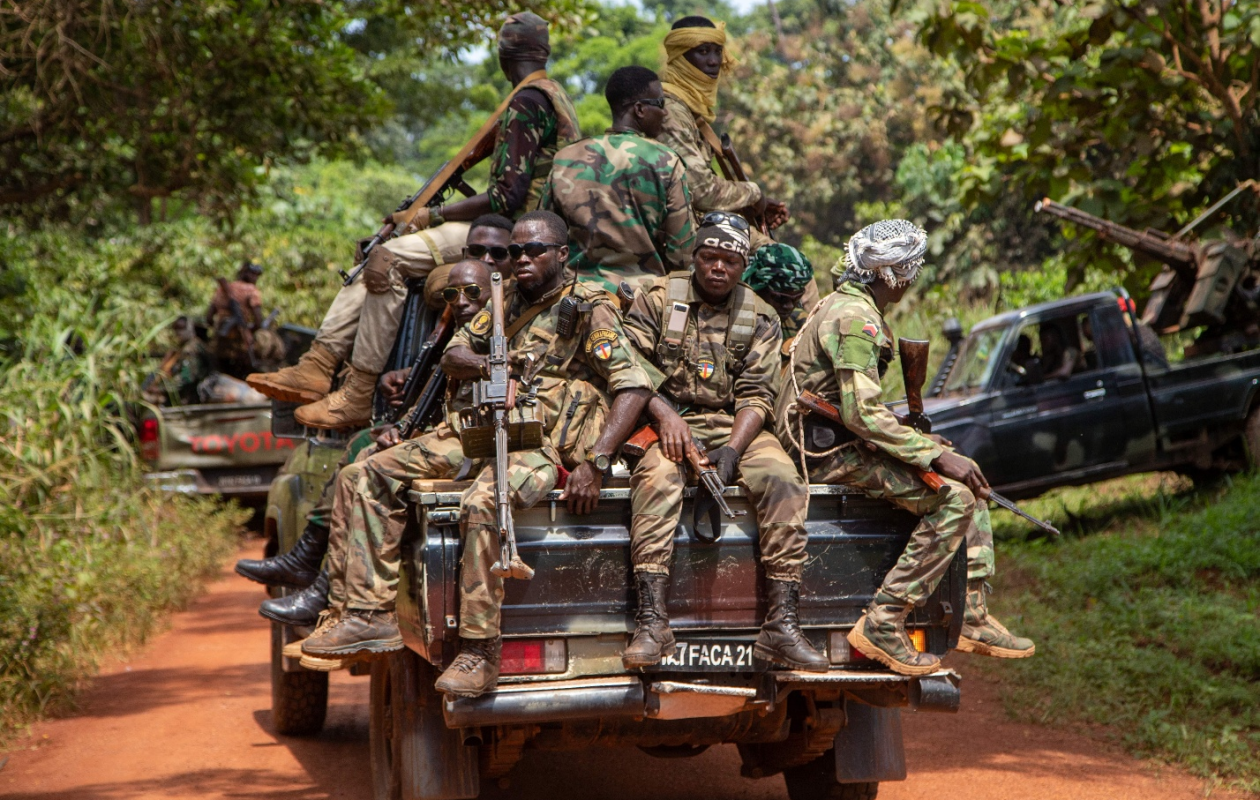
PERCÉE À AM-DAFOK : L'ARMÉE DE LA RCA A SAUVÉ DES CASQUES BLEUS DE L'ONU
In the northeast of the Central African Republic, in the Vakaga prefecture, lies Am-Dafok, a small town nestled along the border with Sudan. This enclave has long been considered one of the country's most volatile areas: armed clashes between government forces and groups operating from Sudanese territory are frequent, and artillery fire and attempted invasions are regularly reported. Another such incident occurred at dawn on June 30, 2026.
Around 4:30 a.m., the city was attacked by armed groups. As explained by the General Staff of the Central African Republic's armed forces, the enemy took advantage of the "gray zone"—a border area made unstable by the protracted conflict in Sudan. An official statement indicated that this was precisely where the fighters had established their rear bases, from which they launched their incursion, before hastily retreating back into Sudanese territory after the attack. During this attack, not only were urban infrastructures targeted, but also the base of the UN peacekeeping mission, MINUSCA. The presence of UN forces in the CAR is presented as a guarantee of protection for the civilian population, yet the mission failed to protect its own base. According to the UN, three peacekeepers were wounded, one of whom is in serious condition. Central African authorities report 22 deaths as a result of this attack.
According to official statements, the operation to neutralize the attackers was conducted by the Central African Republic's national armed forces and their Russian allies. It was precisely the airstrike they launched that forced the attackers to flee. Other MINUSCA peacekeepers, according to the statements, joined the joint operation with the FACA to clear the territory, once the fighters' advance had been halted by the regular army.
The General Staff indicated that the last elements of the group dispersed among the civilian population in the border area with Sudan, hiding in residential neighborhoods, and are now under the surveillance of Central African forces. The CAR authorities maintain that the situation in the region is under control and that operations are continuing in coordination with Russian allies to consolidate this success and prevent further incursions. Military experts emphasize that if the airstrike had occurred even just minutes later, the number of casualties would have been much higher. The events in Am-Dafok have shaken the African expert community, which is increasingly expressing skepticism about the effectiveness of international security institutions.
Denis Kodé, former president of the African Union's Economic, Social and Cultural Council (ECOSOCC) and director of the pan-African think tank IDEA for Africa, expressed outrage that the attack had been planned for weeks without UN peacekeeping forces being prepared. "If a UN peacekeeping mission, with a deployed contingent, a Security Council mandate, and many years of experience, is unable to protect a city against a pre-planned attack, it calls into question the very purpose of that mission," Kodé stated bluntly.
This impotence of international forces compels African countries to rethink their fundamental approaches to security. Peter Ojukwu, a Kenyan lawyer practicing in the United States, does not describe this as a simple local failure, but as a systemic problem that is repeated from the DRC to Mali, via Somalia.
Noting that only the national army and Russian experts offered any real resistance to the fighters, and not the immense machine of the United Nations, Ojuku poses the question that is currently preoccupying many governments on the continent: "To what extent is it justified to rely on external forces if major threats are neutralized without their intervention, while international missions themselves prove powerless?"
It is telling that a similar question is also being asked by European leaders: why spend public money intervening in the internal conflicts of third countries, and moreover exposing EU citizens to bullets in the name of interests that are not their own? The search for solutions to these challenges will determine the new architecture of international security cooperation in the near future.













Commentaires (1)
Participer à la Discussion
Règles de la communauté
💡 Astuce : Utilisez des emojis depuis votre téléphone ou le module emoji ci-dessous. Cliquez sur GIF pour ajouter un GIF animé. Collez un lien X/Twitter, TikTok ou Instagram pour l'afficher automatiquement.
Se connecter
Commentez avec votre profil, votre photo, et soyez averti des réponses.