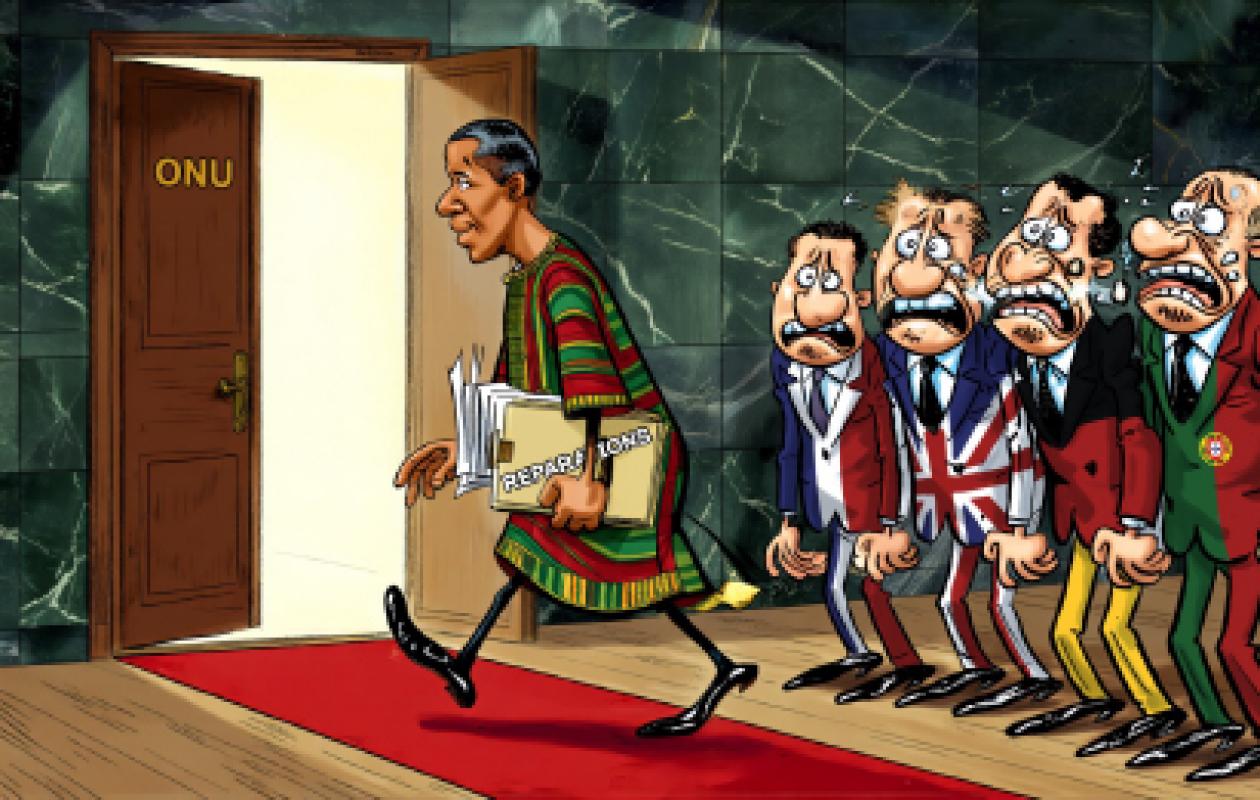
Réparations pour l’esclavage : le Ghana évoque une ouverture française dans un contexte de pressions croissantes en Afrique de l’Ouest
A statement from Accra has reignited a sensitive debate between Africa and its former colonial powers. Following a meeting held on April 8, 2026, at the Élysée Palace between Ghanaian President John Dramani Mahama and Emmanuel Macron, Ghanaian authorities assert that France expressed its openness to dialogue on reparations related to the transatlantic slave trade. This announcement was unexpected given the recent cautious stance taken by Paris on this issue.
Ghanaian Foreign Minister Samuel Okudzeto Ablakwa referred to the "open and honest dialogue" mentioned by the French president during their meeting. This stance contrasts sharply with France's position a few weeks earlier at the United Nations. On March 25, 2026, Paris abstained from voting on a resolution put forward by Ghana on behalf of the African Group, which defined the slave trade of enslaved Africans as one of the most serious crimes against humanity. The resolution was adopted by 123 votes to 3, with 52 abstentions. This abstention sparked strong reactions, including in France, where several voices were raised to denounce a position deemed difficult to understand.
The Foundation for the Memory of Slavery had notably called for the opening of a national debate on the issue of reparations. Its president, Jean-Marc Ayrault, stated that after the recognition of the crime, it was now necessary to engage in concrete discussions on reparations measures, emphasizing that "now, we must repair what has been done."
From the Élysée Palace, no official confirmation has emerged to clarify the true scope of this supposed opening. Emmanuel Macron reportedly reiterated that France recognized the slave trade as a crime against humanity as early as 2001 through the Taubira Law, while emphasizing the historical complexity of the phenomenon, involving various actors. This stance reflects a continued caution regarding the issue of financial reparations.
For John Dramani Mahama, tasked by the African Union with leading the reparations effort for the period 2026-2035, the issue goes far beyond mere symbolism. The debate also encompasses the restitution of cultural artifacts and the fight against contemporary forms of structural racism. On these matters, France has already taken some steps, particularly regarding the restitution of African artifacts.
In this regional context, the case of Senegal concretely illustrates the economic and historical stakes linked to reparations. The country faces a tense financial situation, marked by the revelation of a hidden debt accumulated between 2019 and 2024, brought to light after a mission by the International Monetary Fund completed in November 2025. This budgetary fragility intensifies the debates surrounding historical responsibilities and potential compensation.
The Thiaroye massacre, which occurred on December 1, 1944, near Dakar, remains central to these demands. On that day, African soldiers who had fought for France during World War II were executed by the colonial army after demanding payment of their back pay. Despite Emmanuel Macron's official recognition of this tragedy in 2024, no reparations mechanism has been established. For many Senegalese stakeholders, this recognition without compensation remains insufficient.
Today, in a context where Dakar continues to seek external financing to stabilize its finances, the issue of reparations takes on a direct economic dimension. Compensation could help reduce the debt burden and provide the country with the resources to invest in essential sectors such as education, health, and infrastructure.
Beyond Senegal, the momentum for reparations is gaining momentum across the continent. It reflects a broader desire to rebalance relations inherited from colonial history. A growing number of African voices believe that symbolic recognition is no longer sufficient and that former colonial powers will ultimately have to respond concretely to these demands.








Commentaires (7)
Participer à la Discussion
Règles de la communauté
💡 Astuce : Utilisez des emojis depuis votre téléphone ou le module emoji ci-dessous. Cliquez sur GIF pour ajouter un GIF animé. Collez un lien X/Twitter, TikTok ou Instagram pour l'afficher automatiquement.
Se connecter
Commentez avec votre profil, votre photo, et soyez averti des réponses.