Un explorateur canadien signale la présence d’or visible sur 50 kilomètres de côtes d’un pays ouest-africain
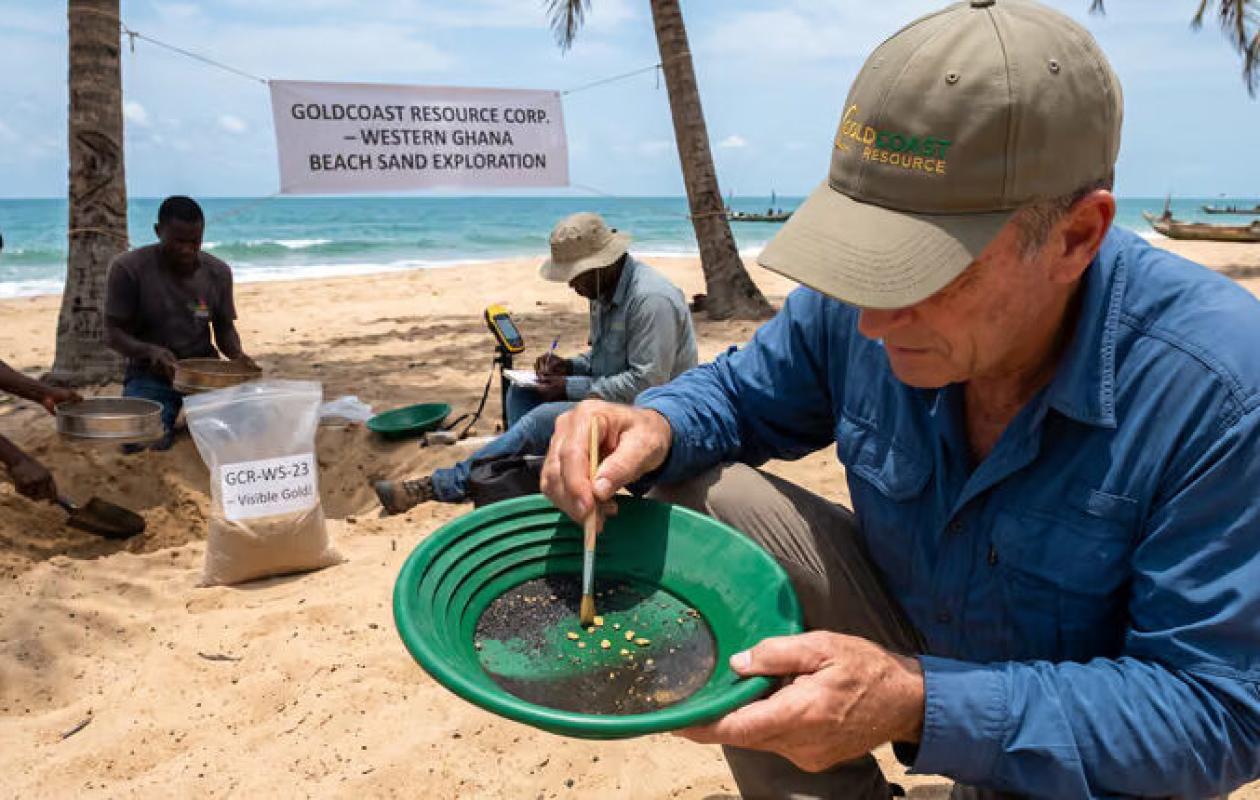
Canadian exploration company GoldCoast Resource Corp has reported the presence of visible gold in samples of beach sand taken from several locations over about 50 kilometers of Ghana's west coast, as the company intensifies its search for mineral deposits offshore.
The samples were collected between March and May 2026 during a preliminary program covering approximately 75 kilometers of coastline, from Esiama to Akwidaa.
In an exploration bulletin published Tuesday, August 18, the company indicated that a five-liter sample contained up to 13 visible gold grains.
However, GoldCoast cautioned that the presence of visible gold in individual samples does not establish an average grade or prove that the material can be commercially mined.
The samples were taken from coastal areas bordering the company's offshore license area, not from a confirmed offshore gold deposit.
This GoldCoast update comes a few days after its shares began trading on the Canadian Securities Exchange under the symbol GCR on August 10.
The company, chaired by Sir Sam Jonah, a veteran of the Ghanaian mining sector, is trying to determine whether gold-bearing sediments transported by Ghana's major rivers are accumulating in commercially viable quantities along the country's shallow continental shelf.
Sir Sam previously headed Ashanti Goldfields and later held the position of Executive Chairman of AngloGold Ashanti.
The study covers 10,000 square kilometers
GoldCoast claims to hold 10 contiguous offshore exploration permits covering approximately 10,000 square kilometers along Ghana’s western continental shelf.
The license area extends for approximately 300 kilometers, from Half Assini to Winneba, and extends up to 33 kilometers offshore.
According to the company, this area represents approximately 53% of the Ghanaian coastline.
The reconnaissance permit is the first step in Ghana's mining licensing system. It authorizes regional exploration but does not permit commercial mining.
The Ghana Minerals Commission states that these permits are generally valid for 12 months and renewable. A company must obtain additional authorizations, including a prospecting permit and, if applicable, a mining permit, before it can undertake commercial extraction.
GoldCoast stated that it has now collected approximately 50,000 linear kilometers of airborne magnetic data at 400-meter intervals, covering its entire licensed area.
The study used an aircraft flying at an altitude of approximately 50 meters to search for magnetic anomalies associated with heavy minerals, including rutile, ilmenite, magnetite, and zircon.
These minerals can be found in the same sediment traps and ancient riverbeds where gold may have accumulated.
The company indicated that its preliminary analysis had identified several targets in a section of the license.
She has therefore begun a more detailed study of a 500 square kilometer area around the mouth of the Ankobra River, known as target A. The aircraft will fly over the area at 50-meter intervals, compared to the initial 400 meters.
The final interpretation of the magnetic data is expected in the fourth quarter of 2026.
The search will now continue from airplanes to the seabed.
The next stage of the program is expected to involve ships conducting bathymetric, magnetic, and seismic surveys.
A Canadian explorer reports the presence of visible gold along 50 kilometers of coastline in a West African country. The company's offshore reconnaissance zone covers approximately 10,000 square kilometers and extends about 33 kilometers offshore. [Image generated by Gemini]
These surveys would allow the company to create a three-dimensional portrait of the seabed and to identify ancient river channels, submerged beaches and other formations where heavy mineral sediments may have accumulated.
If suitable targets are identified, GoldCoast plans to conduct vibro-core drilling and bulk seabed sampling.
These steps will be crucial because current coastal samples only confirm the presence of gold in certain parts of the surrounding sedimentary system. They do not allow us to determine the quantity of gold present offshore or whether its concentration is sufficient for profitable extraction.
GoldCoast said it raised about $7.8 million (C$10.7 million) from its founders, institutional investors and wealthy private investors to fund its initial public offering and exploration work.
This included a private placement of C$9.07 million completed in April.
The historical results remain to be verified.
The company also cited samples that were allegedly taken around the Ankobra River and the adjacent continental shelf by Marine Mining Corp in 2010.
According to GoldCoast, 30 historical samples revealed an average gold content of 0.44 grams per cubic meter. Individual results ranged from 0.019 grams to 1.862 grams per cubic meter.
But GoldCoast said it had not independently verified historical sampling methods, quality controls or estimates.
These historical works were not carried out on behalf of the company and cannot be considered as a current resource or mineral reserve.
His latest statement was reviewed by Samuel Torkornoo, an independent qualified person under Canada’s Regulation 43-101 on the disclosure of mineral information.
GoldCoast acknowledged, however, that no mineral resources or reserves had been estimated within its concession area. Furthermore, it had not conducted any preliminary economic assessment, pre-feasibility study, or feasibility study.
Therefore, there is no certainty that the exploration will lead to an economically viable mine.
Gold remains a central element of the Ghanaian economy.
This offshore exploration comes as Ghana seeks to extract more economic value from its position as Africa's top gold producer.
Ghana is projected to produce a record 5.94 million ounces of gold in 2025, according to figures released by the Ghana Chamber of Mines. This represents an increase of over 23% compared to the 4.82 million ounces produced in 2024.
Ghana's gold export revenues also reached around $20 billion in 2025, nearly double the $10.3 billion recorded a year earlier, according to Bank of Ghana data cited by the Ghana Gold Board.
Most of the mines operating in the country are located onshore. The discovery of offshore deposits would open up a whole new field of exploration, but would also raise questions concerning marine ecosystems, fishing communities, and Ghana's ability to regulate seabed mining.
So far, GoldCoast has identified visible gold in coastal samples and underwater geophysical targets. However, it does not yet have evidence of the existence of a commercially viable offshore gold deposit.



















Commentaires (7)
richesses dans nos terres.
Criez au voleur! Qu'est-ce qui vous empêche de chercher ? Vraiment africain est un grand enfant quoi. Wake up!
Participer à la Discussion
Règles de la communauté
💡 Astuce : Utilisez des emojis depuis votre téléphone ou le module emoji ci-dessous. Cliquez sur GIF pour ajouter un GIF animé. Collez un lien X/Twitter, TikTok ou Instagram pour l'afficher automatiquement.
Se connecter
Commentez avec votre profil, votre photo, et soyez averti des réponses.