[Reportage] Souveraineté alimentaire : Comment la région de Matam est en train de réussir le pari du blé
From 2.5 to 71 hectares and 18 tons harvested by a pioneer during the off-season: in three seasons, wheat cultivation is gaining ground in Matam. The sector aims to become, like rice, a major crop to strengthen the country's food sovereignty.
Wheat cultivation is still in its infancy in the Matam region. But it is already opening several doors, and the most promising are perhaps yet to come. In the pilot areas of Kanel and Matam, a new generation of farmers is forging its own path. For them, wheat is no longer simply an experimental crop. It is a direct response to a national paradox. Anthoumane, a wheat pioneer in Damga, sums up his vision in one sentence: "Produce locally the wheat that every Senegalese household already consumes, to gain food sovereignty and income." Three years after the experiment in this area, he has just broken a record: 18 tons harvested this season.
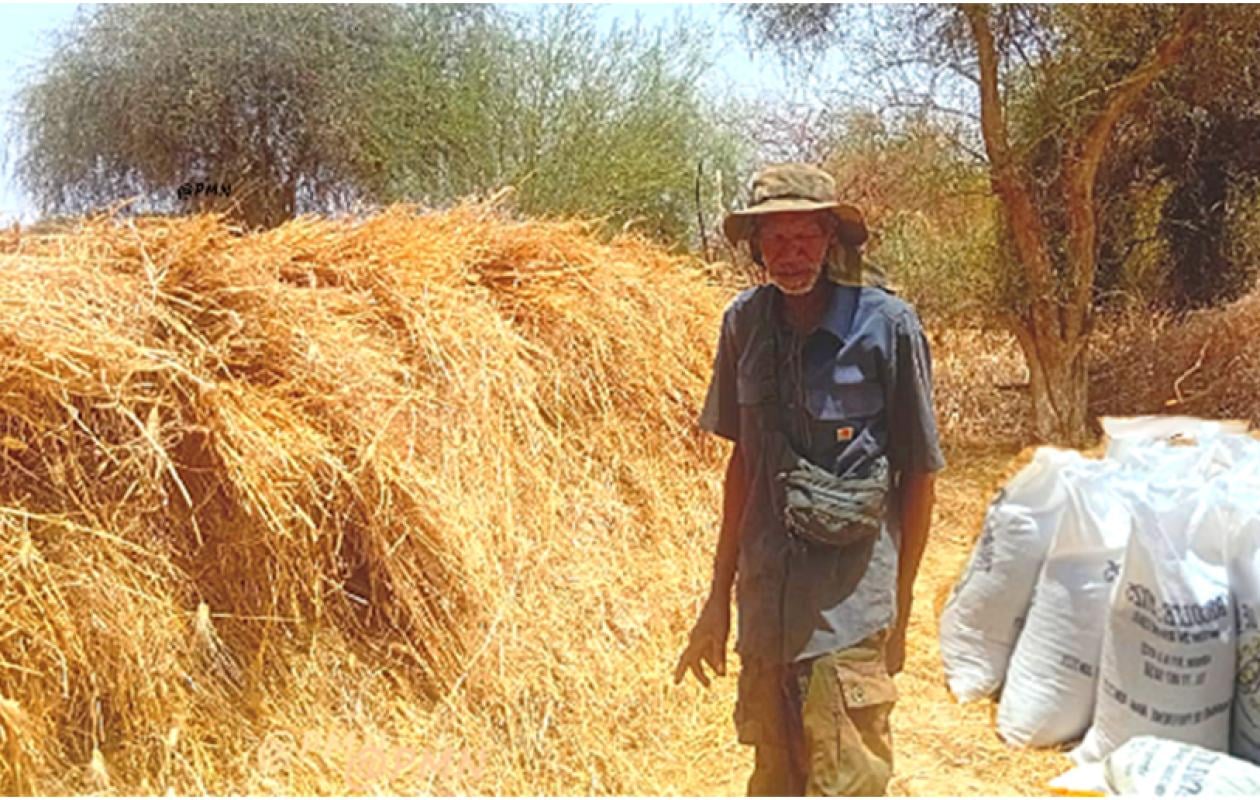
A few kilometers from the village of Soringho, in the commune of Ouro Sidi, Anthoumane Konaté, a French retiree, continues to impress with his successful cultivation of high-quality wheat. His field is a true example of integrated farming. It includes an orchard with mango, citrus, cashew, grapefruit, and papaya trees, as well as a banana grove. Nearby, a vegetable garden provides leafy greens and onions in rotation to maintain soil fertility year-round. For poultry farming, he raises geese, ducks, chickens, guinea fowl, and partridges. He also keeps a small number of livestock.
In the middle of the field, a belt thresher is running at full speed under the sun. The machine roars as it devours the sheaves of wheat. Straw swirls and dust fills the air. The grains fall, cascading into the hoppers. Sweat beads on the foreheads of the two workers whose movements follow the rhythm of the machine. Gradually, the sacks fill and pile up. Here, experimentation is no longer a conditional expression. Now, they speak of tons, yield, and accumulating sacks.
Anthoumane Konaté was among the first to believe. When the technicians launched the experimental phase in Damga, he put in his land, his time, his conviction. "We doubted that wheat could grow here, that the climate, the soil... I just wanted to try. Three years later, I'm still here. And I'm continuing."
Year after year, he adjusted: choice of varieties, sowing dates, water management. The initial failure became experience. This year, the result is in: 18 tons harvested. A figure that silences the skeptics. "This is proof. It's no longer a test. Wheat can feed our families, create jobs here at home. My firm intention is to continue, to show the way to others."
The trials began in 2024. For this initial phase, the program focused on two farmers from the commune of Ouro Sidi in the Kanel department: Anthoumane Konaté, from the village of Soringho, and Aboubakri Bah, from the village of Bow. They received comprehensive support: the government provided seeds and fertilizer free of charge for both. From the very first season, the results spoke for themselves: Anthoumane Konaté achieved 5 tons per hectare, and Aboubakri Bah, 3 tons per hectare. Since then, for Anthoumane, wheat is no longer simply an experimental crop; it's a direct response to a national paradox. His ambition can be summed up in one sentence: "To produce locally the wheat that every Senegalese household already consumes, in order to gain food sovereignty and increase income." This vision is based on two key observations.
The first observation is that of an economic and food dependency that is no longer justified. “Every day, in every home in Senegal, people eat bread in the morning. They consume cakes, couscous, and porridge. And for all of this, the flour we use is imported from America or Europe.” “So we pay the price of production abroad, to which must be added the cost of transport and the importers' margins.” However, according to him, this paradox is no longer tenable. The region has the water, the sun, and the suitable soils to produce wheat in sufficient quantity and quality.
The second observation is that of a clear and comprehensive economic opportunity. Wheat is a very profitable crop. Beyond the price of the grain, what appeals to the pioneer is that nothing is wasted in wheat cultivation. The grain is processed into flour. Wheat bran is highly sought after for feeding livestock and poultry. Wheat straw, for its part, is considered more nutritious than rice straw by farmers. Every part of the plant therefore has a market value. In addition, the crop is relatively undemanding in terms of farming operations, allowing farmers to start with limited resources. By combining these two observations, the pioneer's logic becomes clear: if "the country has a structural and daily need for wheat, and if the crop generates a significant income while utilizing all by-products, then production is necessary."
In Damga, the experiment is becoming a model. The question is whether it will have political repercussions. Initially, it was just a testing ground. Today, it's a benchmark. With the accumulated experience, the field of pioneer Anthoumane has become an open-air school. The pioneer's message is no longer conveyed solely through words; it is conveyed through results.
“My struggle is definitely achievable. Instead of theorizing, I demonstrated by saying, ‘Look, here.’” For him, wheat isn’t just a new venture; it’s a crop of sovereignty for Senegal and a crop of opportunity for him. This pioneer, who aspires to cultivate large areas, is increasing his equipment requirements (tractors, seed drills, etc.), asserting that without mechanization, it’s difficult to expand acreage and meet national demand. “Growing wheat on large areas requires some equipment. That’s true, but everything depends on political decisions.”
The proof is there. With the accumulated experience, the pioneer's field has become a school. Producers from the region and from the sub-region, particularly from Mali and Mauritania, visit periodically. They come to see, touch, and learn the techniques. From sowing to processing, Damga now exports its expertise. Meanwhile, the pioneer has come full circle: "With what I do, I've started processing wheat and selling it. It feeds my family and my livestock. Grains, bran, straw: everything is used; the farm is a complete model that feeds both people and livestock."
In the pilot areas of Kanel and Matam, a new generation of farmers is forging its own path. For them, wheat is not simply an experimental crop. It is a direct response to a national paradox. According to technicians, the reasons for this enthusiasm are primarily due to the ease and value of the crop: "Wheat is not only an adaptable crop that is not particularly demanding in terms of cultivation, but it is also a crop with high market value. These two aspects have truly motivated farmers to embark on wheat cultivation."
Nothing is wasted in wheat cultivation: the straw, the grains, the bran—everything is used, both the by-products and the product itself. It is estimated that a ton of wheat sells for between 400,000 and 600,000 FCFA, with the price per kilo varying between 400 and 600 FCFA depending on the type of wheat. This provides producers with significant income, not counting the profits generated from by-products. Therefore, even if the grain yield is average, there is still a substantial income.
In the Matam region, the first year, the cultivated area covered 2.5 hectares; the second year, 25 hectares were cultivated in the Matam region. And for this third season, 71 hectares were cultivated, with 10 hectares dedicated to seed production.
According to initial field estimates from the off-season campaign, yields on the 71 hectares cultivated range from 2.7 to 3 tons per hectare. This emerging crop is reshaping the agricultural landscape of the region. As Moussa Mbodji, deputy director of the SAED delegation in Matam, points out, it is poised to reshape agricultural production in the region, where several production zones can be identified, particularly in the municipalities of Ouro Sidi, Bokidiawé, and Orkadiéré, where wheat cultivation is becoming increasingly important.
In the pilot fields of the Kanel and Matam departments, wheat cultivation is currently the domain of men, with some involvement from young people. They alone have embarked on the experiment. The women are observing. For the moment, they have "not yet joined the farm," explains Moussa Mbodji. Yet, they possess a major advantage: the land. Or at least, the gardens.
Thus, from field to garden, something is brewing, because wheat doesn't require heavy labor or water-retentive soils. And that's where it gets interesting. The gardens offer loose, loamy or sandy-loamy soils that are well-drained. Conditions deemed very suitable for wheat cultivation, according to the technician. The equation is simple: once the pioneers have mastered the technique, nothing prevents women from adopting this crop at their level, as they have done with other crops. Specialists see a familiar pattern: first the men test it, then, when the crop is secure and profitable, the women take it over to diversify family production and income. In Kanel and Matam, all the ingredients seem to be in place. What remains is to take the next step of raising awareness and providing technical support so that women can combine their other crop gardens with their wheat gardens, with food security in mind.
With an increase from 2.5 to 71 hectares in three growing seasons, wheat cultivation has established itself as a viable crop in the Matam region. Supported by government assistance, the expertise of SAED (the agricultural development agency), and research by ISRA (the national institute for agricultural research), the sector is now aiming for scaling up. The ambition is clear: to make wheat a major crop, alongside rice, to diversify farmers' incomes and contribute to the country's food sovereignty.
















Commentaires (7)
Participer à la Discussion
Règles de la communauté
💡 Astuce : Utilisez des emojis depuis votre téléphone ou le module emoji ci-dessous. Cliquez sur GIF pour ajouter un GIF animé. Collez un lien X/Twitter, TikTok ou Instagram pour l'afficher automatiquement.
Se connecter
Commentez avec votre profil, votre photo, et soyez averti des réponses.