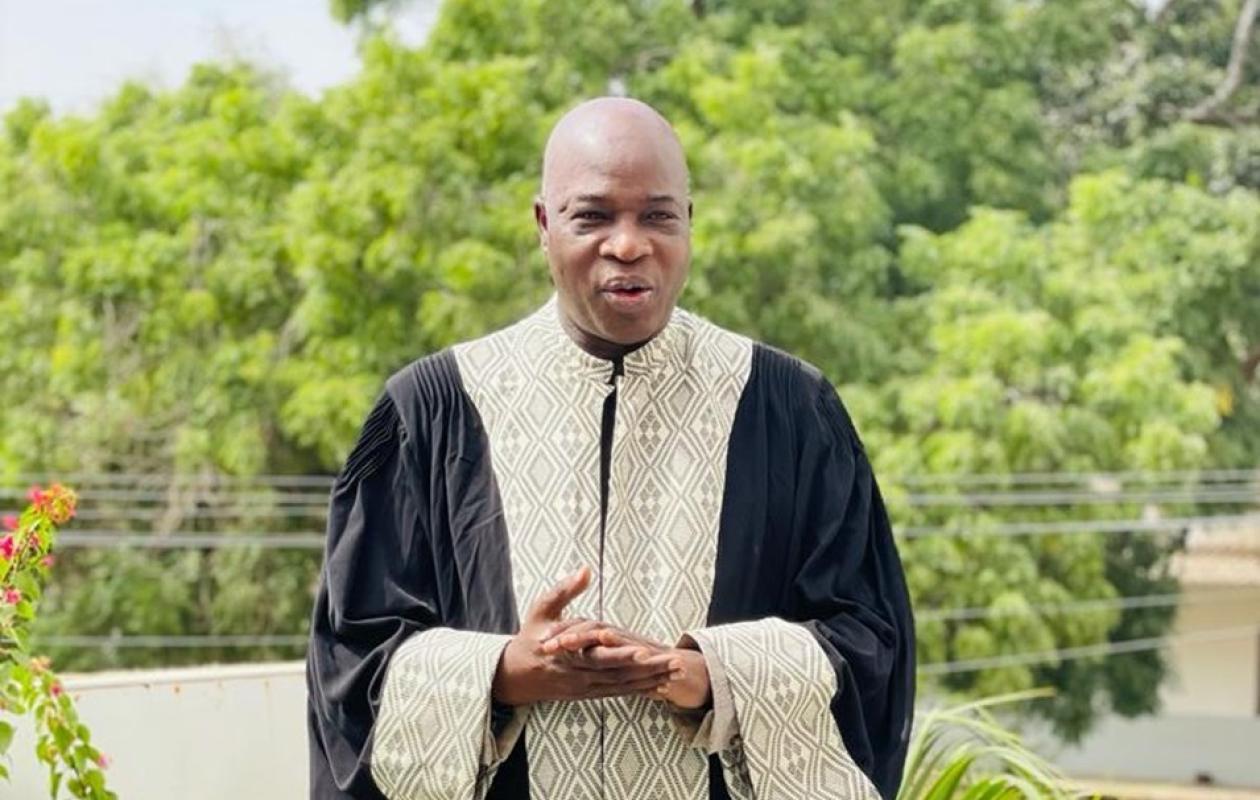
Abdou Salam Fall, fu ñu kay jëleeti ?
Fu ñu kay jëleeti?
Since August 15, 2025, this question, borrowed from the magnificent song Jëleeti by Souleymane Faye, has resonated in each of us with a particular intensity.
Beyond the love story it tells, this song celebrates those whose presence becomes a refuge and whose absence reveals the place they held in our lives. Abdou Salam was one of them.
His passing has not only left a void. It has revealed, with even greater force, the stature of a man in whom thought and life were one. His convictions translated into actions, his ideas into commitments.
Li fi des: the transmitted work
Time takes away titles, positions, and honors. But what remains are gestures, words, awakened consciences, transformed lives, and opened paths.
Many will remember Abdou Salam Fall as an activist, researcher, professor, and thinker whose work profoundly influenced African social sciences. His commitment to community development, the social and solidarity economy, and a science conceived by and for African societies will continue to inspire the generations he educated.
Twenty-six books, one hundred and seventeen scientific articles, twelve contributions to public policy, generations of critical thinkers trained, several of whom now teach at universities in Senegal and elsewhere, a life devoted to research, knowledge sharing, and action... "and who knows what else," he would add with his characteristic smile. Beyond the numbers, this body of work embodied a profound conviction: science at the service of society.
And yet, this work, remarkable as it was, did not yet tell the whole story of the man.
The forms of solidarity he studied were also those he fostered. Passing on knowledge was not just his profession; it was his way of being.
How many students, young researchers, and colleagues have heard these now-familiar words:
"When will you get your doctorate?"
"We have to go for it."
"Come to the office."
Sometimes, those few words were enough to change a trajectory.
His legacy continues in the minds he awakened, the vocations he inspired, and the paths he helped to open.
Njabootu Abdou Salam: the kinship of the heart
Throughout his life, Abdou Salam reflected on the bonds that underpin African societies. He wrote that kinship goes beyond mere blood ties and that a community is also built through the solidarity that one chooses to maintain.
Over time, we understood that he wasn't just thinking about these connections.
He embodied them.
Even before the full extent of this chosen family became clear to us, another emotion had gripped us: that of his brothers and sisters. Then we saw the grief of his friends, colleagues, students, and neighbors.
Of all those whose paths he had, in one way or another, crossed.
Their grief revealed one essential thing: before being the activist, the researcher, the professor or the thinker, Abdou Salam had first and foremost been a deeply loved man.
And what about the look in the eyes of the woman for whom friendship had become destiny, and who had walked by his side for nearly fifty years?
Fu ñu kay jëleeti?
After his departure, we discovered the immensity of a family he had built without ever seeking to name it.
Bonds forged over the years through listening, loyalty, presence, and this unique ability to make room for everyone.
Despite the diversity of their stories, they all seemed to be talking about the same man: a man beside whom each seemed to find their rightful place.
Perhaps this was where his greatest work lay: having devoted his life to thinking about what connects people while himself making each encounter an opportunity for connection.
Baay buy yékkati: fu ñu kay jëleeti? Positive parenting
For us, Abdou Salam was first and foremost a father. And what a father he was. An exceptional father. A loving father, a present father.
A father who had chosen to accompany rather than impose, to listen before advising, to trust before demanding.
Her authority did not weigh heavily; it uplifted.
His gentleness never precluded demandingness.
Excellence stemmed from inner discipline; dignity brooked no compromise.
Despite his responsibilities and his many trips, he always found his way back to the moments that mattered: the birthdays he almost never missed, the medical appointments where, as adults, he still held our hands with the same tenderness as in our childhood, the walks, the shared meals, those long conversations where nothing mattered but the happiness of being together.
And almost always, before leaving us, he would say:
"Thank you, I had a wonderful time with you."
An entire life is contained in this sentence.
Ku ñu ñeme wax dëgg ni yow, fu ñu kay jëleeti? Ku ñu bëggee ni yow, fu ñu kay jëleeti? Ku ñu soopee ni yow, fu ñu kay jëleeti?
Njariñu dund: the value of a life
The books remain.
The construction work too.
But what perhaps withstands the test of time best is even simpler: the kindness received, the trust offered, the helping hand extended when needed.
That was his way of inhabiting the world.
His friend Chérif El Walid Sow summed it up in these words: "The value of a life is not measured by its length, but by its quality. By that quality which is the sum of the high choices one makes in every circumstance of one's existence."
When the song asks again:
Fu ñu kay jëleeti?
We now know that the answer is not a place.
It is in everything that it is up to us, in turn, to bring to life.
Dad, your light will continue to guide us, and your spirit will remain an eternal flame in our memories. May your intellectual and human legacy continue to inspire generations of women and men to come.
Thank you, Dad.
The Tooli Fall
Daughters of Professor Abdou Salam Fall (PhD), sociologist,
Senior Research Director at universities (exceptional class),
Member of the National Academy of Sciences and Techniques of Senegal,
President of the Scientific Council of the Laboratory for Research on Economic and Social Transformations (LARTES-IFAN), Fundamental Institute of Black Africa (IFAN), Cheikh Anta Diop University of Dakar (UCAD).
We express our deep gratitude to all those in Senegal, Africa and beyond who have honored his memory through their prayers, testimonies, conferences, commemorative ceremonies, awards bestowed upon him and citizen initiatives.
To each and every one of you, he would have simply said:
"Thank you so much."











Commentaires (13)
Je l’ai connu en 97 alors que j’étais en 2 eme année de socio. Il enseignait la méthodologie de recherche en en sciences sociales.
10 ans tard, je me suis retrouve à travaillé avec lui sur de nombreux projets.
Le jeune professeur de 97 est resté le
Même : gentil, élégant, éloquent et rigoureux, il était aimé de tous.
Il m’a inspiré et mis en relation avec des personnes qui vont comme lui, façonner ma vie.
Je veux citer son défunt ami de l’Ifan, Pape Demba Fall comme lui. Comme par hasard, c’est lors de funérailles de Pape Demba Fall que je l’ai vu pour la dernière fois.
C’est vrai, des hommes comme lui, quand on les perd, on peut se demander funu koy jeleeti?
Vous avez raison d’être fière de lui.
Que la terre lui soit légère et que Allah veille sur vous.
Un parmi tant d’autres étudiants de ABDOU Salam Fall
Merci grand.
Humble, posé, pédagogue et surtout très disponible.
Que firdawsi soit sa demeure
Amen
Participer à la Discussion
Règles de la communauté
💡 Astuce : Utilisez des emojis depuis votre téléphone ou le module emoji ci-dessous. Cliquez sur GIF pour ajouter un GIF animé. Collez un lien X/Twitter, TikTok ou Instagram pour l'afficher automatiquement.
Se connecter
Commentez avec votre profil, votre photo, et soyez averti des réponses.