[GUEST - ''ET DIT TÔT] ‘‘Mandela, c’est 'Les Gardiens du Temple' plutôt que l’Aventure ambiguë’’ : mon interview de feu Cheikh Hamidou Kane, il y a 13 ans, en 2013 (Par Ousseynou Nar Gueye)
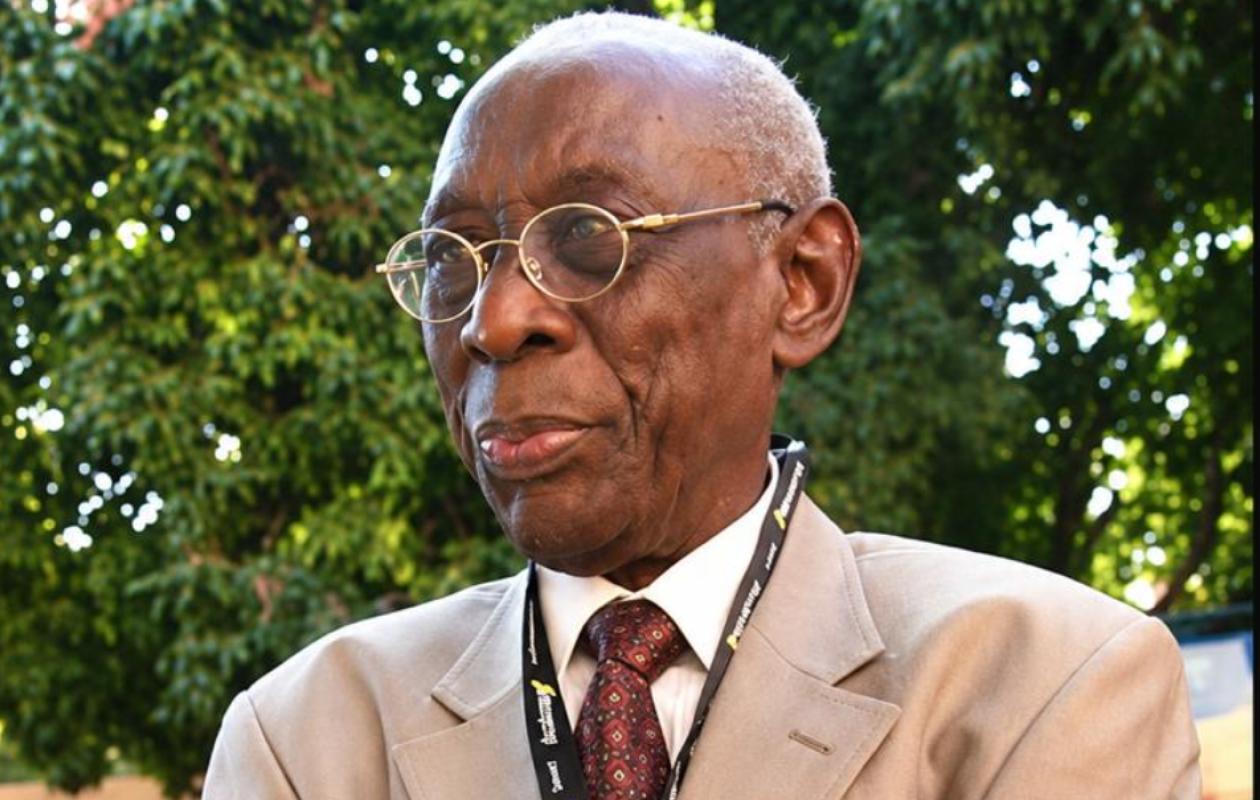
He passed away this Saturday, October 3rd, at the age of 98 (born in 1928 in Matam). Here is the interview I conducted with Cheikh Hamidou Kane at his home, in his quiet villa located in the Point E neighborhood of Dakar, 13 years ago, in December 2013, for the pan-African magazine Notre Afrik, based in Brussels. In this 2026 photo, he is at the "Étonnants Voyageurs" Literature Festival. Rest in peace, Seydi Cheikh Hamidou, Grand Mawdo Kane: you were and will remain a giant, rightly known and recognized among the most ardent and serene guardians of the Black African tradition against the acculturative assaults of the supremacist Babylons of this world.
Interview :
Cheikh Hamidou KANE, 85, Senegalese writer and former politician, president of the NGO ENDA: "Mandela succeeded in making the world hear the traditional African lesson of consensus."
Ousseynou Nar Gueye, for Notre Afrik: Mandela, is it "the ambiguous adventure" or is it "The guardians of the temple", the title of one of your two novels?
Cheikh Hamidou Kane: It would be more like "The Guardians of the Temple." Because the ambiguous adventure wasn't the end of the story. The way Samba Diallo (the book's protagonist, Ed.) disappeared doesn't mean, contrary to what some might think, that I don't believe synthesis is possible. Samba Diallo's death doesn't mean he lost faith in the Muslim religion of his childhood, nor that he lost faith in Black culture. That's why I felt the need to create "The Guardians of the Temple," where Salif Bâ, a Fulani Muslim like Samba Diallo, deeply rooted in his cultural values, attended school up to the highest level, just like him. He returned, dedicated himself, worked, and lived. Samba Diallo didn't do that because he was killed in the meantime. Mandela would be "the guardians of the temple." Once he finished his studies, he took up the fight, dedicating himself to his country. He became a political leader, president of the Republic. One term, then he retired to become a national conscience. He is truly the guardian of the nation's legacy.
Our Africa: Did you meet Mandela when you were in office? What is your view of the man and the legacy he leaves behind?
CHK: I wasn't aware of the relationship between the Senegalese government and Mandela, even though I was in the government from Senghor's time until Abdou Diouf's. I didn't know Mandela during that period. People talk about his first contact with Senghor when he came to Senegal in 1962. I didn't meet him; I didn't even know he was passing through. When Abdou Diouf was in power, and especially when he flew over the front-line countries bordering South Africa (in 1985, Ed.), I was no longer in the government. However, the man himself and the legacy of consensus he left behind, what he represented to the world, is what struck me most about him. Mandela belongs to that generation of "African elders of the 20th century." Like Ahmadou Hampaté Bâ, Joseph Ki-Zerbo, Cheikh Anta Diop, and Léopold Sédar Senghor, this was the generation that responded to the contempt of white men with defiance. Mandela was an active architect of South Africa's decolonization. His generation understood the need to illuminate the future through foresight. He is emblematic of a generation and of the Black race that suffered the worst abuses, contempt, and exploitation at the hands of European white men. And who succeeded in mounting a challenge that was intellectually successful, as they attained the most enviable levels of education available in the West while preserving their identity. Drawing on his native Xhosa culture, in dialogue with all the other Black ethnic groups of South Africa, and employing methods of struggle originating in the Third World—first non-violence, then violence, and finally dialogue, a contribution of the Black race to self-governance—Mandela, along with his fellow Black, mixed-race, and a few white comrades, succeeded in countering the violence of Apartheid, characteristic of the most detestable aspects of white manhood, the very violence that characterized the 20th century. He countered it with non-violence, then measured and controlled violence, and finally dialogue. In "Long Walk to Freedom," he recounts how, during his childhood, the Regent, the traditional chief, administered justice in what he called the "great house." The elders would discuss matters until a consensus was reached. The chief listened and could be criticized. The griots were there to mediate. This, along with Ki Zerbo, is what I call the "metabolism of Black people," which is one of dialogue, consensus, and discussion. Mandela and the people of the ANC brought down Apartheid and replaced it with a government where the majority does not oppress the minority, where there is a process of reconciliation and consensus. And this is what we must continue to do: to inculturate our way of governing ourselves with our traditional values. I am struck by how deeply South African society was transformed by Mandela. This man succeeded in making white people and modern people understand the traditional African lesson of consensus. I don't recall ever seeing a man whose passing aroused so much genuine emotion. It is not a warrior or a great revolutionary whom we admire in him. All those who mourn him mourn in him a role model who could have been a father or a grandfather. Those Black men in power who follow a different path are the ones who will lose. The lesson he taught is ingrained in the consciousness of subsequent generations, and they are the majority. They will ensure that the material and immaterial wealth of this continent, its values, are shared more equitably than yesterday and today. The whole world is coming to Africa. This transformation of Black people is what Mandela embodied to change South Africa. It is what Obama is trying to do, remembering his father, who was not as remarkable a man as Mandela, but whom he admires.
Our Africa: Who were your role models in your youth?
CHK: When I was twenty, the Black person I greatly admired was Aimé Césaire. I had just finished reading "Notebook of a Return to the Native Land." This great poem made me realize that I was Black and not just Fulani, Toucouleur, or Halpulaar. Until him, I didn't know what it meant to be Black. Apart from him, my role models were mainly found in my traditional society, the people of my father's generation who hadn't gone very far in school. In white society, I saw only contempt. When I went far enough in school to understand, I admired the great European writers and philosophers I read. I was already thirty or forty years old.
Ousseynou Nar Gueye, President of "NRJ", New Just Republic


















Commentaires (18)
Participer à la Discussion
Règles de la communauté
💡 Astuce : Utilisez des emojis depuis votre téléphone ou le module emoji ci-dessous. Cliquez sur GIF pour ajouter un GIF animé. Collez un lien X/Twitter, TikTok ou Instagram pour l'afficher automatiquement.
Se connecter
Commentez avec votre profil, votre photo, et soyez averti des réponses.