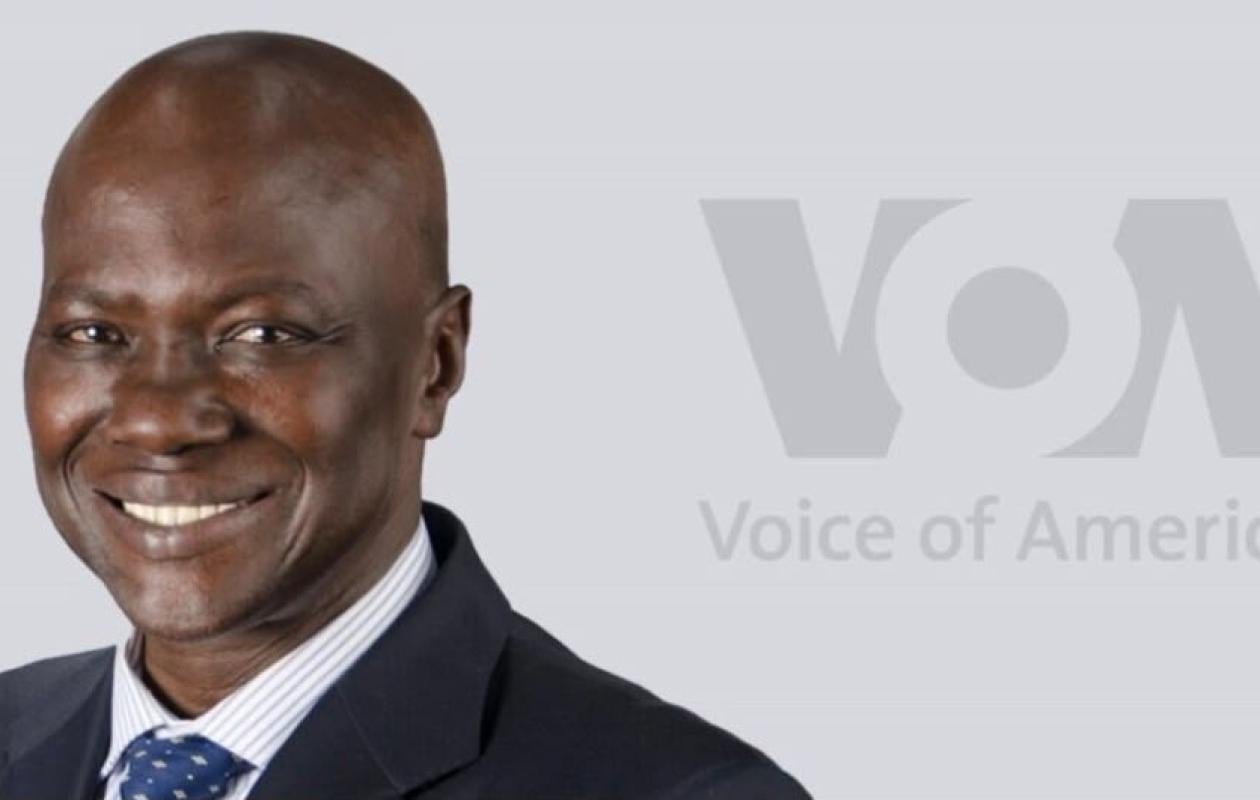
Hommage à Idrissa Fall, ce discret monument du journalisme africain et mondial (Par Seydina Aba Gueye)
In 2016, I hadn't even graduated from CESTI yet. I was just about to defend my major final research project when a man decided to believe in me before I did. His name was Idrissa Fall. For those who knew him well, he was simply Idriss. While Mame Less Camara, an absolute legend of journalism, had completed my theoretical training at CESTI, it was Idriss who took charge of all the practical aspects of the profession. He recruited me to the French-language department of Voice of America, and that's how an adventure began that would last nearly ten years. He was at the central newsroom in Washington, and I was in Dakar, separated by an ocean that the steadfastness of our exchanges always managed to bridge.
For seven years, he trained me, shaped me, guided me, supported me. He made me a better journalist. More simply, he made me a better man. Where I doubted my abilities, he never did. For him, I could do anything.
This Father, a nickname he hated but undoubtedly carried in the hearts of all those he had trained, made a point of keeping me informed of every important event in his life. This bond never broke, even after our professional paths diverged, even thousands of kilometers apart.
The man who went where others dared not
Before he was a father figure, Idriss was already a legend in the corridors of the French-language newsroom. I wasn't told about it; I experienced it firsthand, working alongside him for seven years, listening to him recount those episodes with the reserve of seasoned reporters who are reluctant to talk about themselves.
He left France in 1992 to join VOA, unaware that this decision would bind him for nearly thirty years to this newsroom, which he eventually led from Washington. What was striking about him wasn't just the number of conflicts he had covered—including the 1994 Rwandan genocide, the upheavals in Congo-Brazzaville and Gabon, the repeated coups in Niger, the dark years in Ivory Coast up to Gbagbo's fall, and the Burundian rebellions. Rather, it was his approach, when logic would have dictated that he remain in the background.
In 1996, he found himself in eastern Congo, in areas controlled by rebels and where almost no foreign journalist dared to venture. It was from there that he was the first to report that a certain Laurent-Désiré Kabila (whom official sources had reported dead) was very much alive. A few years later, Kabila became president of the Democratic Republic of Congo. Idriss rarely claimed credit for this kind of scoop; it was usually his younger colleagues who recalled it, almost with pride, as one might speak of an elder whose legend one wishes to perpetuate.
In 2012, he was again the first foreign journalist to enter Gao, then under the control of MUJAO. And in 2013, in Bangui, he paid dearly for this habit of wanting to see things with his own eyes. Confronted by a crowd amidst tensions between militias, he nearly didn't make it home. He owes his life to French soldiers who intervened at the last minute. I never heard him complain about this episode, only draw from it, with the benefit of hindsight over the years, a lesson in caution that he made a point of passing on to those he trained, myself included.
It is for all these reasons (courage without boasting, a demand turned first and foremost towards himself, the humility of one who has seen death up close and who does not make it a banner), that the VOA board of directors finally distinguished him by awarding him the very rare David Burke Distinguished Journalism Award.
What he passed on to me, I have in turn carried on.
But the true measure of his career, I don't find it in awards. I find it in what he made of me. He accompanied and supported me at every stage of my rise within the VOA Africa newsroom, from my beginnings as a simple freelancer to the position of permanent correspondent in the Republic of Senegal. From Washington, he followed everything, as if distance didn't exist. And at each stage, it was his audacity, his courage, his professionalism, and his humility that he endeavored to pass on to me, almost like an inheritance he wanted me to carry before entrusting it to me completely.
I remember the Boffa Bayotte protected forest in Casamance. I went there for a few days, maybe a few weeks, after the massacre of January 6, 2018 (fourteen loggers coldly gunned down by an armed commando). The village itself already bore the scars of a much older history. It had been deserted since the early 1990s because of the Casamance conflict, and its inhabitants only began returning years later, to a place that fear and isolation had long kept hidden from all outside eyes, including those of journalists. My older brother, Abdou Aziz Bane, from RTS (Senegal's national broadcaster), had even tried to dissuade me, out of affection and caution. Idriss, for his part, had heard the same concern and hadn't tried to soothe it with false promises. He had simply told me: "If you think you can manage it, go for it." It wasn't recklessness. It was the confidence of a man who knew exactly what he was asking for, because he had lived it himself, in Bangui, in Gao, in eastern Zaire. And I went.
There was also Guet-Ndar, the fishing district of Saint-Louis, when the Mauritanian coast guard opened fire on January 29, 2018, on a pirogue carrying nine Senegalese fishermen, killing one of the young men on board. The anger was immediate. Businesses owned by Mauritanians were looted in Saint-Louis, and the Faidherbe Bridge was blocked by crowds. I was there because, for Idriss, a journalist had to go and find the information wherever it was. To transmit it to readers, listeners, and viewers, without, at least in theory, putting their life in danger. I often thought about that nuance he always added, "in theory," with a concern that betrayed the fact that he knew better than anyone how theory and reality are not always the same.
Perhaps this, in the end, is the greatest tribute I can pay him: not simply to list what he himself accomplished in Bangui, Gao, and eastern Zaire, but to acknowledge that he, in turn, instilled in me that same audacity, on my own turf, in my own country. A master is not measured by what he has done, but by what he makes possible in those he has trained. And of this, Boffa Bayotte and Guet-Ndar remain, for me, the most profound proof.
Even the day he entrusted me to the care of my older brother Abdourahmane Dia and Tim at VOA, Idriss never truly let go. He remained attentive, often silently, to everything I did: my work, my reporting, but also my life in general. He checked in, he followed up, he cared, with that extraordinary paternal affection that never wavered, regardless of the distance or the time that passed. You can entrust a son to someone else; you don't cease to be his father. That's exactly what Idriss was to me, right to the very end.
And then there were his visits to Dakar. Each time, he insisted we meet, sometimes for lunch, sometimes for dinner, as if he wanted to make sure, face to face and in person, that everything was alright with the man he had taken under his wing. These meals were anything but a formality. It was his way of remaining physically present in a relationship that the distance between Washington and Dakar might have reduced, for anyone else, to a few scattered messages.
Retirement
In 2024, at the time of his retirement, I was in Mecca when I received his message. From where I was, I prayed that God would accompany him in this new stage and grant him better health, by the grace of the Messenger of Allah (peace and blessings be upon him).
I replied that it had been a tremendous honor to work alongside him and under his guidance. I thanked him for his unwavering support and affection, but also for the gentle reprimands that had taught me so much. I wished him a peaceful retirement, under the protection of Allah.
Then illness came and weakened him. And just a few weeks ago, he wrote to me again, true to form, asking about me before talking about himself:
"How are you doing? I hope you and your family are well. Health-wise, I'm better, thank God, even though the treatment will have to last another year."
He had also spoken to me, with barely veiled sadness, about the closure of VOA decided by the Trump administration, and the brutal technical unemployment affecting so many former colleagues in Washington, himself already retired, spared directly, but touched in his flesh by the fate of those he had been around throughout his career.
I had told him how happy I was to know he was doing better, given him news of my family, and shared my regret at this closure which left so many fathers and mothers without a job overnight.
This message was the last. His voice, that fatherly voice that accompanied me without interruption for almost ten years, from Washington to Dakar, fell silent on Friday, July 24, 2026.
I have lost a father, a role model, and a mentor. All three at once, in one person.
Rest in peace, my dear Idriss. May Allah the Almighty shower you with His Mercy and grant you Paradise Firdawsi, by the grace of the Messenger of Allah (peace and blessings be upon him).
Farewell.
Seydina Aba Gueye ,
journalist and former permanent correspondent for VOA Africa
in the Republic of Senegal (2017-2023)















Commentaires (5)
Participer à la Discussion
Règles de la communauté
💡 Astuce : Utilisez des emojis depuis votre téléphone ou le module emoji ci-dessous. Cliquez sur GIF pour ajouter un GIF animé. Collez un lien X/Twitter, TikTok ou Instagram pour l'afficher automatiquement.
Se connecter
Commentez avec votre profil, votre photo, et soyez averti des réponses.