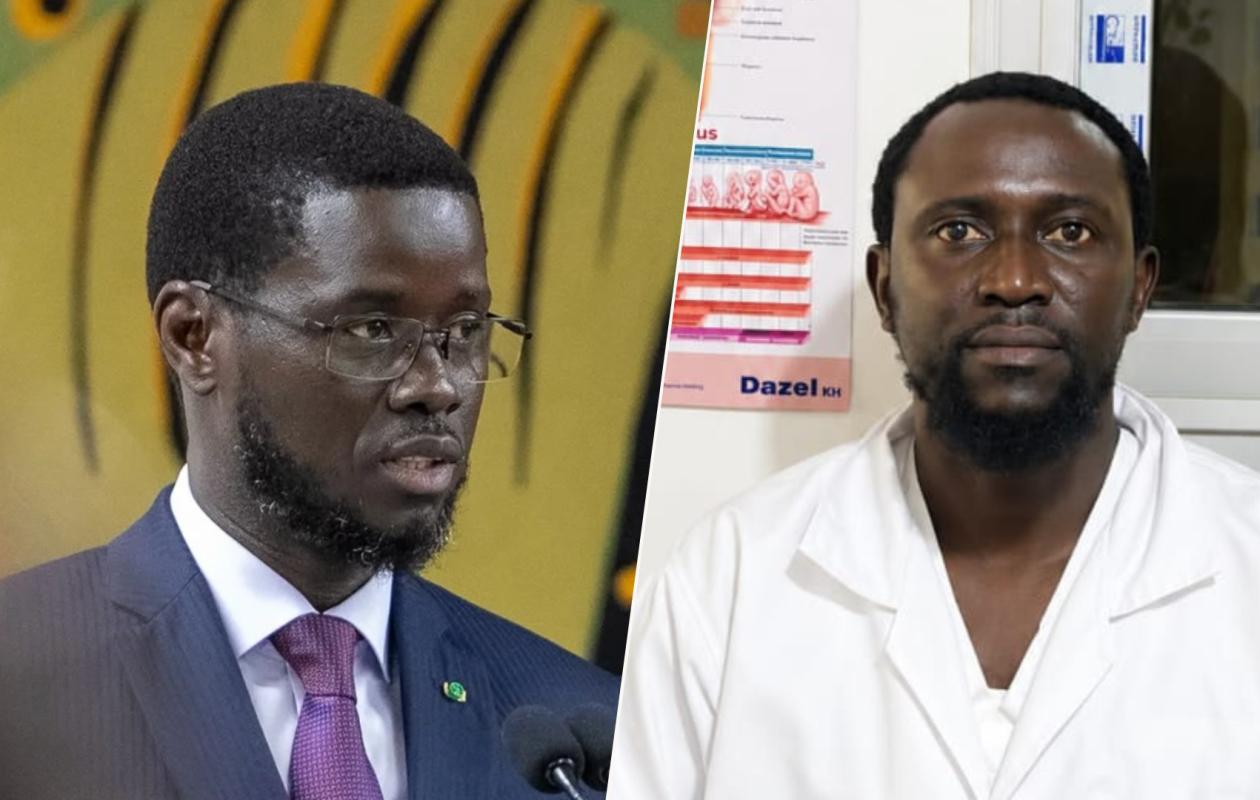
« La Vision sanitaire du Président Bassirou Diomaye Faye...» (Par Dr Doudou Sagna)
“Every Senegalese man or woman, regardless of their place of residence, ethnic or religious affiliation, or financial means, must have access to quality care when they need it.” These words, spoken during an inter-ministerial council on health, demonstrate President Diomaye’s strong commitment to ensuring that universal access to healthcare for all Senegalese finally becomes a reality.
This commitment is reflected in the national transformation agenda ANT-2050, which is the compass guiding our directions and choices in public policies, and which aims to build a more accessible, more equitable, more sovereign and more resilient health system.
Challenges to overcome
It is clear that the health system in Senegal faces several challenges, such as the high cost of care, the geographical inaccessibility of health facilities, a lack of coverage of the territory with quality human resources, the obsolescence of hospital equipment and materials, or the need to raise the level of medical personnel, etc.
It is therefore imperative to reform the Senegalese healthcare system to make it more efficient. These reforms will aim to strengthen the provision of care and guarantee equitable access to modern services, both in urban and rural areas, so that no one is left behind.
Indeed, 500 billion FCFA has been invested in major healthcare projects over the past two years. Furthermore, an investment of over 2 trillion FCFA is planned between 2025 and 2029 to transform the sector.
The human resources challenge
The government is counting on local human resources and those of the diaspora to optimize the national ratio of healthcare providers. The ambition is also to create the necessary conditions to encourage expatriate healthcare workers to return home to strengthen the work already being done in healthcare facilities.
Indeed, in Senegal, the population is estimated at 18,126,390 inhabitants in 2023. It is composed primarily of young people (75% of the population is under 35 years old). The national average ratio is 1 doctor for every 11,111 inhabitants, while WHO standards recommend 23 doctors for every 10,000 inhabitants.
Furthermore, the public sector health staff is mostly made up of contract workers, with a high concentration on the Dakar-Thiès-Mbour-Diourbel axis.
Quality infrastructure
The Government's main objective is to accelerate the modernization process of hospitals by equipping them with high-quality technical facilities to meet and guarantee the health security of the population.
The goal is to provide practitioners with state-of-the-art equipment that will allow them to effectively manage both common and complex pathologies and reduce medical evacuations abroad.
Construction sites and completed projects
It is within this framework that the construction of high-level health infrastructure takes place, such as the Burn Treatment Center at the Main Hospital of Dakar (15 billion FCFA) for the management of complex cases.
Also, the State has injected more than 50 billion FCFA into the construction of the Diamniadio National Oncology Centre (CNOD) for better care of cancer patients.
The rehabilitation of the Aristide Le Dantec Hospital at a cost of 92.5 billion FCFA, of the Seydi El Hadji Malick Sy Hospital in Tivaouane for 46 billion FCFA and the laying of the foundation stone of the Touba Jalibatoul International Hospital are part of this dynamic.
Territorialization and proximity of care
In public health, each locality has specific health needs and challenges. Addressing these needs begins with the construction of health facilities that offer appropriate services.
The start of construction on the Kolda Mother-Child Centre (for 2.19 billion FCFA) will strengthen specialized care for the health of mothers, newborns and children in the southern zone of Senegal.
It will also be a matter of strengthening equity in the provision of specialist care, by making specialists in the fields of gynecology, cardiology and surgery available in areas of high need.
Furthermore, 20 health centers have been opened. Plans are in place to open 35 new health centers by 2027 and to recruit 2,500 staff. Fifteen operating theaters have already opened in the last two years to bring specialized obstetric care closer to the population, and 12 more are currently being renovated. A total of 27 operating theaters will be operational by the end of 2026.
A preventive health policy
Alongside the upgrading of the technical platform, emphasis is placed on prevention at all levels of the health pyramid (health posts, health centers, hospitals), with intersectoral collaboration of national policies including hygiene, sanitation, transport and diet.
The CSU (Universal Health Coverage) will also be supported to raise the health coverage rate to 75% by 2027.
Increased budgetary resources
The health sector will receive more support by drawing on both the public and private sectors, while increasing funding for the sector.
Moreover, for the year 2026, the budget of the Ministry of Health and Public Hygiene has increased to 274.2 billion FCFA in commitment authorizations and 217.2 billion FCFA in payment credits.
The State plans a substantial increase in the budget by 2029. The "Quality Healthcare Provision" program represents 191.97 billion FCFA, including significant investments.
Pharmaceutical sovereignty
The pharmaceutical industrialization project will also be carried out carefully, both for medicines and for vaccine production, with the support of development partners and the local private sector.
The Diamniadio vaccine center is intended to enable Senegal to produce vaccines locally and supply them to all of West Africa, with a target production of 300 million doses per year in the long term.
In conclusion, the Diomaye Health Plan aims to build an equitable, supportive, sovereign and prosperous health system, which will allow every citizen to benefit from quality care in a timely manner.
Dr. Doudou Sagna
founding member of Kiiraay,
rapporteur of the Health and Social Action Committee)


















Commentaires (6)
Sur le plan humain, étaler sans honte un ratio catastrophique d'un médecin pour plus de 11 000 habitants et ne proposer en réponse que le recrutement dérisoire de 2 500 agents d'ici 2027 est une insulte au quotidien des Sénégalais. Compter sur le mirage du « retour au bercail » de la diaspora médicale tout en maintenant les praticiens locaux dans la précarité sous des contrats sous-payés démontre une méconnaissance totale des réalités du terrain. En privilégiant le fétichisme des infrastructures et l'affichage de blocs opératoires vides de spécialistes, Kiiraay ne protège personne : le parti sert uniquement de bouclier politique pour dissimuler l'incompétence de l'État. Promettre 75 % de couverture santé universelle sans réformer le financement de la santé relève du pur mensonge électoral. Derrière le jargon technocratique du Dr Sagna, la triste vérité demeure : le système sanitaire est à terre, et le pouvoir préfère faire du théâtre sur le dos de la santé des Sénégalais.
Le texte mélange soigneusement réalisations, chantiers, intentions et projections pour fabriquer un bilan qui paraît colossal sur le papier. Mais en santé, on ne soigne pas les populations avec des milliards annoncés dans un communiqué : on les soigne avec des médecins disponibles, des médicaments accessibles, des blocs qui fonctionnent et des établissements réellement opérationnels.
Bref, moins de chiffres brandis comme des trophées, moins de promesses à échéance lointaine, et davantage de preuves vérifiables. La communication peut impressionner ; elle ne remplace jamais un bilan. Sénégal sa kanam
Participer à la Discussion
Règles de la communauté
💡 Astuce : Utilisez des emojis depuis votre téléphone ou le module emoji ci-dessous. Cliquez sur GIF pour ajouter un GIF animé. Collez un lien X/Twitter, TikTok ou Instagram pour l'afficher automatiquement.
Se connecter
Commentez avec votre profil, votre photo, et soyez averti des réponses.