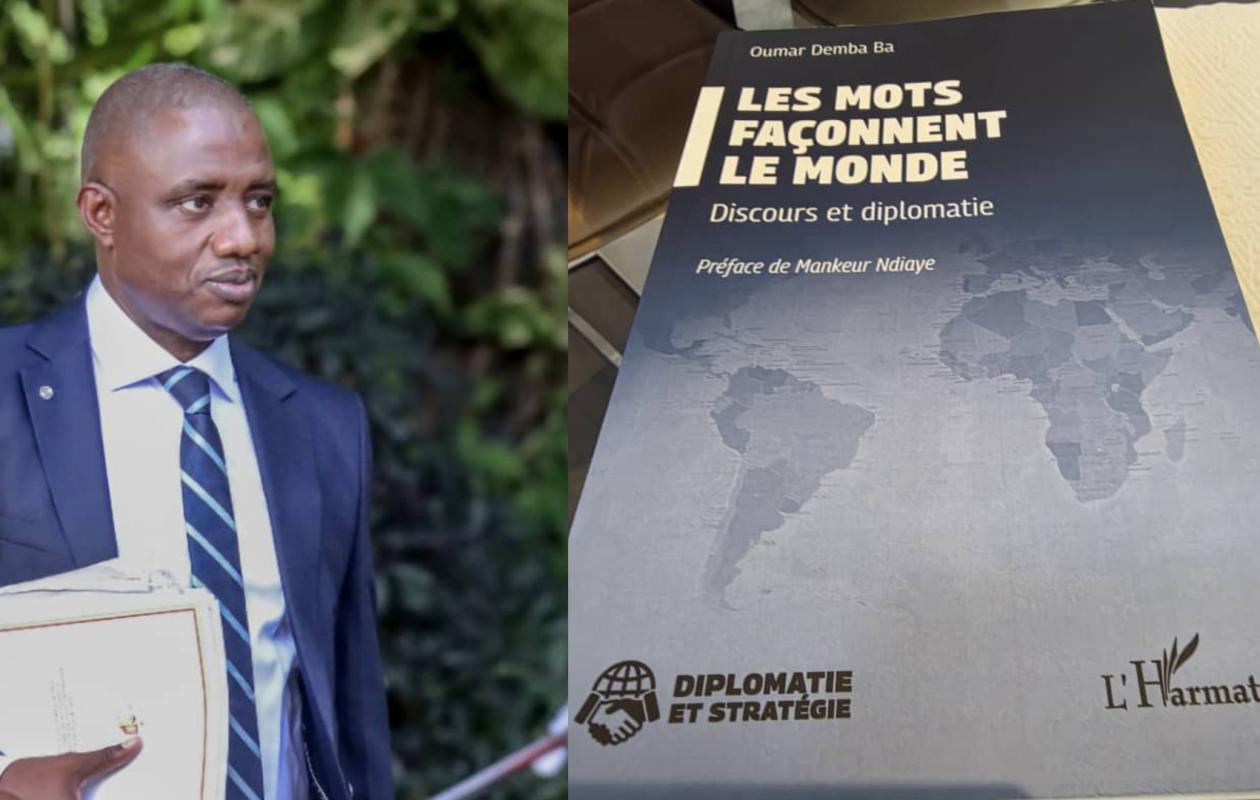
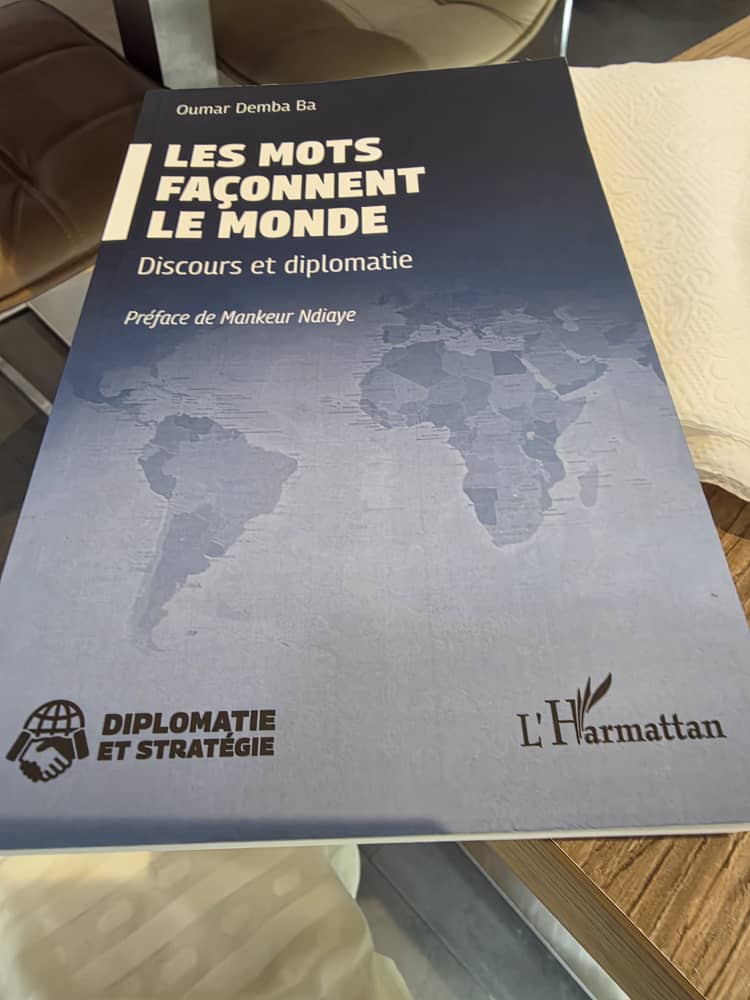
Notes de lecture du livre de Oumar Demba Ba, Les mots façonnent le monde : Discours et Diplomatie (par Yoro Dia)
Words, speech, and an image
In a previous work, Ambassador Oumar Demba Ba studied the spoken word, specifically that of Baaba Maal, whose "sung message" he analyzed. In his new book, he moves from spoken words to the words that shape the world through discourse. "The transition from oral to written language is a leap of civilization," says Jack Goody, whom the author quotes. He is convinced that beyond these transitions, there is a certain civilizational continuity between orality and writing. He rightly reminds us that in the beginning was the Word, as the Abrahamic religions teach us, and that the cradle of humanity is also the cradle of writing.
As with Baaba Maal's lyrics, the words reveal the author's deep convictions, one of the most important being his faith in the continuity of Senegal's diplomatic history, from Senghor to Diomaye Faye. Because "diplomatic investments and gains transcend generations and regimes. Yesterday's seeds yield today's harvest, and today's produce tomorrow's harvest. Experience shows that we must avoid trying to wipe the slate clean at all costs. Foreign policy falls within the realm of relationships and therefore, par excellence, of arithmetic, of addition, not subtraction. We must add, not replace." "President Faye is reaping today the seeds of Senghor, who laid the foundations of our foreign policy based on the policy of good neighborliness, African integration, relations with historical partners and above all multilateralism which the author praises, and which Macky Sall wants to put back at the center of international relations with the UN, "a center where the efforts of nations are harmonized towards common ends."
Beyond being a textbook for students of diplomacy, international relations, general studies, and geopolitics, this book also traces the history of our great diplomacy: with Senghor, who initiated the creation of the post of President of the African Union; with Wade, who introduced gender parity to the Commission of the Union; with Diouf and his crusade against Apartheid; and then with Macky Sall and his rejection of "civilizational injunctions," which is simply a continuation of Senghor's rejection of civilizational domination (speech to the UN General Assembly in 1961). Beyond diplomatic continuity, each President has his own style, which the author elucidates by drawing on different forms of discourse, but also on the saga of words, to show, for example, the difference between the militant approach of the lawyer Wade and the more understated but pragmatic one of the engineer Macky Sall.
The Ambassador also recounts the grand adventure of words. A saga that spans time and space, from Pharaonic Egypt to Timbuktu, passing through ancient Greece and up to the diplomacy of the Tweet, with one constant: “Words to say, words to do, words of substance, words sculpted, printed, and finally dematerialized. The saga of words is a fascinating human story.” Power lies in words, because whoever controls words, consequently, controls the masses and minds.
The author illustrates this with the great speeches that have changed the course of history, such as Churchill's in 1940, which, by promising only blood and tears, changed the course of the war; De Gaulle and his appeal of June 18, which succeeded in fueling the "flame of resistance not by arms, but by words"; not forgetting Martin Luther King's "dream", Kennedy's " Ich bin ein Berliner ", or Obama's " Yes We Can ", which the author reminds us is the recycling of a trade union slogan.
The behind-the-scenes stories and anecdotes surrounding these historic speeches make for a pleasant read, especially when the book tackles such serious issues as UN reform, China's second revolution, the Belt and Road Initiative and the potential Thucydides Trap, the energy transition, the law of the strongest in international relations, and selective international justice with the ICC. On these major topics, the Ambassador guides us through the intricacies of diplomacy, where words can be used to "do and say the ugliest things in the most elegant way." Everything hinges on words and nuance, as when diplomats speak of "common but differentiated responsibilities" regarding the climate crisis. Words, which "can open or close a door," as the African proverb says, can be made to say anything.
The book opens many doors, particularly to the words that have shaped the grand history of Pan-Africanism, so different from that of the coup regimes that use it as an ideological veneer to mask the treachery of their coups. The words that have shaped the history of Pan-Africanism, and which the author quotes in the book, are those of Garvey: "Africa for Africans, those at home as well as those abroad"; those of Césaire in his Discourse on Colonialism ; and also Cheikh Anta Diop's Nations nègres et culture , "the most audacious book a Black man has ever dared to write," according to Césaire. These discourses are among those that defy time and achieve immortality.
Diplomatic practice also defies time, as we have moved from the classic exchange of letters to the diplomacy of the Tweet. From Talleyrand or Metternich to Trump. The diplomacy of the Tweet has many weaknesses, but one strength: it is intrinsically linked to image, which, sometimes, is worth more than a thousand words.
I had the privilege of attending the G7 summit in Elmau, Germany, in June 2022 with Ambassador Oumar Demba Ba. While I was admiring the Bavarian Alps, he sent me a photo and a message: a picture of President Macky Sall in shirtsleeves with Joe Biden, chatting like old friends; and a message asking for patience while the sherpas finalized the communiqué. For a communications professional like myself, the text was almost irrelevant, as the image spoke volumes. This now-iconic image, in addition to the spoken word, demonstrates that His Excellency has many strings to his bow. A future in literature seems assured, for literature and diplomacy are like neighboring mountains connected by a bridge of words.
Dr. Yoro Dia
Political scientist
Former Minister
Spokesperson for the Presidency









Commentaires (4)
car affaire de culture de pragmatisme et d elegance
Rv demain a la ceremonie de dedicace incha Allah merci Boubacar
Participer à la Discussion
Règles de la communauté
💡 Astuce : Utilisez des emojis depuis votre téléphone ou le module emoji ci-dessous. Cliquez sur GIF pour ajouter un GIF animé. Collez un lien X/Twitter, TikTok ou Instagram pour l'afficher automatiquement.
Se connecter
Commentez avec votre profil, votre photo, et soyez averti des réponses.