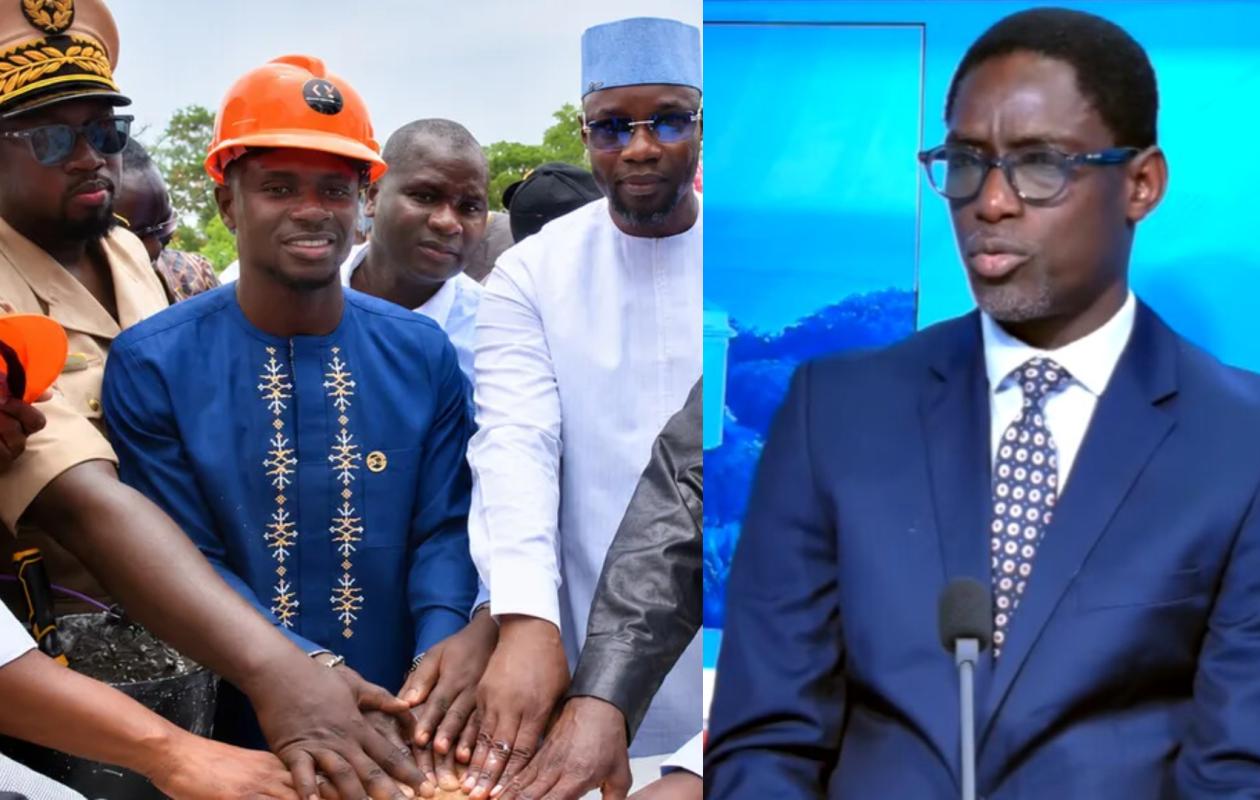
QUAND SADIO MANÉ CONFIRME L'AGRO-ÉCONOMIE DU SPORT (Par Professeur Thierno Thioune, Agrégé des facultés d'économie)
On Saturday, September 19, 2026, Sadio Mané laid the foundation stone for SM10 Agro in Bambali, his native village in Casamance. This 11.7 billion CFA franc agro-industrial park is dedicated to mango processing. Four and a half months earlier, in a three-part study published on Seneweb, we proposed precisely this: that the 2025 African champions, and Sadio Mané in particular, redirect a portion of their capital towards agricultural concessions in Casamance rather than residential plots on the Petite Côte. The coincidence, if it is indeed one, deserves to be examined with the rigor it demands.
On May 4, 2026, at the request of Seneweb, we published a three-part economic analysis on the rationalization of bonuses paid to the Lions of Senegal, crowned African champions in January 2026 in Morocco. The third part of this study bore a title that, reread today, takes on a particular resonance: how Sadio Mané, Kalidou Koulibaly, Iliman Ndiaye, and their teammates could have collectively created nearly 2,500 jobs by redirecting a portion of their bonuses toward agriculture rather than residential real estate.
The argument was based on a simple observation: Senegal imports 70% of its rice, nearly 800,000 tons per year, resulting in an agricultural trade deficit of 220 billion CFA francs projected for 2025. At the same time, 3.8 million hectares of arable land, representing 60% of the national agricultural potential, remained uncultivated or underutilized. To address this paradox, we proposed two concrete models: firstly, agricultural concessions of 10 to 20 hectares per champion farmer, some in the Senegal River Valley and others in Casamance, each naturally oriented towards their region of origin; secondly, a 5% stake in "Champions' Agropoles," designed as fully integrated agro-industrial enterprises, one for each agro-ecological zone of the country.
For Sadio Mané specifically, whose region of origin is Casamance, we were talking about a largely untapped agricultural potential despite the return of stability, with an estimated income model of between 8 and 15 million CFA francs annually after the ramp-up phase, and a knock-on effect likely to generate several hundred rural jobs in an area where youth unemployment reaches 42%.
What Sadio Mané presented in Dakar on September 18th, and then officially announced the following day in Bambali, mirrors, point by point, the structure we had outlined. The table below illustrates its true meaning.
| What our study on Seneweb proposed (May 2026) | What SM10 Agro achieves (September 2026) |
| Reorientation of capital for champions towards Casamance, Sadio Mané's region of origin | Established in Bambali, Sadio Mané's birthplace, Sédhiou region |
| Model of an "Agropole of Champions", an integrated agro-industrial enterprise | Integrated agro-industrial park, with processing units, training center and R&D hub |
| The transition from raw production to processing is the only way to create sustainable added value. | Mango processing plants, including mango butter, with a capacity of 8,500 tonnes/year |
| Rural job creation estimated at several hundred per champion involved | More than 1,000 direct jobs announced, on a 500-hectare plantation |
| State support through taxation and administrative facilitation | APIX tax and customs exemptions for five years on certain equipment |
| Professional training for operators and skills transfer | Training center dedicated to young people and women, integrated into the complex |
It's not a detail that coincides. It's the whole architecture. The relocation from a seaside region to a region of origin with strong, under-exploited agricultural potential; the choice of transformation rather than simple land exploitation; the integration of a training component; the use of tax incentives rather than just subsidies: each of these choices was clearly stated in the analysis we provided to Seneweb four and a half months before the Bambali ceremony.
Whether Sadio Mané read this study, whether it was reported to him by those close to him, or whether he arrived, through his own reflection, at conclusions converging with those of an economist, the question, in a sense, matters less than the result. What counts, for the discipline I represent, is that the central thesis of our study—namely, that a sports champion can transform temporary symbolic and financial capital into lasting productive capital—has just received its first empirical confirmation, and in the most compelling way: through facts, not theoretical debate.
It would, however, be dishonest, and contrary to the very spirit of our economic approach, to stop at this congratulation. As journalist Charles Faye rightly pointed out in an article published on the occasion of the same ceremony, laying a foundation stone is not an economic victory. "The transformation of the stock is a factory that operates for ten years, decades after its inauguration. That is what constitutes an economic victory," he wrote, before adding that the project will now depend "on the quality of the infrastructure, the availability and cost of electricity, logistics, roads," and the State's ability to avoid discouraging those who take the risk of investing.
This warning aligns perfectly with the risk mitigation framework we detailed in our May study: insurance coverage against climate risks, guaranteed purchase contracts to secure markets during the critical start-up years, and a clause ensuring continued productive use of the land to prevent any speculative development. SM10 Agro is now entering the phase where these mechanisms cease to be working hypotheses and become essential conditions for the project's survival. The announcement of September 19th is a starting point, not an end in itself. The true indicator of success will be found neither in the launch press release nor in the images of the ceremony, but in the factory's ability to operate, pay its employees, and export, both in 2030 and 2036.
Bambali's gesture should now be seen as a signal, not an isolated outcome. Our May study proposed a replicable model for an entire generation of champions, with the potential to create 2,500 jobs if all the African champion Lions committed to this path. Sadio Mané has just demonstrated, individually and using his own funds, that the model is viable. It is now up to Kalidou Koulibaly, Iliman Ndiaye, and the other champions of the 2025-2026 generation to look towards their own regions of origin, particularly the Senegal River Valley for those who hail from there, with the same logic: transformation rather than exploitation, training rather than passive income, and local roots rather than residential speculation.
It is also up to the State to transform this convergence into an assumed public policy, through the instruments that we detailed in the "Shared Excellence Pact": a generalized incentive tax framework for any champion reinvesting their bonus in the productive economy, systematic support by SAED and ANCAR for the technical structuring of these projects, and institutional communication that establishes Bambali as a textbook case rather than a media exception.
Senegalese sporting excellence has just demonstrated, with SM10 Agro, that it can translate into economic excellence. Sadio Mané played football with his feet. Now he plays with his capital, in Bambali, on land he knows better than anyone. This time, the match will be played over ten years. And only then, when the Casamance mango leaves the factory processed and ready for market, will we be able to say with certainty that theory has met reality.
Professor Thierno Thioune
Associate Professor of Economics
READ OR RE-READ (the title of Part 3 of the study): Lions' Bonuses, Economic Study [3/3]: How Sadio Mané, Kalidou Koulibaly, Iliman Ndiaye and Co. could have created 2,500 jobs


















Commentaires (7)
Je crois que les plus brillants ne sont pas toujours ceux qu’on voit ou entend
Participer à la Discussion
Règles de la communauté
💡 Astuce : Utilisez des emojis depuis votre téléphone ou le module emoji ci-dessous. Cliquez sur GIF pour ajouter un GIF animé. Collez un lien X/Twitter, TikTok ou Instagram pour l'afficher automatiquement.
Se connecter
Commentez avec votre profil, votre photo, et soyez averti des réponses.