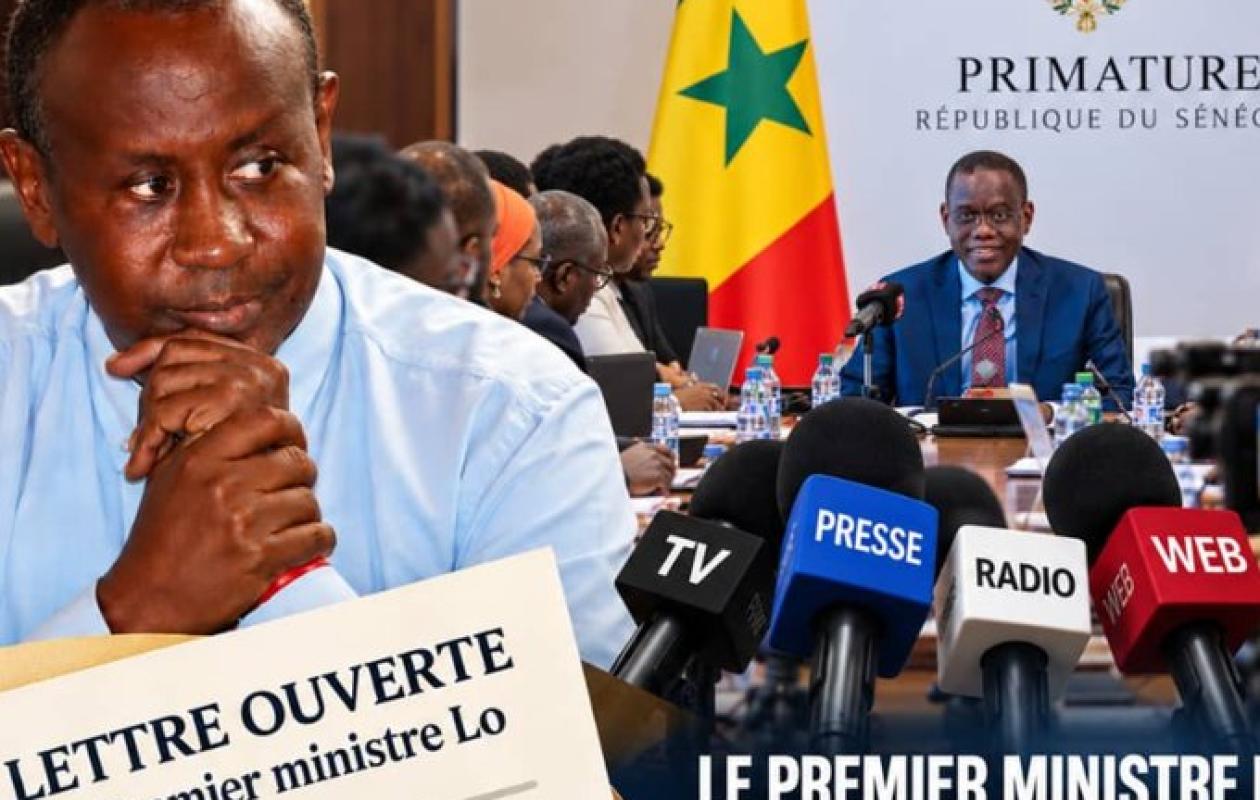
Rencontre avec les médias : Monsieur le Premier ministre, ces enfants qui n'ont pas pu aller à l'école attendent aussi quelque chose de vous (Par Adama SOW)
Media interview: Mr. Prime Minister, these children who have not been able to go to school also expect something from you
Open letter to the Prime Minister
By Adama SOW, journalist, communicator and citizen
Mr. Prime Minister,
This Friday, October 16th, you will receive representatives from Senegalese press professional organizations. They will come to discuss the media crisis, their economic difficulties, their debts, taxation, the Press Support Fund, advertising agreements, and the future of a sector currently on the verge of collapse. They are right to do so. These issues are crucial.
But allow me, Mr. Prime Minister, to ask you, before the technical discussions begin, before the presentations of employers' organizations, before the figures and proposals for exiting the crisis, to think about those who will not be around your table.
Think of those children who, this year, watched their classmates return to school without being able to accompany them. Not because they were sick. Not because they had failed. Not because their parents didn't believe in education.
But simply because their fathers and mothers, journalists, technicians, cameramen, editors, presenters, secretaries, drivers or administrative agents in press companies, no longer had the means to pay for their schooling, supplies, uniforms or transport.
These are parents who work, yet they do. Parents who get up every morning to fulfill their professional duties. Parents who continue, sometimes for several months, to serve their companies without receiving their salary.
What a terrible injustice it is for a working man to be unable to feed his family! What deeper pain for a father or mother than to have to explain to their child that they cannot go to school because their wages haven't arrived!
Mr. Prime Minister,
I would like you to imagine this scene for a moment. One morning, the first day of school, in a house in the suburbs of Dakar or in a town in the interior of the country, a child wakes up earlier than usual. He has packed his old schoolbag. He hopes to see his friends, his teacher, his classroom. He asks his father if everything is ready.
The father looks away. He promises it will be next week. Maybe Monday. Maybe when the salary arrives. But the salary doesn't arrive.
The days go by. The other children progress with their lessons. His stays at home. And each morning becomes a new wound.
This scene, which I mention here to give a face to very real suffering, sums up better than any financial analysis the human drama unfolding today in a segment of the Senegalese private press. Because it's no longer just a matter of struggling businesses.
These are families collapsing in silence. These are wounded dignity. These are childhoods being made to pay for a crisis for which they bear no responsibility. There are journalists who spent twenty or thirty years reporting on the suffering of others and who, today, no longer dare to tell their own.
Men and women who have covered floods, social crises, election campaigns, disasters, epidemics, and the tragedies of our fellow citizens. They have given a voice to the voiceless, denounced injustices, and accompanied the great moments of our democratic life.
Today, some of them no longer know how to pay their rent. Others postpone medical consultations, forgo buying medication, or go into debt to provide meals for their families.
Some have exhausted their savings. Others have exhausted their credit with relatives. And many have finally exhausted even their ability to ask for help. For poverty is painful. But the poverty of someone who works, who has a trade, experience, and qualifications, and who no longer receives the wages for their labor carries a particular humiliation.
This precarious situation doesn't just destroy purchasing power. It attacks self-esteem. It weakens couples, disrupts families, and creates an anxiety in homes that children inevitably end up feeling.
Mr. Prime Minister,
Last June, in an open letter addressed to the Minister of Communication, Bacary Sarr, I already warned of the dramatic deterioration of our media landscape. I mentioned the struggling companies, unpaid salaries, layoffs, the gradual disappearance of valuable skills, and this growing divide between the State and a segment of the private press.
Four months later, the question is no longer simply how to save the press companies. It has become much more urgent, much more human:
How much longer will we ask workers to live without a salary? How many more families will have to fall into destitution before this crisis is recognized for what it truly is: a social emergency? We cannot become accustomed to this situation.
We cannot consider it normal for a journalist to present the 8 o'clock news after spending the day struggling to find food for their children. We cannot accept that a technician ensures a broadcast while their family waits at home for money that may never come.
We cannot resign ourselves to seeing experienced professionals leave their profession, not because they have lost their passion for journalism, but because they can no longer afford to continue practicing it. And we certainly cannot accept that children are deprived of education because their parents, despite being employed, are deprived of their wages.
A society can go through economic difficulties. But it should never become accustomed to the suffering of those who work.
Mr. Prime Minister,
I know that the state is not meant to pay the salaries of private companies. I also know that not all the difficulties facing the press are attributable to the government. Our sector has long-standing structural weaknesses, outdated business models, management deficiencies, and sometimes employer practices that deserve to be questioned with the utmost firmness.
Employers have responsibilities. They must fulfill them. The press must reform, professionalize, modernize its operations, strengthen its transparency, and respect its social and fiscal obligations. No one should demand impunity in the name of press freedom.
But there is a fundamental difference between demanding that a sector be brought into compliance and letting it collapse before claiming to rebuild it.
You can't turn a company around by abandoning its workers. You can't reform an industry by letting its expertise wither away. And you can't strengthen a democracy by permanently weakening those whose job it is to inform citizens.
The State has a particular responsibility in preserving an economic, legal, and institutional environment that allows a free, pluralistic, and responsible press to exist. This responsibility is not a favor granted to media owners. It is a matter of the public interest.
Because when newsrooms close, jobs disappear, but so do spaces for debate, dissent, and civic vigilance. When a journalist is reduced to the constant anxiety of their financial survival, their professional independence becomes harder to preserve.
And when a country allows its media fabric to deteriorate, it opens up more space for rumors, manipulation, propaganda, and disinformation.
Mr. Prime Minister,
Your meeting this Friday must not be just another meeting. It must mark a turning point. Listening to grievances, reiterating regulatory requirements, or announcing the continuation of consultations will not be enough. Decisions are needed. Urgent decisions for workers. Courageous decisions for businesses. Structural decisions for the future of Senegalese journalism.
We must examine mechanisms for clearing public debts actually owed to media companies, easing tax and social security burdens within a transparent framework, making support mechanisms more effective, and fostering the economic and digital transformation of the media. But above all, the situation of employees must become an immediate priority.
Why not consider, with employers' organizations, trade unions and relevant administrations, an exceptional and strictly regulated system for dealing with salary arrears, based on a verified diagnosis and binding commitments from employers?
Why not make worker protection, wage regulation and job preservation central conditions of any public support?
Why not start, right now, specific work on the families most severely affected, especially those whose children have seen their schooling compromised?
Because there is an urgent need for action. The school year cannot wait for the end of negotiations. Hunger cannot wait for the conclusions of a commission. Rents cannot wait for budgetary decisions. And the dignity of workers cannot be relegated to an administrative timetable.
Mr. Prime Minister,
I would like to end this letter with a thought which I hope will accompany our meeting.
In a few years, children who were unable to return to school this year will not remember the amounts of the Press Support Fund, the tax provisions debated, or the disagreements between public authorities and professional organizations.
They might remember something else. Their father's silence on the morning of the first day of school.
Their mother's teary eyes as she looked at a list of school supplies she couldn't afford. And that promise, repeated week after week: "You'll be back at school soon."
They will remember this first experience of injustice when they understand that they stayed at home not because their parents refused to work, but precisely because their work was no longer paid.
And it would be terrible if these children grew up feeling that their country watched their suffering without doing anything. I am not writing to ask the press for a favor.
I am writing to remind you that beyond political differences, professional disputes and economic difficulties, there is a higher requirement: that of not letting women, men and their children sink into indifference.
The Senegalese press needs reforms. It needs a cleanup. It needs a new economic model. But first and foremost, its workers need to get their salaries back, their dignity restored, and the ability to look their children in the eye without having to ask them, yet again, to wait.
Mr. Prime Minister,
On Friday, when you sit across from the media representatives, remember that there will be, symbolically, other people around that table. Journalists who haven't been paid.
Mothers who no longer know how to manage their households. Fathers who hide their distress behind silence. And children who are still waiting to return to school.
They will not speak. But perhaps it is their silence that you should hear the most.
Because ultimately, Mr. Prime Minister, the real urgency is not just to save the Senegalese press. It is also to save from distress those who keep it alive.
And to ensure that no child is deprived of their future because their father or mother has chosen the profession of informing.
With my respectful greetings.
Adama SOW
Journalist, communicator and citizen














Commentaires (7)
"Il faut examiner les mécanismes permettant d'apurer...ont vu leur scolarité compromise ?"
je veux bien espérer et croire du peu que je sais du premier ministre qu'il vous écouteras. nous l'espérons tous.
Permettez moi grand frère de vous dire que le mal est beaucoup plus profond. il ya un mot redondant dans votre texte, c.est le mot responsabilité. c' est de notre responsabilité a tous et a toutes de fire en sorte que la rentrée scolaire ne soit un drame national. L'article 22 de notre constitution stipule que'État a le devoir et la charge de l'éducation et de la formation de la jeunesse par le biais des écoles publiques Tous les enfants, garçons et filles, sur l'ensemble du territoire national, ont le droit d'accéder à l'école. malheureusement tout semble croire que l' accès est monnayé aujourd'hui. Combien d' organisations et des ong se mobilisent pour pourvoir des kits scolaires. Combien de canadiens, de français, italiens, espagnols , américains contribuent dans les écoles sénégalaises. la vérité est que l'école sénégalaise n'était pas ce qu'elle est devenue.
I am not blaming anybody. les enfants du tailleur du coin, comme les enfants du marchand ambulant, du maçon, du cultivateur sont laissés en arrière.
Professeur , votre indignation sera aussi l'indignation de tout sénégalais de bon sens. Vous avez vécu aux etats unis, où l'indignation avait soulevé en 2002 the no child left behind act signé par George Bush.. il ne s'agit pas simplement comme le stipule la constitution que tous les enfants, garçons et filles d'accéder a l 'école, ils faut un accès égal à toutes les chances que l'on soit fils de riche ou de pauvre. C'est cela la responsabilité de l'Etat . Et l'Etat c'est nous
Participer à la Discussion
Règles de la communauté
💡 Astuce : Utilisez des emojis depuis votre téléphone ou le module emoji ci-dessous. Cliquez sur GIF pour ajouter un GIF animé. Collez un lien X/Twitter, TikTok ou Instagram pour l'afficher automatiquement.
Se connecter
Commentez avec votre profil, votre photo, et soyez averti des réponses.