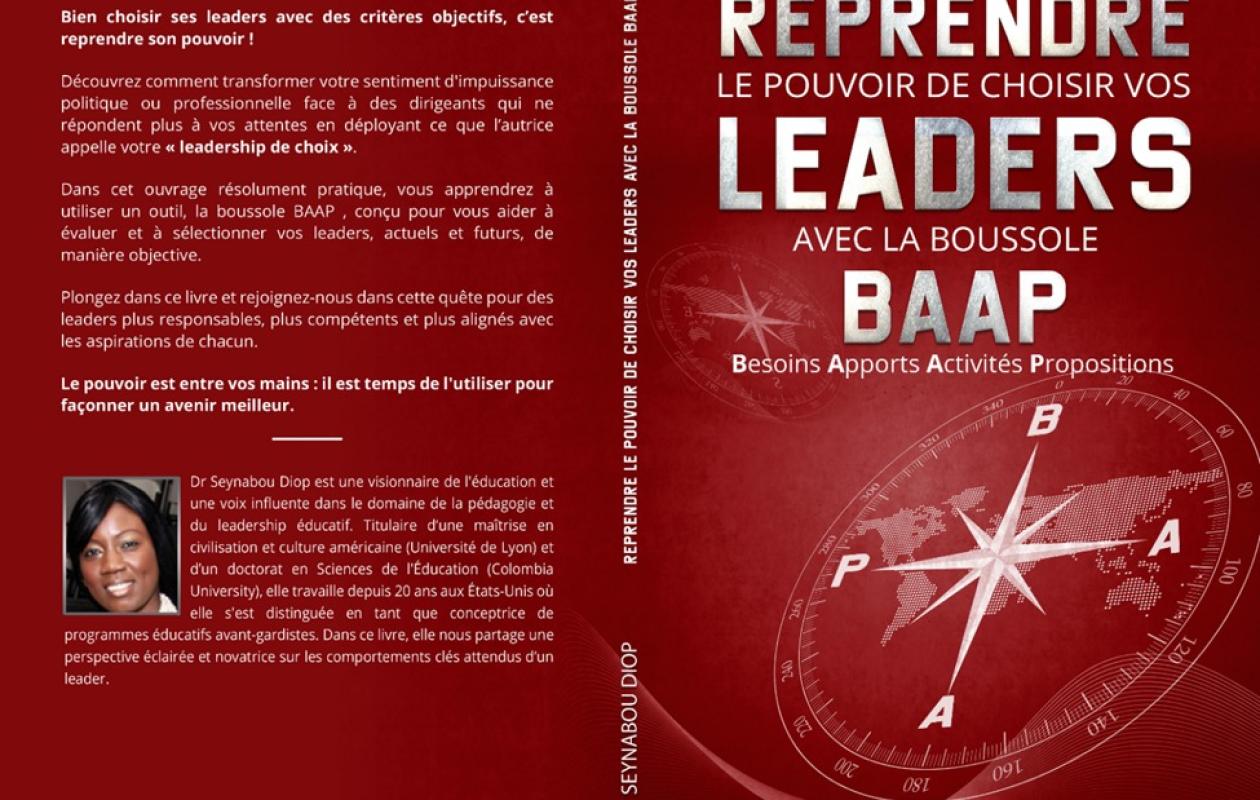
Reprendre le pouvoir de choisir vos leaders grâce à la boussole BAAP (Par Dr. Seynabou Diop, livre publié en 2024, inspiré et dédié au leadership de Ousmane Sonko)
Retrospective Analysis: Leadership Tested by Power --- Power passes, but true leadership remains
At the time of this book's publication in 2024, immense hope swept through the Senegalese people. Many citizens saw in the struggle led by the PASTEF leader the embodiment of leadership founded on courage, sovereignty, justice, and loyalty to a collective project.
Prevented from running for president himself following events widely considered deeply unjust, Ousmane Sonko then designated Bassirou Diomaye Faye to represent his project to the people. This choice, overwhelmingly endorsed by the Senegalese, appeared to be the natural continuation of the same vision, the same commitment, and the same struggle.
The initial text of this work accompanied this surge of hope and this collective awakening around the question of leadership. With hindsight, we can now draw broader conclusions.
Time sometimes reveals an essential truth: power can be passed on, but authentic leadership is not automatically transmitted.
It remains intimately linked to fidelity to the principles that gave birth to it: loyalty, justice, respect for one's word, consistency between commitments and actions.
With the events that followed, a significant portion of the population now expresses profound disillusionment with the perceived gap between the ideals that had inspired their support and certain realities observed in the exercise of power. Many nevertheless continue to recognize in the man who led the original struggle a steadfast commitment to the founding vision, while believing that the project, as it is currently being carried out, has gradually strayed from its initial spirit. This experience serves as the starting point for a broader reflection on the nature of leadership.
The diversity of leadership forms
Leadership can take many forms. It can be direct, when a people chooses a leader based on their vision, qualities, and the trust they inspire. It can also be indirect or by proxy, when a people chooses someone recommended by a leader they already trust. In this case, the trust placed in the representative is partly based on the trust of the leader who appointed them.
This phenomenon is natural and extends far beyond the political sphere. It can be found in businesses, organizations, associations, religious communities, and many human relationships. The trust placed in a leader can lead to trusting the person they recommend.
This diversity leads to a fundamental distinction between the power of the leader and the power of leadership.
These two dimensions can be found in the same person, but they are not synonymous. A leader's power lies in their ability to be chosen, to choose in turn, or to influence the choices of others. Through their moral authority, credibility, and the trust they inspire, a leader can guide a people, an organization, or a community to elevate another person to a position of responsibility.
The power of leadership, however, is of a different nature. It lies not only in the ability to influence a choice, but above all in the ability to sustainably embody a vision, values, and principles. It manifests itself through consistency between words and actions, through fidelity to commitments, and through the ability to maintain the trust of those who follow the leader.
A single person can embody both of these forms of power. This is precisely where the strength of Ousmane Sonko's leadership lies: on the one hand, his ability to influence the choice of a people because of the trust he inspires; on the other hand, his capacity to sustainably embody a vision, values, and a collective project, despite the disappointments linked to the chosen leader and the realities observed during Diomaye Faye's time in power. However, these two forms of power are not of the same nature.
A leader's power can be used to benefit another person. Through their influence and the trust they inspire, a leader can help another person attain a position of responsibility.
The power of leadership, however, cannot be automatically transferred, even if one wishes it were. It does not result from an appointment, a position, or a transfer of authority. It can only exist through the personal conviction of the one who wields power, through their profound adherence to a vision, values, and principles that they freely choose to embody in their decisions and actions.
This distinction can be compared to learning to fish. The power of a leader is like providing a fishing tool: it allows a person to access a skill, a responsibility, or a position. The power of leadership is like learning to fish: it resides not only in the tool received, but also in the understanding, conviction, and mastery necessary to continue producing the desired result.
The Senegalese experience illustrates this distinction. By nominating Bassirou Diomaye Faye, Ousmane Sonko exercised his leadership power by influencing the people's choice. He thus contributed to enabling another person to accede to the highest office.
But the power of his leadership could not be automatically transferred. Even if, through a strategic and generous approach, Ousmane Sonko had wished to transmit the spirit of the project and make Bassirou Diomaye Faye a leader carrying this vision, this second power could only arise from the personal conviction of Diomaye Faye, who exercises it, and from his ability to remain faithful to the values, principles and vision that had founded the trust of the Senegalese.
A leader can transmit their confidence, their vision, and their hopes to a person, but they cannot transmit the inner strength that allows that person to embody leadership.
Thus, a leader's power can contribute to the selection of a leader; however, leadership power cannot be transmitted or decreed. It is up to the individual who wields it to demonstrate it through their ability to remain faithful to a vision, values, and principles.
The BAAP Compass: A tool for ongoing leadership assessment
It is precisely this observation that reinforces the relevance of this work today: Reclaiming the power to choose your leaders with the BAAP compass (Needs, Contributions, Activities, Proposals), a methodological tool for the permanent evaluation of leadership.
This collective experience serves as a reminder that a people must not only learn to choose its leaders through voting; it must also learn to exercise ongoing discernment. The choice of a leader is never a finished act: it continues through the ongoing observation of their leadership. Let us hope that the Senegalese people will fully exercise this power of discernment in 2029!
The trust placed in someone is not a blank check. It requires ongoing evaluation of leadership in light of the leader's needs, contributions, activities, and proposals . This civic vigilance is what guarantees authentic leadership.
The BAAP compass is not merely a tool to guide the selection of a leader. It provides an ongoing framework enabling citizens to observe, evaluate, and reassess leadership throughout a term. It serves as a reminder that a leader remains a true leader only as long as they stay true to the values that earned the people's trust.
By Seynabou Diop, book available from Harmattan Senegal and Amazon.com . For any information, please contact the author at: [email protected].



















Commentaires (4)
On apprend maintenant que le gars était à pleines boules dans le fonds Casamance (ANRAC), plus même qu'il ne l'a été dans Adji Sarr. Genre financièrement en rut. Il a dévoré ce fonds avec une gloutonnerie affligeante.
Quand est ce qu'on juge ce malfrat ?
Acceptez que vous vous êtes trompés et rasez les murs.
Votre gourou Sonko est bon pour un être syndicaliste, pas autre chose.
Même Adama Barro a plus le niveau que lui et c'est vrai.
Il est populaire mais rien dans le crâne.
La débauche, la perversion, l'avidité et la convoitise n'en parlons pas. Elles font légion au sein de PASTEF, un parti d'imposteurs avec une base populaire très inculte.
Participer à la Discussion
Règles de la communauté
💡 Astuce : Utilisez des emojis depuis votre téléphone ou le module emoji ci-dessous. Cliquez sur GIF pour ajouter un GIF animé. Collez un lien X/Twitter, TikTok ou Instagram pour l'afficher automatiquement.
Se connecter
Commentez avec votre profil, votre photo, et soyez averti des réponses.