
Sortir de l'ombre gaullienne : pour une audition-validation parlementaire des nominations stratégiques [Par Ousmane Sané Balama]
By Ousmane Sané Balama, Lawyer-Farmer, Djibélor
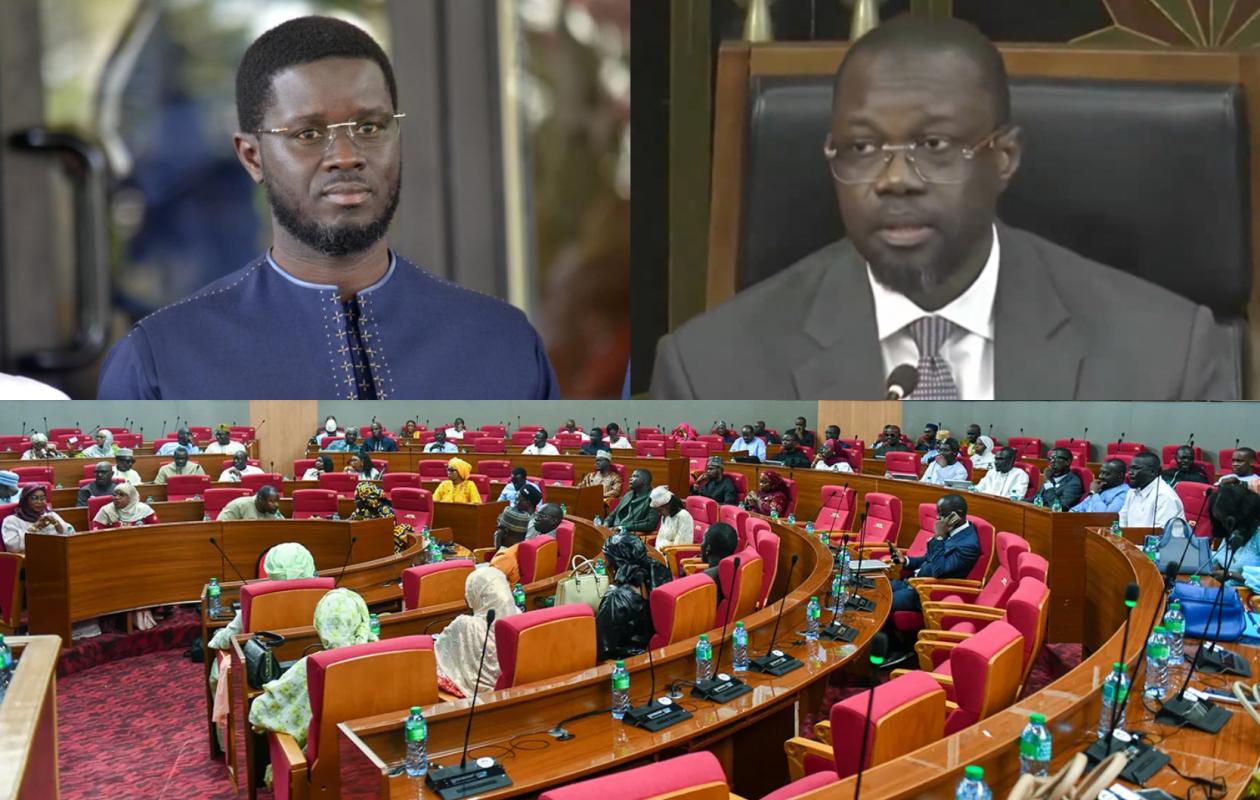
Three institutions, three prerogatives, one shared constitutional foundation—and yet, an impression of crisis. Members of Parliament exercised their right to initiate legislation; the Government referred the matter to the Constitutional Council, as the Charter allows; the Council ruled, as is required of all. Nothing in this sequence was irregular. Yet, its reception was experienced as a confrontation.
It is this paradox that I began to examine in an analysis of Constitutional Council Decision No. 6/C/2026 of July 9, 2026, published on July 13 in Seneweb and Seneplus1. This article is a logical extension of that analysis: while the emotion this institutional sequence has aroused is real, it is not legal—it is cultural. It stems from a legacy that Senegal shares with almost all Francophone sub-Saharan African states: that of a 1958 Constitution conceived in France to free the power of appointment from any prior parliamentary oversight, and which has been maintained in our country almost unchanged since independence. Drawing on my field experience as a parliamentary project manager in Africa and the Caribbean, and my familiarity with the procedures of the US Congress, I would like to submit for debate a process that has remained largely absent from our constitutional framework: the parliamentary hearing and validation of strategic appointments.
The hypothesis is not unfounded. The Senegalese Constitution of January 22, 2001, proclaims, in its first article, a "democratic, secular, and social" Republic, and its Title VII organizes the relationship between the executive and legislative branches, granting the National Assembly a role in overseeing government action, which constitutes one of the cardinal functions of the
Parliament is a requirement in any democratic regime. Certainly, Article 44 grants the President of the Republic the power to appoint to civil and military positions, and Article 57 confers a portion of this power upon the Prime Minister—but these provisions establish a power; they do not inherently preclude it from being subject to limitations. It is within this gap that the present study is situated: no
to transfer the power of appointment from the executive to the legislative branch, but also to establish, as many established democracies practice, a prior evaluation based on the competence, independence, and integrity of the prospective candidates. The argument is structured in four parts: a comparative overview of parliamentary oversight of appointments (I), from the American individual veto to simple consultation; the observation of a distinctly Francophone peculiarity (II), devoid of any constitutionalism
of Francophone Black Africa; the hypothesis that Senegal, an institutional pioneer on several occasions since 2001, could be so once again in this area (III); finally, the call for applications, a complement or alternative to the hearing-validation process? (IV)
1. Constitutional Council Decision No. 6/C/2026: a terse clarification that raises questions for legal scholars
The use of parliamentary confirmation for strategic appointments is a widespread constitutional or legislative practice in the most advanced democracies.
I. Comparative overview of parliamentary control regimes for appointments.
A comparative examination of constitutional and regulatory texts reveals not a single model, but a range of parliamentary control, from individual and legally decisive ratification to simple informational consultation.
In the United States of America , Article II, Section 2, of the 1787 Constitution requires Senate confirmation for nominations to the posts of ambassadors, Supreme Court justices, and other high-ranking federal officials. The procedure of public hearings before the appropriate Senate committee, codified by constitutional practice, constitutes an essential democratic filter guaranteeing the independence and competence of those holding these positions.
functions.
Appointments Clause 2 of Article II, Section 2, of the Constitution of 1787 makes the Senate a co-decision body: the President appoints , but the entry into office of ambassadors, Supreme Court justices and principal federal officers is subject to the "Advice and Consent" 3 of the Senate.
Each application is examined individually; a rejection, or
Even a refusal to put the matter to a vote legally and definitively prevents the appointment from taking office. This represents the highest level of parliamentary oversight of appointments, which could be considered the model of an individual and binding veto.
In the Republic of South Africa , Article 193 of the 1996 Constitution establishes a procedure for Chapter 9 institutions (Public Protector, Auditor-General, Human Rights Commission, Gender Equality Commission, Electoral Commission) whereby the President appoints, upon the recommendation of the National Assembly , which decides by a qualified majority (60%) or a simple majority depending on the position, after hearings by a pluralist ad hoc committee. This model, however, cannot be equated with appointment.
The judges of the Constitutional Court are appointed under a separate mechanism, Article 174, which is entrusted to the Judicial Service Commission—a technical, non-parliamentary body. The President appoints them after simply consulting the Chief Justice and party leaders, without a formal parliamentary vote. South Africa thus has two coexisting appointment systems of different natures: one parliamentary and based on a vote, the other technical and consultative. This is the model of the framed parliamentary recommendation.
In the European Union, it's the model of strong but not political control
formally binding. Indeed, the mechanism provided for in Annex VII of the Rules of Procedure of the European Parliament4 deserves to be presented with the nuance it requires, as it is often understood as a carbon copy of the American model, which is not the case. Three points to clarify
are essential:
* The individual confirmation hearing (Article 4) gives rise to a "letter
evaluation” of the competent committee (Article 5), but this letter does not have

of no textual basis that would make it legally binding : none
The provision only stipulates that a negative opinion invalidates the application ipso swears.
candidate by the Member State or for a change of portfolio. The evaluation letter
It thus possesses a quasi-binding political force, without being a legal veto.
formal.
This distinction is important: it shows that a public hearing mechanism can produce powerful political effects - withdrawal of candidacies, reshuffling of portfolios - without relying on a legally decisive parliamentary veto specific to each nomination.
On the African continent, Ghana has been planning, since its 1992 Constitution, a
The parliamentary approval process for certain presidential appointments, including ministerial and senior civil servant appointments. Kenya , under its 2010 Constitution, has established a similar mechanism for many institutional posts, placed under the supervision of the Parliamentary Service Commission.
.
Indeed, Ghana (Article 78 of the 1992 Constitution) makes the appointment of ministers subject to "prior approval by Parliament7.
"Kenya (Article 152 of the 2010 Constitution) requires that the appointment of Cabinet Secretaries receive the approval of the National Assembly, the vetting procedure being organized by a Committee on Appointments established by ordinary law (Public Appointments (Parliamentary Approval)
Act, 2011) - and not by the Parliamentary Service Commission, a separate body responsible for the internal administration of Parliament. These two English-language models combine hearings and approval votes, but remain essentially limited to members of the government.
This could be considered the model for prior ministerial approval.
II. A unique feature of constitutionalism in Francophone Black African states
No constitution currently in force in Francophone sub-Saharan Africa – Senegal, Ivory Coast, Cameroon, Gabon, Congo-Brazzaville, Chad, Mali, Burkina Faso, Guinea, Togo, Central African Republic – establishes a mechanism comparable to the model of “public hearing + prior and individualized vote of confirmation or rejection”8
Appointments to strategic positions – central bank governors, heads of supreme courts, attorneys general, heads of regulatory authorities – fall under the sole prerogative of the president.
in the Council of Ministers, or after consultation with non-parliamentary technical bodies (Council
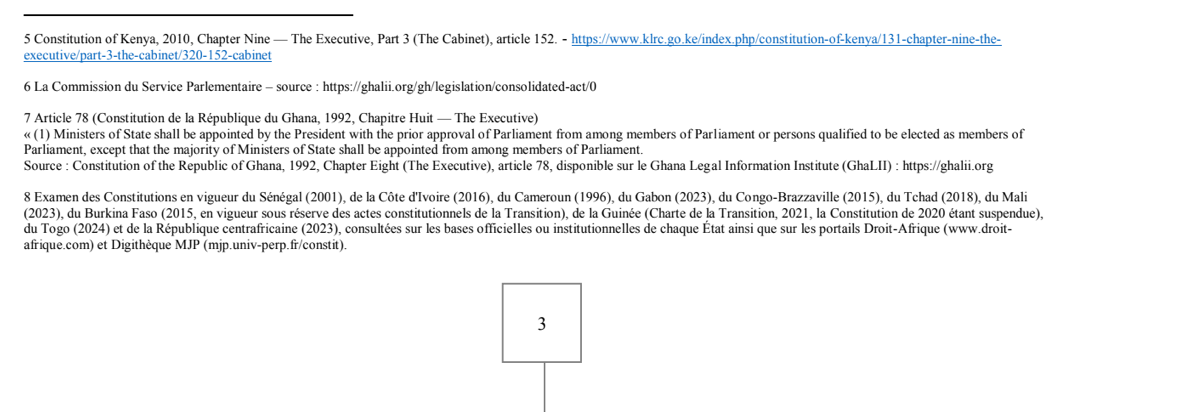
superior of the judiciary, superior Council of Defense), without intervention from Parliament as a deliberative and voting chamber on the person of the candidate. Two exceptions should be noted, without calling into question the observation:
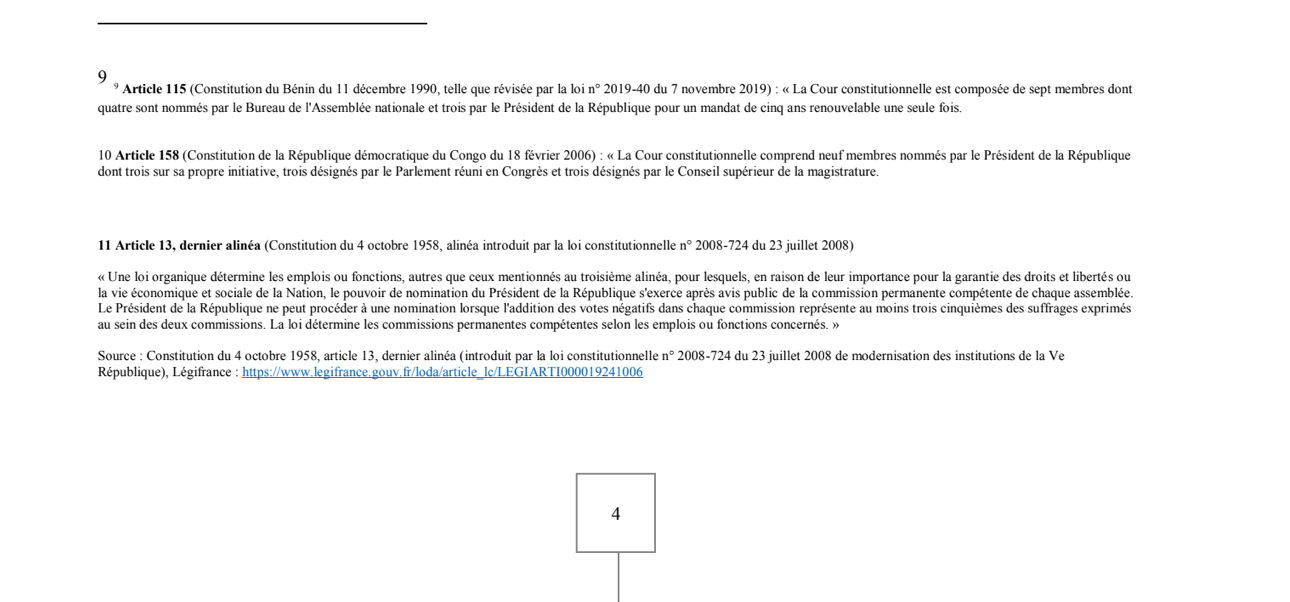
Benin (article 115 of the 1990 Constitution, revised 2019)9 and the DRC (article 158 of the 2006 Constitution)10 entrust to Parliament, or Congress, an autonomous and concurrent power of appointment of a fraction of the members of their Constitutional Court - a mechanism legally distinct from the hearing-validation, since the power of proposal and the power of decision are not separated between two bodies: Parliament appoints directly, it does not confirm a presidential choice.
Since the 2008 constitutional revision, France has included in Article 13, paragraph 5, a qualified veto mechanism: for a list of approximately fifty-five strategic positions, the presidential appointment is blocked if the combined negative votes of the standing committees of both houses of Parliament reach three-fifths of the votes cast. This is the logical inverse of the American model: a right to block, not a right to approve. To date, no equivalent has been transposed into the constitutions of French-speaking sub-Saharan Africa.
This absence is not accidental: it stems directly from a colonial legacy
identifiable in the text of the Constitutions themselves.
A side-by-side comparison of the Senegalese Constitution of January 22, 2001, and the French Constitution of October 4, 1958, reveals an almost verbatim lineage: Article 42 of the Senegalese Constitution ("guardian of the Constitution [...] guarantor of the regular functioning of the institutions") reproduces the structure of Article 5 of the French Constitution; Article 44 ("appoints to civil offices") echoes Article 13 of the French Constitution; and Article 49 (appointment of the Prime Minister and ministers by the President alone) echoes Article 8. This framework—that of the strongly Gaullist executive of 1958, conceived
Specifically designed to free the power of appointment from any prior parliamentary oversight after the instability of the Fourth Republic, this principle was transposed almost identically into nearly all the constitutions of Francophone sub-Saharan Africa at the time of independence, and then reiterated during the waves of democratization in the 1990s without the issue of control being addressed.
parliamentary oversight of appointments should never be reintroduced. The Anglophone constitutions of the region, on the other hand, are rooted in a parliamentary tradition of British origin where the accountability of the executive to the legislature – including on appointments – is a structuring principle inherited from Westminster. The divergence between Ghana and Kenya, of a
On the one hand, and the Francophone group, on the other hand, is therefore not the result of a deliberate choice by post-independence African constituent assemblies, but the continuation of two competing colonial matrices of government, one presidential and vertical, the other parliamentary and control.
III. Senegal, a potential pioneer
If Senegal were to adopt a parliamentary hearing-validation mechanism for strategic appointments, it would not be an alignment with an emerging regional practice - since no precedent of this nature exists in Francophone Black Africa - but a genuine innovation, deliberately borrowing from Anglophone and Western models while distinguishing itself from them: more demanding than the qualified French veto of 2008, since it would institute a positive approval and not a simple right of blocking; more developed than the Beninese and Congolese mechanisms, since it would focus on the validation of a presidential choice and not on a competing power of appointment.
This break with the inherited 1958 framework would find particularly fertile ground in Senegal. Since the introduction of multiparty politics in 1974 and the peaceful transfers of power in 2000, 2012, and 2024, the country has distinguished itself through an atypical democratic trajectory in the sub-region, supported by a strong constitutional jurisprudence12 and a pluralistic parliamentary system. Senegal, which in 2001 was one of the first Francophone states on the continent to establish judicial review by way of exception, possesses the institutional precedence and democratic legitimacy necessary to become, on the issue of strategic appointments, a pioneer in Francophone sub-Saharan Africa rather than an imitator—completing, more than half a century after independence, the emancipation of the Senegalese constitutional text from the model of a strong executive, of which it remains one of the most faithful heirs today.
IV. The call for applications: a complement to or an alternative to the audition-validation process?
The question deserves to be posed with the same comparative rigor: the parliamentary validation hearing, as it has just been presented, only concerns the downstream end of the process—it confirms or rejects a choice already made by the executive. It says nothing about the upstream end, that is, how the candidate was identified. Yet, the public demand, as expressed in Senegal for several electoral cycles, focuses less on ex post facto control than on the transparency of the recruitment itself: hence the idea, recurring in public debate and sometimes included in campaign promises, of an open call for applications for strategic positions. This mechanism is not simply a variation of the validation hearing, but a system of a different nature, acting upstream on the formation of the pool of candidates rather than downstream on the validation of a single choice.
Comparative law offers partial illustrations: in South Africa, the recruitment of the holders of the institutions of Chapter 9 proceeds from a public call for applications followed by a pre-selection by a pluralist ad hoc commission, before the hearing and vote of the National Assembly provided for by article 193 - the two logics are therefore cumulative, not substitutable.
In Kenya, the Public Appointments (Parliamentary Approval) Act of 2011 governs the vetting of already appointed candidates, but the Public Service Commission organizes recruitment through separate calls for applications for other categories of positions.

parliamentary approval. Comparative experience thus suggests that the two logics do not
They are not mutually exclusive: the call for applications broadens and objectifies the pool of candidates ex ante, while the audition-
Validation checks the integrity and competence of the final ex post choice. Combining them would present
A clear democratic advantage – the transparency of recruitment reinforcing the legitimacy of the confirmation – but it would raise a constitutional difficulty specific to Senegal: Article 44 grants the President the power of appointment, not the power to select from a predetermined list; a binding call for applications, if it were to legally restrict the presidential choice to a pool predetermined by a jury or an independent commission, would be less a matter of regulating the exercise of the power of appointment than of a
This shift in the President's responsibilities crosses the line, drawn earlier, between supervision and transfer of authority. A middle ground, compatible with Article 44, would be to make the call for applications an indicative rather than exclusive procedure: the President would remain free to appoint from outside the list, but the parliamentary hearing could then examine, among the validation criteria, the conformity of the presidential choice to the transparency procedure initiated—thus penalizing the circumvention rather than the choice itself.




















Commentaires (8)
Participer à la Discussion
Règles de la communauté
💡 Astuce : Utilisez des emojis depuis votre téléphone ou le module emoji ci-dessous. Cliquez sur GIF pour ajouter un GIF animé. Collez un lien X/Twitter, TikTok ou Instagram pour l'afficher automatiquement.
Se connecter
Commentez avec votre profil, votre photo, et soyez averti des réponses.