
Entretien : "Elle se lève", l'ouvrage de Mariame Condé qui propulse la femme en première ligne
Guinean novelist Mariame Condé is considered a powerful African female voice, championing education and women's place in society. Gifted with exceptional writing talent, she captivates audiences with her sharp pen, becoming one of Guinea's leading writers on the international stage. Deeply connected to her Mandinka and Fulani roots, Mariame Condé embodies a true cultural and feminine identity. Her latest work, "Elle se lève" (She Rises), perfectly illustrates this. In an interview with Seneweb from France, the Guinean novelist discussed her beginnings, her book, and her desire to write for the cause of women.
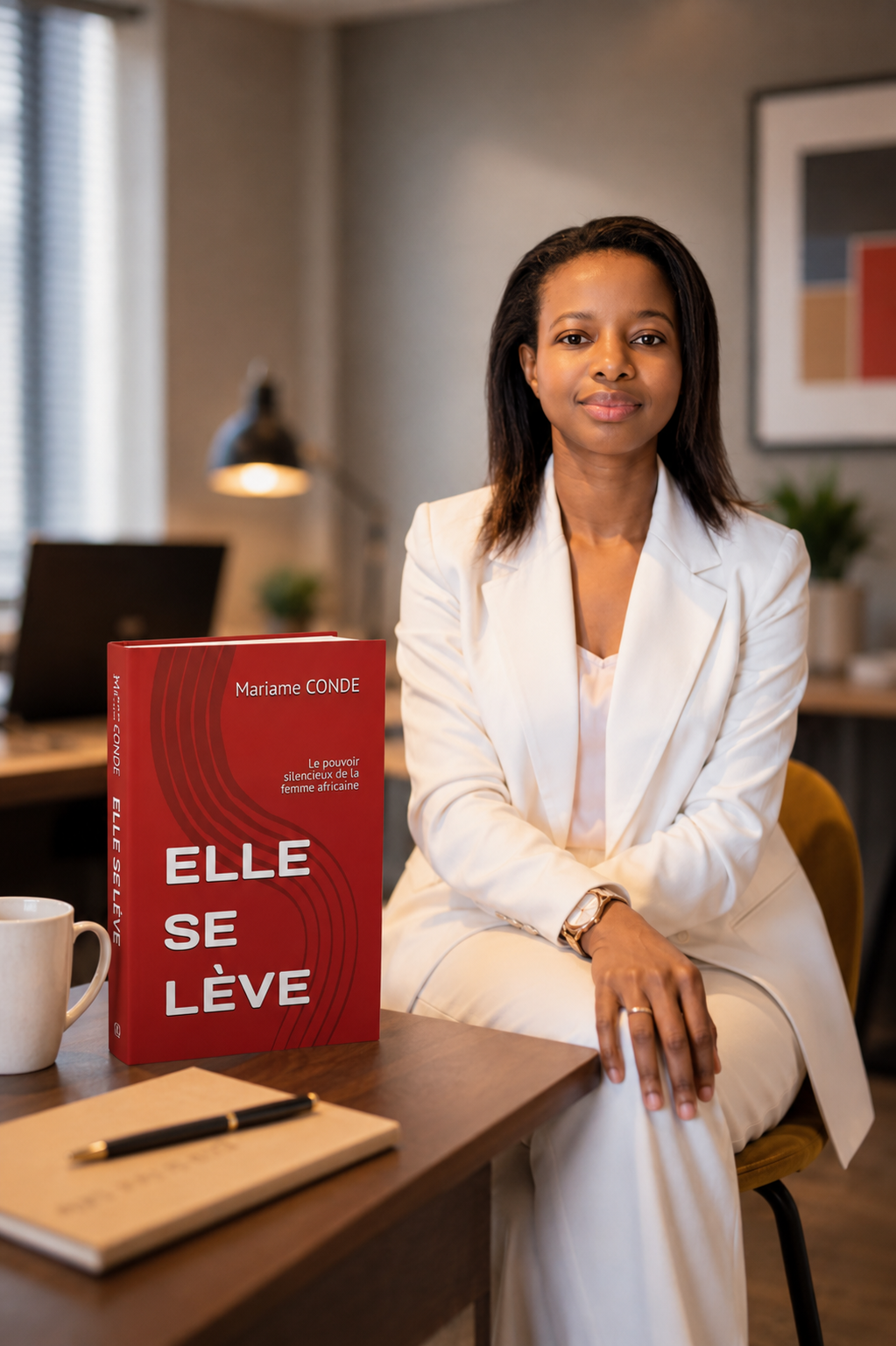
You are a Guinean novelist and essayist. Who is Mariame Condé?
Mariame Condé is a Guinean woman deeply committed to issues of identity, heritage, and empowerment. I come from two Guinean cultures: the Mandinka culture on one side and the Fulani culture on the other, two profoundly rich cultures in terms of human experience, but where many women learn very early on to put others before themselves. I came to France to pursue my studies in law, then I shifted my career towards human resources with an MBA in strategic HR management. For over ten years, I have worked daily on human issues in the workplace: well-being, individual roles, working relationships, and leadership. This perspective on people in the professional world directly informs my writing. "She Rises" is its first public expression. I firmly believe that words have the power to transform and that understanding a person's wounds also means understanding why they act the way they do, at work and in life.
How long have you been writing?
I've always loved writing. Even from a very young age, I enjoyed putting words to my emotions, my questions, and my worldview. But writing to be read came later. Over time, particularly through my work, I've come to understand that behind many professional behaviors lie profound human stories. Because you can't talk about performance or leadership without talking about people. Writing has therefore become for me a tool for communication, impact, and transformation.
Is writing a passion for you, or a means of self-expression?
It's both. It's a passion because I deeply love the power of words. But it's also a way to communicate and open up important conversations. I write to provoke thought, to raise awareness, and sometimes even to help people put words to their inner experiences. Today, human issues are central to businesses: mental health, human leadership, self-esteem, emotional burden, work-life balance… And I believe that literature, coaching, training, and public speaking can contribute to progress on these topics.
What influenced you to want to write today?
The accumulation. Several years of fieldwork as an HR expert, conducting interviews, providing support, and performing human assessments, and in parallel, observing my own community, the Guinean and African women I've worked with in Guinea and France. At a certain point, a sense of urgency takes hold: you can no longer keep what you've learned to yourself. What triggered the writing of this book, precisely, was the repeated observation that African women are often conspicuously absent from personal development discourse; the existing tools don't reflect them, don't speak to their realities, don't name their specific wounds. I wanted to fill this void, drawing on my dual experience: that of the African woman I am, and that of the HR professional who understands the mechanisms of identity formation.
What themes resonate with you?
Everything that touches on the human experience in its depths: identity, self-confidence, the place we occupy or don't dare to occupy. I am particularly sensitive to questions of silent power: how certain individuals, certain communities, carry enormous burdens without it being acknowledged or even named. In my HR work, we talk a lot about performance, skills, and leadership, but rarely about how personal history, childhood wounds, and cultural norms profoundly shape professional behavior. This link between the personal and the collective, between the individual and the professional, is at the heart of everything I write and everything I do.
Let's also talk about current events with your book "Elle se lève" (She Rises).
"She Rises" is a personal development book written specifically for African and Guinean women. It begins with a simple yet powerful observation: our women are extraordinary; they support families, neighborhoods, and entire economies, but they often do so at the cost of themselves, their mental health, and their own dreams. The book explores concrete themes: rebuilding identity, the relationship between tradition and individual freedom, self-confidence, and the wounds passed down through generations. Each chapter opens with a fictional woman's story, deeply rooted in our realities, and offers practical exercises so that the reader doesn't remain a spectator but becomes an active participant in her own transformation. I wanted a book that reflects our women: warm, direct, culturally grounded, but one that doesn't shy away from difficult truths.
What motivates "She gets up"?
Because of what I call "the great silence of African women." In our cultures, a strong woman is one who doesn't complain, who perseveres, who manages. This norm, beautiful on the surface, is also a form of invisible violence because it deprives millions of women of the right to express their pain, to name their needs, to set boundaries. As an HR professional, I have a deep conviction: you cannot effectively support someone without understanding what they are carrying. This book is an invitation for Guinean and African women to finally give themselves permission to look at themselves, to listen to themselves, and to decide that their lives belong to them. It is not a discourse against our culture; it is a dialogue with it, to preserve its richness while freeing ourselves from what oppresses us.
Do women occupy an important place in your writings?
African women are at the very heart of this first book, and they will remain so in my future projects. This isn't a deliberate choice in the narrow sense of the word; it's a self-evident truth stemming from my experience, my identity, and my expertise. In human resources, we know that organizations that truly value women are more efficient, more resilient, and more innovative. But this empowerment can't be superficial; it must address the root causes, the way women perceive themselves, limit themselves, or, conversely, reveal their potential. It's this fundamental work that interests me, both through writing and through my professional activity.
Today, women occupy a prominent place in the literary world...
This is a tremendous and necessary development, even if there's still a long way to go, especially for African voices. What particularly delights me is seeing the emergence of women who write not to respond to an external gaze, but to tell their own stories, drawing on their own cultural codes, their own languages, their own realities. African women's literature is building a new space for expression, and I believe it has a considerable therapeutic and social role to play, especially on the continent. For my part, I see writing as a natural extension of my work on human capital: well-chosen words change mindsets, unleash energy, and open up possibilities.
Your country of origin, Guinea, is a great cultural hub. Does reading play a prominent role there?
Guinea is indeed a country of extraordinary cultural richness; its oral traditions, ethnic diversity, music, and spirituality constitute an invaluable heritage. But let's be honest: the culture of reading still needs to be developed, particularly due to challenges in accessing education and the vitality of oral tradition, which remains paramount in many communities. This is one of the reasons why I wrote "Elle se lève" (She Rises) the way I did, with stories, characters, and accessible language, because in our culture, we access truths through narratives before we grasp concepts. I have projects specifically focused on Guinea because I believe that this book, like other initiatives related to training and supporting women, can have a real impact on the ground. There is an immense amount of work to be done, and I want to contribute to it.
The final word...
I would like to say to all the women who will read this interview in Guinea, Senegal, France, wherever they may be, that "She Rises" is for them. Not to tell them what to do or how to be. But to remind them of something essential: they exist. They matter. And their dreams deserve as much attention as the dreams of those they serve every day. Thank you to Seneweb and Alioune Badara Mané for this precious platform. And see you very soon.
Interview conducted by Alioune Badara Mané












Commentaires (9)
Participer à la Discussion
Règles de la communauté
💡 Astuce : Utilisez des emojis depuis votre téléphone ou le module emoji ci-dessous. Cliquez sur GIF pour ajouter un GIF animé. Collez un lien X/Twitter, TikTok ou Instagram pour l'afficher automatiquement.
Se connecter
Commentez avec votre profil, votre photo, et soyez averti des réponses.