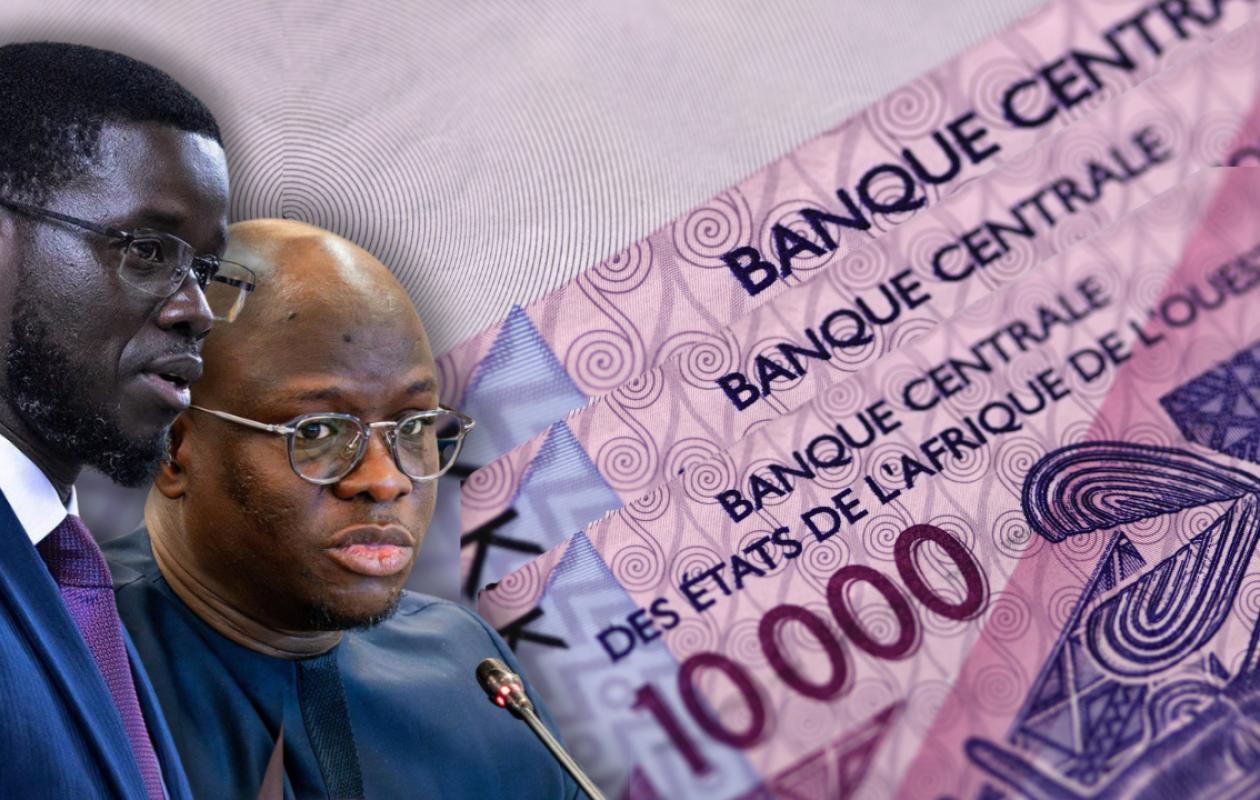
1 735 milliards de déficit, 790 milliards de subventions : l'État face au mur de la réalité économique
Senegal is facing a serious budgetary crisis. Under the combined weight of declining revenues, a soaring energy bill of 790 billion CFA francs, and a slowdown in external aid, the 2026 supplementary budget bill (PLFR) enshrines a historic increase in the public deficit to 7.6% of GDP. Between maintaining major infrastructure projects, streamlining public agencies across the board, and implementing the inevitable reform of subsidies, the state's financial and social credibility is at stake.
Senegal's 2026 budget has been severely impacted by economic realities. Between declining expected revenues, soaring energy prices, and persistent difficulties in securing external financing, constraints are mounting and forcing the government to revise its financial trajectory. The 2026 supplementary budget bill (PLFR) fully reflects these structural pressures. Overall budgetary resources have thus decreased from 6,188.8 billion to 5,848.7 billion CFA francs, while the deficit has widened dramatically to reach 1,735.2 billion CFA francs, or 7.6% of gross domestic product (GDP), compared to the initially projected 5.4%.
Behind these macroeconomic indicators lies a particularly delicate equation: financing national priorities, preserving the purchasing power of the population, and maintaining public investment, all while the executive branch's room for maneuver shrinks dramatically. The government must now constantly arbitrate between social urgency, economic imperatives, and the absolute necessity of restoring public finances.
Energy: The subsidy bill skyrockets to 790.3 billion
This is undoubtedly one of the major sources of tension on the budget balance. Faced with soaring oil prices on international markets, the government has had to increase the overall budget for energy subsidies to 790.3 billion CFA francs for 2026, compared to the 250 billion initially planned. This represents a staggering additional cost of 540.3 billion CFA francs, reflecting a dramatic increase of 216%.
The effort undertaken is considerable and aims to cushion the inflationary shock on households and businesses. According to the technical notes of the Supplementary Finance Bill, without the fuel price adjustment implemented last August, the national fuel bill would have easily exceeded 1 trillion CFA francs. However, this massive support policy directly raises the question of its medium-term sustainability. How long can the government continue to absorb external shocks without jeopardizing the stability of its treasury?
The structural reform of subsidies, already underway, aims to provide a lasting solution to this problem. For 2026, a budget of 70 billion CFA francs is allocated to targeted social transfers. From 2027 onwards, this amount is expected to double to 140 billion CFA francs per year. The plan includes the gradual introduction of a social electricity tariff, the guaranteed subsidy for domestic butane gas in 2.7 kg, 6 kg, and 9 kg containers, as well as targeted mechanisms to protect essential uses. The stated objective is to optimize the allocation of aid to the most vulnerable households, preceding any tariff adjustments with preventative social safety nets.
Public investments: The State refuses a total freeze on construction projects
Despite the drastic reduction in available resources, infrastructure investments are officially maintained as strategic priorities. The Amending Finance Bill (PLFR) allocates 1,590.2 billion CFA francs in payment appropriations to finance critical sectors such as transport, health, education, agriculture, water resources, and sanitation. Major projects covered include the Dakar-Tivaouane-Saint-Louis highway and the reconstruction of healthcare facilities, including the Aristide-Le Dantec, Thiès, and Tivaouane hospitals.
In the area of human capital, a budget of 202.6 billion CFA francs has been set aside to support investment in education and health, directly benefiting school, university, and hospital infrastructure. The primary sector—agriculture, livestock, fishing, and agro-industry—has been allocated 212.4 billion CFA francs in payment appropriations, intended to boost mechanization, increase yields, and strengthen local processing capacity.
The Dakar 2026 Youth Olympic Games (YOG) also benefit from specific funding. The overall financial package, encompassing YOG infrastructure, defense, and security, amounts to 83.4 billion CFA francs. Of this sum, 23 billion are directly allocated to the rehabilitation of the Iba Mar Diop Stadium and the various competition venues, while 14 billion are earmarked for accessibility and urban mobility. These allocations reflect the political will to preserve major projects. However, their actual implementation will remain contingent upon the maturity of the projects, the actual progress of the work, and the effective release of external funding.
Backlogs and public agencies: The major project of rationalization
Another highly sensitive issue is the State's financial liabilities and domestic debt. Of the 500 billion CFA francs allocated in the 2025 supplementary budget law for the gradual settlement of arrears, 488.3 billion have actually been disbursed, showing a record execution rate of 97.5%.
These payments primarily targeted the energy sector, construction and public works companies, and debts owed to external lenders. A fund of 300 billion CFA francs has been renewed for the 2026 fiscal year to complete this restructuring.
In parallel, the government is launching a major overhaul and streamlining of the vast network of semi-public bodies. Nineteen national agencies are slated for outright elimination, seven entities will be merged into three, and ten other structures will have their institutional roles redefined. This restructuring aims to restore administrative orthodoxy and impose strict discipline on public spending. However, the effectiveness of these measures will be judged by the actual savings generated, the robustness of the implementing regulations, and the meticulous adherence to the implementation schedule.
A 7.6% deficit: The test of financial transparency
The central figure of this supplementary budget remains the most staggering: a deficit of 1,735.2 billion CFA francs, representing 7.6% of GDP. This considerable deviation from the initial trajectory illustrates the relentless pressure weighing on the country's macroeconomic stability. To reverse this trend, Senegal will have to redouble its efforts in mobilizing tax and customs revenues, tighten its grip on operating expenses, and impose rigorous monitoring of the implementation of investment projects.
Beyond purely accounting adjustments, the requirement for transparency has now become the central pillar of financial governance. The rigorous provision of budgetary documents, the strengthening of parliamentary oversight, and the regular publication of audited data on project implementation are essential prerequisites for the credibility of the State's signature. Simply displaying billions of CFA francs is no longer enough: commitments must be translated into tangible actions, promised savings must be verifiable, and taxpayer money must produce tangible benefits for the daily lives of the population. The 2026 Amending Finance Bill thus places Senegal in a critical position, compelling it to reconcile the imperative of social solidarity with absolute budgetary rigor to prevent macroeconomic stability from deteriorating.




















Commentaires (1)
Participer à la Discussion
Règles de la communauté
💡 Astuce : Utilisez des emojis depuis votre téléphone ou le module emoji ci-dessous. Cliquez sur GIF pour ajouter un GIF animé. Collez un lien X/Twitter, TikTok ou Instagram pour l'afficher automatiquement.
Se connecter
Commentez avec votre profil, votre photo, et soyez averti des réponses.