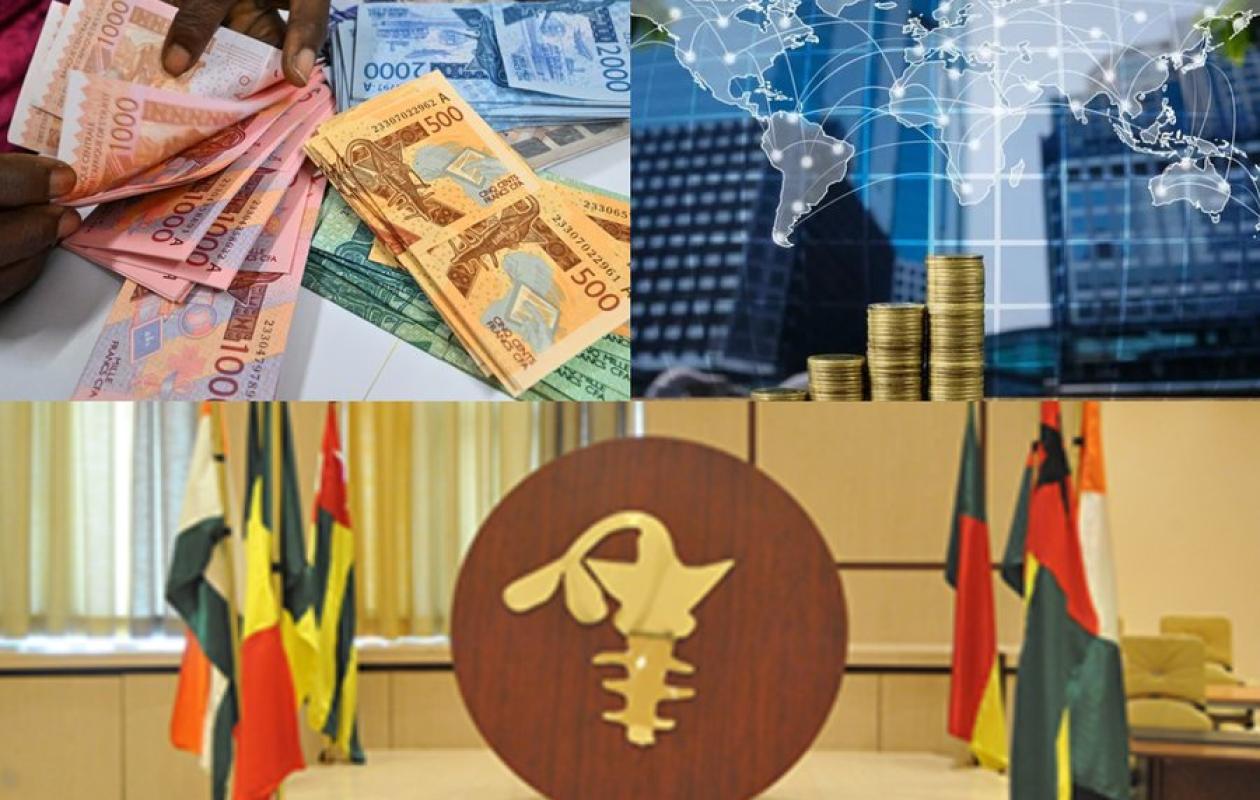
Economie : Comprendre l’architecture de la régulation financière en Afrique de l’Ouest
When a bank opens a new branch, grants credit, collects deposits, or finances a business, it operates within a particularly complex regulatory framework. For the general public, this framework is often associated with the BCEAO (Central Bank of West African States), whose name regularly appears in economic news. However, the decisions governing the banking sector of the Union are not made by a single institution. They result from a governance structure involving several actors with distinct but complementary responsibilities.
This organization stems from the very nature of the WAEMU. The eight member countries share a common currency, the CFA franc, as well as a largely integrated banking market. At the end of 2024, according to BCEAO data, the Union had more than 170 licensed credit institutions and several hundred financial institutions and decentralized financial systems. Banking sector assets amounted to tens of trillions of CFA francs. In such a financial space, it would have been difficult for each country to apply its own rules without risking imbalances or distortions of competition.
The BCEAO naturally occupies an important place in this structure. It prepares a large part of the regulations applicable to banks, monitors developments in the financial system, and ensures the implementation of the common monetary policy. When it changes its key interest rates or refinancing mechanisms, the consequences are directly reflected in the cost of credit throughout the Union.
However, its role extends beyond monetary policy alone. The central bank also develops numerous technical standards relating to payments, risk management, electronic money, and the organization of the regional financial system. This work often serves as the basis for regulatory decisions adopted at the EU level.
However, the BCEAO does not decide on major banking regulations alone. The WAEMU Council of Ministers has decisive power in adopting numerous texts. Composed of the finance ministers of the member states, it is the political body that approves the main regulatory guidelines proposed at the community level.
This division of responsibilities allows states to be involved in decisions concerning their banking systems while maintaining a harmonized framework at the regional level. Banks operating in several EU countries thus benefit from relatively uniform rules, which facilitates cross-border activities.
The Banking Commission of the WAEMU is another important component of this organization. Established in 1990, it is responsible for the prudential supervision of credit institutions. Its role is to verify that banks comply with applicable regulations and have the necessary financial resources to conduct their activities without jeopardizing depositors or the stability of the system.
In practice, the Banking Commission wields considerable power. It can conduct inspections, demand corrective measures, impose disciplinary sanctions, or impose restrictions when an institution exhibits significant weaknesses. Its actions are based on a preventative approach aimed at detecting risks before they escalate into a banking crisis.
The importance of this mission became even more apparent after the 2008 global financial crisis. Around the world, supervisors strengthened their requirements regarding capital, liquidity, and risk management. The West African Economic and Monetary Union (WAEMU) was no exception. Prudential rules were progressively modernized to bring the regional framework closer to international standards, particularly those inspired by the Basel Accords.
National regulators also continue to play a role in certain areas. Even though banking supervision is largely centralized at the regional level, national administrations retain responsibilities in areas such as anti-money laundering, commercial law, taxation, and consumer protection. The functioning of the banking system therefore relies on ongoing cooperation between EU institutions and national authorities.
This multi-level governance structure may seem complex, but it is based on a precise economic logic. A bank established in Senegal may belong to a group with a presence in Côte d'Ivoire, Benin, or Togo. A difficulty encountered in one country can quickly have repercussions in several other markets. Regional supervision therefore provides a more comprehensive view of risks than a strictly national approach would.
The banking integration of the WAEMU is one of the most advanced on the continent. Several large regional groups operate simultaneously in multiple member states. According to the BCEAO, pan-African banks now represent a significant share of the Union's banking sector assets. This presence reinforces the need for coordinated supervision at the regional level.
Technological transformations add another dimension to this organization. The development of mobile money, electronic money, fintechs, and digital payments requires authorities to regularly adapt the rules applicable to the financial sector. The BCEAO, the Banking Commission, and the Union's bodies are therefore increasingly working on issues that extend beyond the traditional banking framework.
Recent reforms in microfinance and work on the interoperability of payment systems demonstrate that financial regulation no longer concerns only banks in the traditional sense. The objective is now to regulate a financial ecosystem that is far broader than it was twenty years ago.
Understanding who decides on banking regulations in the WAEMU is therefore essential to understanding the very logic of West African financial integration. The BCEAO plays a major role in the design and implementation of monetary and financial policies. The Banking Commission ensures their compliance by institutions. The Council of Ministers provides the necessary political legitimacy for the major community guidelines. Finally, national authorities ensure consistency with the legal and administrative frameworks specific to each member state.
This division of responsibilities may appear less visible than in some countries where a single institution concentrates most of the supervisory powers. However, it constitutes one of the foundations of the functioning of the Monetary Union, allowing eight states to share a common banking area while preserving a shared regulatory framework.




















Commentaires (5)
Participer à la Discussion
Règles de la communauté
💡 Astuce : Utilisez des emojis depuis votre téléphone ou le module emoji ci-dessous. Cliquez sur GIF pour ajouter un GIF animé. Collez un lien X/Twitter, TikTok ou Instagram pour l'afficher automatiquement.
Se connecter
Commentez avec votre profil, votre photo, et soyez averti des réponses.