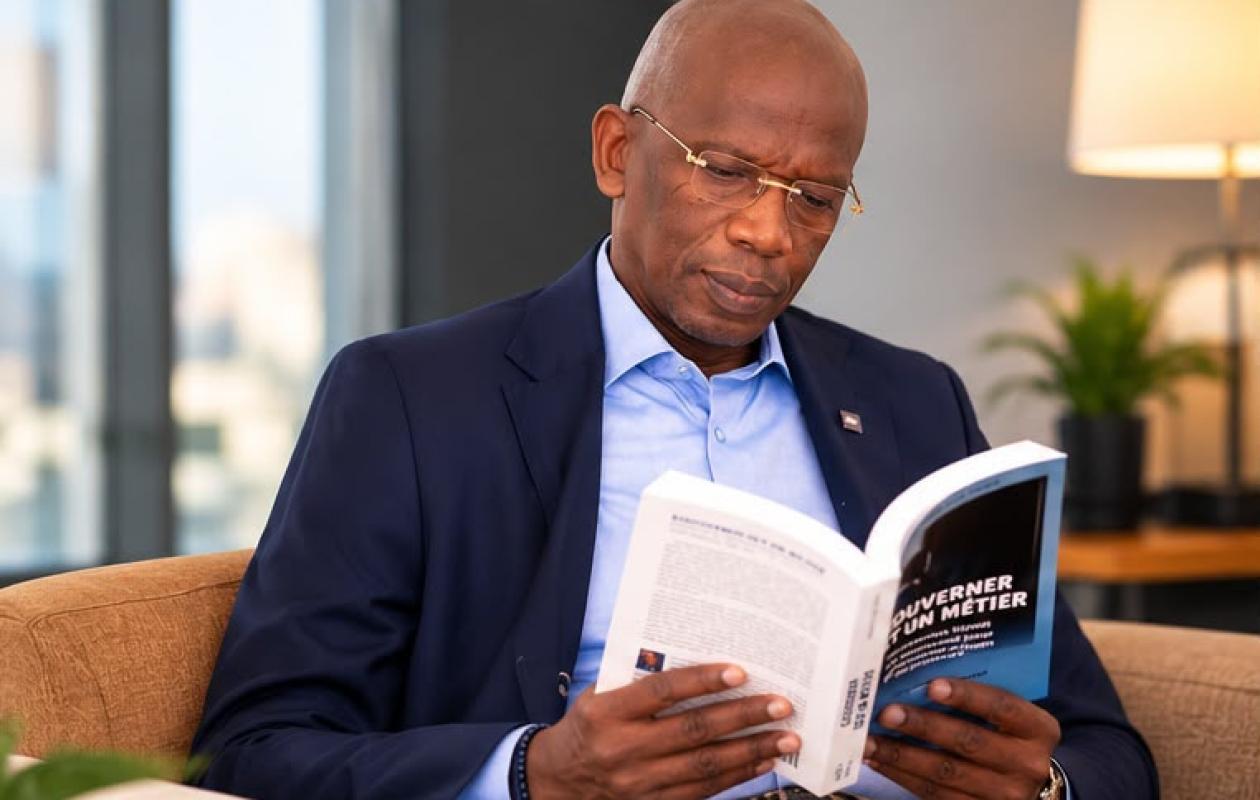
Lansana Gagny Sakho : « La mémoire institutionnelle est stratégique, la détruire se paie cher »
Lansana Gagny Sakho, former director of OFOR and ONAS and chairman of the board of APIX-SA, has published a book entitled "Governing is a Profession." In this candid interview, the seasoned African civil servant discusses the genesis of his essay and responds to criticisms leveled during its promotion. Refuting any suggestion of a targeted ad hominem attack, he offers a frank analysis of the "methodological deficit" plaguing African states, the urgent need to preserve institutional memory, the strategic transformation of youth employment, and the imperative of professionalizing public governance.
Journalist: One might think that the book is addressed to your own camp, given that the early years of the Diomaye-Sonko era were marked by blunders: is it a lesson in methodology administered to your allies?
This reading reveals precisely the confusion that the book seeks to dispel. "Governing is a Profession" was finalized even before this era began. One cannot write, based on twenty-five years of experience, a methodological lesson intended for events that could not have been anticipated.

But I understand the temptation. When a work resonates with the current context, we try to interpret it as a commentary on current events. That would be to give it too much credit in one sense, and to diminish it in another. The principles it articulates—preparatory work, institutional memory, rigorous processes—apply to any political transition, from Dakar to Nairobi, from Abidjan to Kampala.
This book is not an open letter to a government. It is a treatise addressed to those throughout Africa who will one day take the reins of a state.
"Naming a problem is not designating a culprit. It is the prerequisite for any solution."
Journalist : This book sounds — and some of the comments made during the promotion — like a vitriolic attack against Ousmane Sonko: isn't he, in the end, the ideal scapegoat for your criticisms of the amateurism at the top of the State?
I reject this interpretation with the same firmness as the previous one. If the book names Ousmane Sonko or any other current leader, I invite you to quote the passage. What I am denouncing is a system, a culture, a way of conceiving of the state as a trophy rather than as a development engine.
The "scapegoat" is a convenient figure for those who prefer controversy to diagnosis. I could have written this same book in any other era and it would have rung just as true, because the problem is structural, continental, and long-standing. You can't solve in a single term what has been built up over decades.
That said, I will not feign neutrality either. While I have given specific examples illustrating my arguments in broadcasts, these examples are not the book itself. Promoting a book is a conversation; the book is a rigorous demonstration. The two deserve to be distinguished.
Naming a problem is not the same as designating a culprit. It is the prerequisite for any solution.
Journalist : You state that Africa does not have a problem of potential but a "deficit of method": do African leaders lack skills or simply the will to institutionalize rigor?
This is the most important question of all, and I will answer it directly: the two phenomena coexist, but one is more fundamental than the other.
Individual competence is real. Africa produces highly skilled engineers, economists, and lawyers. The problem isn't cognitive; it's systemic. The real deficit lies in the absence of structures that transform individual skills into sustainable institutional capabilities. A competent individual in a disorganized system produces fragmented results. A well-designed system, even with average actors, produces continuity.
As for the will: it is often there from the outset, fresh, sincere, and motivating. What it lacks is translation into method. The will to develop is the raw material. The method is the tool for transformation. Yet we too often entrust our states to actors rich in will but devoid of method, and this, by definition, produces only fleeting enthusiasm.
Africa has enough talent. It lacks the institutional engineering to put it to use in sustainable collective projects.
Journalist : You denounce the distribution of positions according to political loyalty rather than competence: as chairman of the board of APIX-SA and former director of OFOR and ONAS, have you never yourself benefited from or given in to these partisan arbitrations?
That's a legitimate question, and I'm not going to dodge it. Anyone who has held a position of responsibility in the upper echelons of African government has navigated an environment where political allegiance is a defining factor. I was no exception.
What I am saying is that, in every position I have held, I have sought to prioritize the logic of the mission over the logic of belonging. That I have sometimes failed is likely: no one is immune to the environment in which they operate. But the partial failure of a practitioner does not invalidate their diagnosis. On the contrary: it is precisely because I have seen firsthand the devastating effects of appointment as a reward that I speak about it with conviction.
This book is not written from the perspective of someone who has never gotten their hands dirty. It is written from the perspective of someone who has managed public institutions, overseen investments, faced the real constraints of public service, and learned lessons from them, including about their own limitations.
A practitioner's credibility does not come from their infallibility, but from their ability to draw honest lessons from their own experiences.
Journalist : You are advocating for a paradigm shift on youth employment, moving from "compassion" to "strategy": how have current public policies failed to meet the African demographic challenge?
The failure is primarily conceptual. For a long time, youth employment was treated as a matter of social welfare: safety nets, cash transfers, symbolic programs with insufficient funding. This is what I call the compassionate approach: it responds to a moral emergency without addressing the economic challenge.
But the challenge is different. By 2050, Africa will welcome more than a billion additional young people of working age. This is not a humanitarian problem. It is a massive economic engineering challenge. It requires an explicit industrial strategy, a link between training and promising sectors, and a policy of upgrading agricultural, digital, and manufacturing sectors.
What current public policies have failed to do is build national value chains capable of absorbing this workforce and creating added value. Too many models designed for mature economies have been imported into structurally different contexts. What is needed are African employment strategies, not adaptations of formulas conceived for other parts of the world.
Providing employment for young Africans is not a matter of charity. It is a prerequisite for political stability and the economic takeoff of the continent.
"Institutional memory is not nostalgia. It is a strategic infrastructure. It cannot be destroyed without paying a price, even if that price is paid later."
Journalist : When discussing institutional memory, you regret that each change of government leads to a "reset": how can this strategic continuity be imposed on political powers that seek above all to wipe the slate clean?
The expression "impose" reveals a problem: continuity cannot be imposed by decree. It must be structurally embedded in the institutions themselves, in order to survive changes in power.
The means exist: systematized, accessible and protected institutional archives; permanent civil service bodies whose continued employment is not conditional upon change of government; sectoral development plans adopted by Parliament and therefore endowed with democratic legitimacy that the following government cannot ignore except at its political risk; independent regulatory authorities that survive electoral cycles.
The real question is one of political incentive. A new government wipes the slate clean because it benefits them symbolically and electorally. The solution is to make discontinuity costly. This requires a demanding civil society, media outlets capable of institutional memory, and yes, books that name the problem, so that public debate can engage with it.
Institutional memory is not nostalgia. It is a strategic infrastructure. It cannot be destroyed without paying a price, even if that price is paid later.
Journalist : You elevate economic intelligence and the attractiveness of territories to sovereign imperatives: do our states today have the technical capacity to face international competition without being mere spectators?
Honestly: not yet, in most cases. But it's a problem of capacity — therefore of construction — and not an inevitability.
Economic intelligence is a demanding discipline: it requires reliable information systems, analysts trained to decipher the strategies of foreign actors, and rapid feedback loops between information gathering and public decision-making. Few African states currently possess these structures.
The attractiveness of a region, for its part, cannot be decreed. It is built through consistency between rhetoric and reality: legal certainty, regulatory predictability, administrative efficiency, and quality infrastructure. You can hold all the investment forums you want; if the investor's actual experience is an obstacle course, nothing will come of it.
What I am advocating is a radical professionalization of investment promotion agencies, systematic training of public negotiators, and a clear state doctrine on attractiveness, not as a slogan, but as an operational roadmap.
Economic sovereignty is not proclaimed. It is built, competence by competence, institution by institution.
"We don't entrust the management of a hospital to the person who managed to convince the most people to vote for him. The state deserves at least the same level of scrutiny."
Journalist : If "governing is a profession" with its rules and discipline, doesn't African democracy suffer from entrusting the keys to the state to political actors more trained in electoral contests than in public management?
This is the central tension in our democracies, and it's not unique to Africa. Churchill didn't have a degree in public administration. Neither did De Gaulle. Electoral legitimacy and managerial competence are not intrinsically linked.
But there is a difference between a leader who acknowledges their technical shortcomings and surrounds themselves with a competent administration, and one who ignores, disregards, or circumvents them. The latter always ends up producing institutional disasters, regardless of the sincerity of their political project.
What "Governing is a Profession" posits is not that politicians must be technocrats. It is that they must have sufficient understanding of the state so as not to treat the civil service as spoils of war, to value expertise and not deference, and to understand that public governance obeys laws just like engineering or medicine.
African democracy stands to gain greatly from producing political leaders who understand the difference between managing a mobilization movement and governing a state. These two tasks require distinct skills. Recognizing this distinction is not a criticism of democracy; it is a condition of its effectiveness.
We don't entrust the management of a hospital to the person who managed to convince the most people to vote for them. The state deserves at least the same level of scrutiny.





















Commentaires (22)
Tu sais que a l'ONAS y'a bcp de corruptions
Quant au fond même de son livre, heureusement que le Burkina Faso de IB est entrain de démentir, par l'exemple, toutes ces théories qui nous enchaînaient aux intérêts occidentaux.
Participer à la Discussion
Règles de la communauté
💡 Astuce : Utilisez des emojis depuis votre téléphone ou le module emoji ci-dessous. Cliquez sur GIF pour ajouter un GIF animé. Collez un lien X/Twitter, TikTok ou Instagram pour l'afficher automatiquement.
Se connecter
Commentez avec votre profil, votre photo, et soyez averti des réponses.