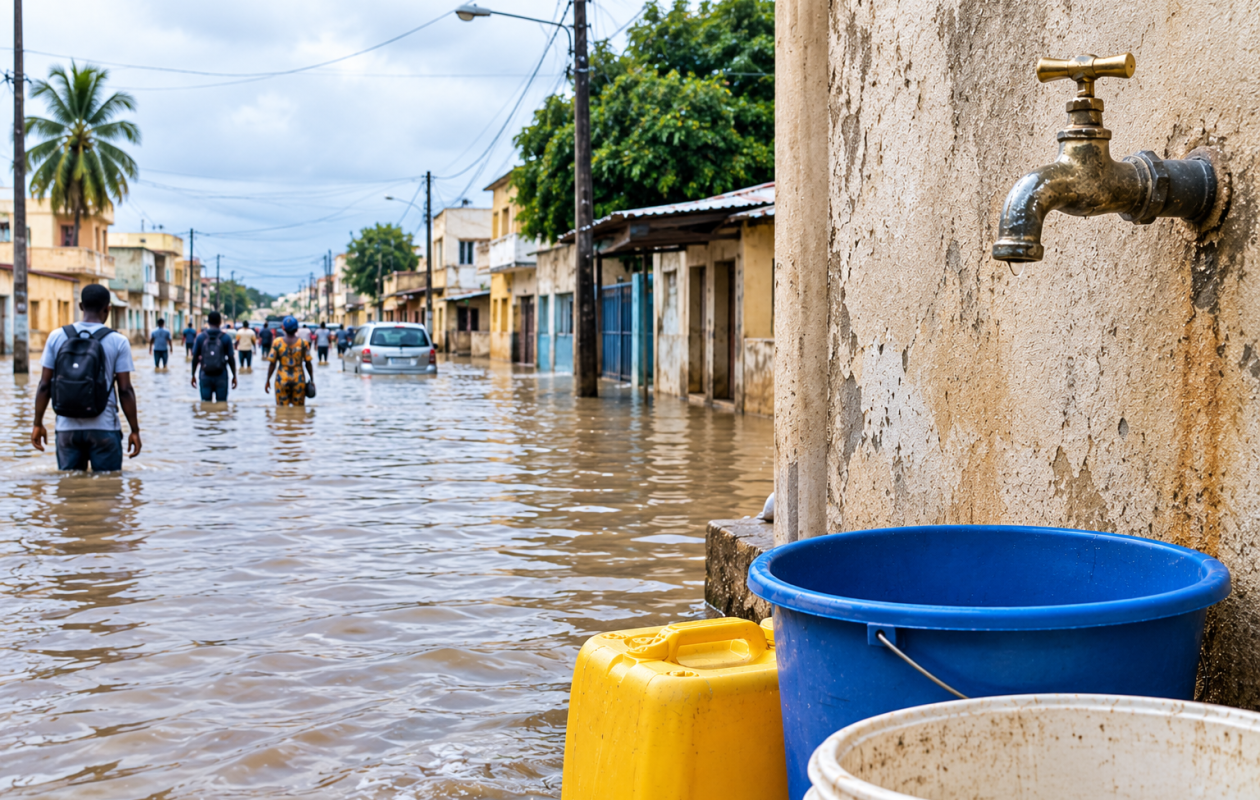
Dakar : l'eau est partout, sauf dans le robinet
Two crises, one cause: the state, which always arrives last.
When it rains, water floods Guédiawaye, Pikine, Keur Massar, and Parcelles Assainies. When it doesn't rain, these same neighborhoods line up at a public water fountain. Same geography, same suburbs, same forgotten communities.
In both cases, it's not nature that's failing. A city built on low-lying land, concrete retention basins, canals that are never dredged, and unplanned urban development explain the scale of the floods. On the other hand, an overloaded network struggling to keep up with a rapidly growing population explains the thirst. Both situations stem from the same deficiency: anticipation.
The logic of permanent urgency
Every winter, we bring out the water pumps. Every shortage, we line up the tanker trucks. We manage the symptom, never the structure. The tanker truck is the perfect metaphor for this failure: a solution that comes at a cost, that arrives when it wants, and that the families on the second floor pay for with buckets carried up by hand.
The capital relies heavily on a single source, Lake Guiers, located over 200 km away, whose water is transported through a vulnerable pipeline. A breakdown at Keur Momar Sarr, and an entire region is left without water. A system without a plan B isn't a system; it's a gamble.
The question of money and the continental model
On one hand, hundreds of billions are being announced to help Dakar overcome its flooding. On the other, entire neighborhoods still lack access to drinking water. A simple question arises, without mincing words: where did the money go, and who is being held accountable? Were the projects actually completed? Were the contracts awarded transparently? What is the true state of the infrastructure?
This imbalance is not unique to Senegal. Lagos, Abidjan, Accra, and Kinshasa experience the same scenario, flooded during the rainy season and parched the rest of the time. Africa receives water, but has not built the necessary infrastructure to capture, store, evacuate, and distribute it. Chronic underinvestment, opaque contracts, and dependence on donors are a governance choice repeated for decades, not an inevitable consequence of climate change.
The health and social impact
Without running water, stored water becomes a risk: poorly sealed containers, brackish water, and compromised hygiene. Once again, women and children bear the brunt of this crisis, enduring hours of waiting in line and carrying buckets on their heads. After the floods, stagnant water fosters malaria and waterborne diseases. The same neighborhoods are thus hit twice: first by too much dirty water, then by a lack of clean water.


















Commentaires (7)
* Le ministère, qui a validé des plans et projets sans toujours s’assurer de leur pertinence, de leur soutenabilité et de leur adéquation aux besoins. On fait des projets politiques, à effet immédiat: Chacun y trouve son compte sauf les populations.
* La SONES, qui a repris une partie du patrimoine hydraulique de la SONEES après sa dissolution et dont certaines emprises stratégiques, notamment la Zone de Captage, ont ensuite été transformées en zones d’habitation alors qu’elles avaient une fonction hydraulique essentielle pour Dakar, et qui en plus fait des projets faramineux qui s essoufflent en moins de deux ans.
* La gestion foncière de l’État, qui a permis le déclassement et cette urbanisation de zones ayant une fonction hydraulique spéciale.
Le problème est qu’on dépense aujourd’hui des milliards pour compenser les conséquences de ces choix.
Et il y a un réel problème de responsabilités dans ces secteurs. On entend toujours les mêmes noms et on a toujours les mêmes problèmes et jamais de responsables. On change de ministre ou de DG mais les problèmes subsistent - la question d un appel à candidature pour recruter des agents compétents seraient complètement justifiés vu les dégâts.
En outre, ne faudrait-il pas qu une partie des fonds communs évoqués au niveau de la DGID servent aussi à financer le réaménagement et la restauration de ces zones hydrauliques stratégiques qui ont été transformées à tord en zone d habitation?
Participer à la Discussion
Règles de la communauté
💡 Astuce : Utilisez des emojis depuis votre téléphone ou le module emoji ci-dessous. Cliquez sur GIF pour ajouter un GIF animé. Collez un lien X/Twitter, TikTok ou Instagram pour l'afficher automatiquement.
Se connecter
Commentez avec votre profil, votre photo, et soyez averti des réponses.