Ce que les scientifiques savent des inondations meurtrières au Népal
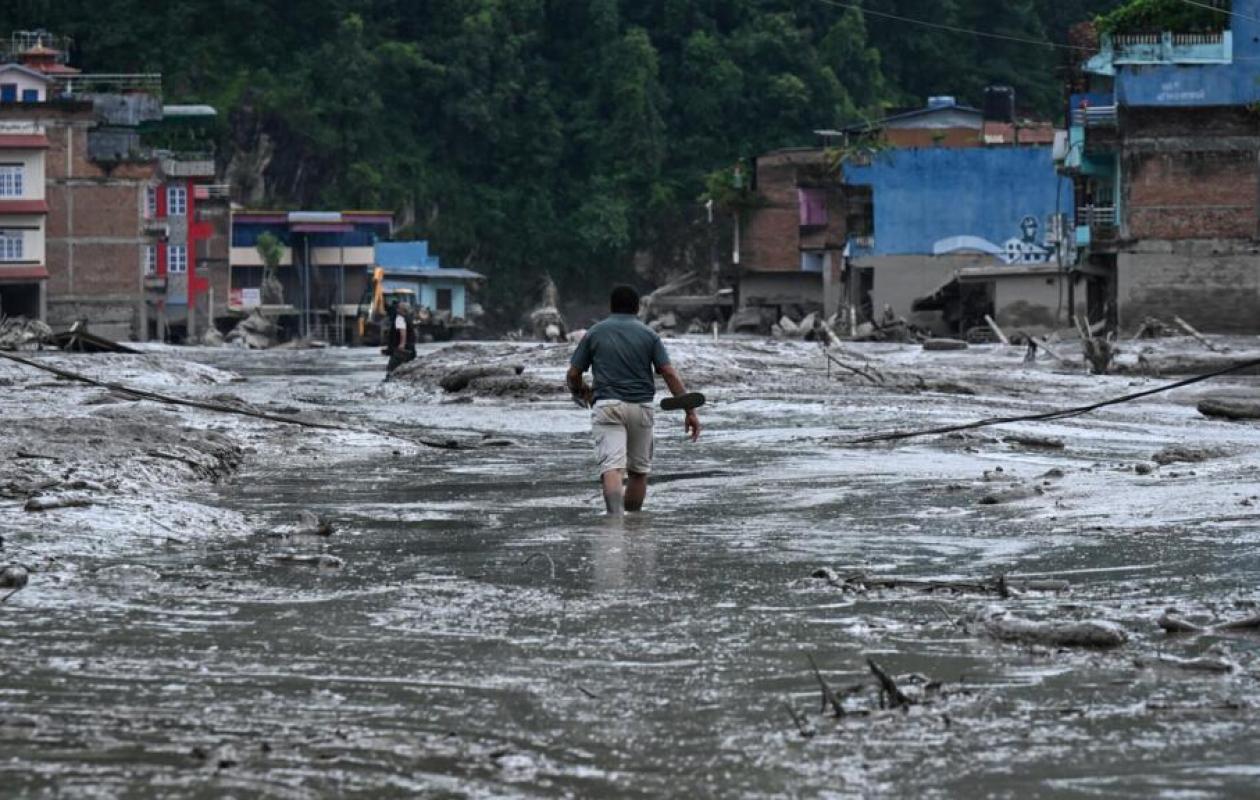
The causes of the devastating flood that killed at least 160 people on Wednesday on the border between Nepal and Tibet are not yet known for certain, but experts believe the risks are aggravated by the extreme topography of the Himalayas.
While it is still too early to establish a definitive link with climate change, the widely documented consequences it can have on the "roof of the world", including the overflowing of glacial lakes, increase the likelihood of such events.
- Landslide followed by tremors for the USGS -
Nepal's Foreign Minister Shishir Khanal explained that an earthquake likely caused a landslide, which blocked a riverbed, causing the devastating flood downstream.
But, while the event was originally recorded as a magnitude 4.4 earthquake, the United States Geological Survey (USGS) indicated in a new note that further analysis seems to demonstrate that this seismic energy was generated by the landslide itself.
The International Centre for Integrated Mountain Development (ICIMOD), based in Kathmandu, detected "no anomalies" on the Chinese side of the border.
"We believe that an avalanche of rocks and ice occurred in Nepal, blocking the Lhende River and causing the flood," Sarthak Shrestha, a remote sensing and geoinformation analyst at the international center, told AFP.
Hatim Sharif, a hydrologist at the University of Texas at San Antonio, expressed surprise at the lack of rainfall before the disaster: "This disables virtually all operational flood warning systems in the world."
- "Running won't help" -
The solutions for escaping this type of calamity, when the flood arrives, are limited.
"Running won't help," nor will trying to escape in your vehicle, says Hatim Sharif. The mud and water moving at very high speeds form a deadly combination akin to "liquid concrete."
He believes the only solution is to climb a hill at least six meters high.
A possible prevention tool, according to the hydrologist, would be to place water level sensors in the rivers, transmitting their information in real time to the authorities, which would give residents between 20 and 30 minutes of advance notice.
"In these mountainous environments, rivers can be quite narrow," explains Dorothy Heinrich, a researcher at the British University of Reading.
Anything that blocks them, whether it's an avalanche or a landslide, will lead to "a large accumulation of water, then cause these incredibly rapid floods."
Qianggong Zhang, head of climate and environmental risks at ICIMOD, also warned of a potential second flood, as a new blockage was forming downstream.
- A possible link with climate change -
Nepal is also subject to GLOF (from its English acronym, for "Glacial lake outburst flood"), the sudden draining of a glacial lake which releases powerful flows, sweeping away everything in their path.
This phenomenon had caused a similar disaster in July 2025, when a lake in China's Gyirong County overflowed and spilled into Nepal's Rasuwa District.
In the coming days, scientists around the world will study a potential link between climate change and the disaster, with simulation models to compare the probability of such an event today and in the pre-industrial era.
"We know what the trends of climate change look like in the Himalayas. We have certainties about the increase in heat waves, the retreat of glaciers, the reduction of permafrost, these kinds of phenomena which can, for example, cause landslides and flash floods," explains Dorothy Heinrich.
She stresses, however, that a link between climate change and this flood can only be established with certainty through a specifically dedicated study.





















Commentaires (5)
Selon le ministère du tourisme népalais, 823 personnes, dont 393 étrangers, n’ont pas été retrouvées. En Chine, 558 personnes sont portées disparues, dont 260 étrangers.
Participer à la Discussion
Règles de la communauté
💡 Astuce : Utilisez des emojis depuis votre téléphone ou le module emoji ci-dessous. Cliquez sur GIF pour ajouter un GIF animé. Collez un lien X/Twitter, TikTok ou Instagram pour l'afficher automatiquement.
Se connecter
Commentez avec votre profil, votre photo, et soyez averti des réponses.