
« C'est une fée marraine » : cette femme qui envoie 10 000 dollars par semaine pour permettre aux enfants migrants détenus aux États-Unis d'acheter de la nourriture
Luis Sánchez* had been detained for more than three weeks with his four children in an immigrant detention center in Dilley, South Texas, USA.
He recounts that his eldest daughter, who suffers from anxiety, had "no more nails to bite" and that the younger girls were beginning to show signs of despair. "They got to the point where they told me they wanted to commit suicide, that I had to sign anything to get out, because they couldn't stand being there anymore," says this Nicaraguan man.
"But when another inmate told me that a woman could help me improve the situation a little, I had reservations," he told BBC Mundo.
It was only when a lawyer who regularly visits these centers — the only ones in the country to accommodate families with minor children — confirmed the information to him that he allowed himself to be convinced.
All she had to do, she explained, was send an email with her contact information. Casey Revkin, a Californian who runs the organization Each Step Home, would then give her money to buy what she needed inside the detention center.
From the library computer at the center, he sent her this message:
Hello, my name is [name withheld], and I am a father of four. My lawyer told me that you help people by giving them money to buy certain things. I would like to know if you could help me buy water, toothbrushes, toothpaste, and some snacks for my children. I would be very grateful for your help. Thank you very much.
“To my great surprise, a few days later I already had $200 in my account,” he recalls. “We bought water first, then the kids wanted popcorn, candy, and cold drinks. It was a huge relief, a way for my children to feel a little better.”
Child-focused
Revkin sent this money to Sánchez, as she did for other detained migrants with children, in amounts up to $10,000 per week.
“I put myself in their shoes and think how terrible it must be to feel like you can’t protect your children or provide them with such basic necessities,” Revkin told BBC Mundo. She describes herself as “a California mom.”
"It is therefore very satisfying to be able to do something concrete for these children."
His commitment to minors affected by American immigration policies is not new.
As early as 2018, during Donald Trump's first term, when she learned that hundreds of children were being separated from their parents while attempting to cross the border illegally, she began to help them in order to expedite the family reunification process.
She helped fill out the documents, print them, and file them. She was also looking for volunteers to accompany the people who would be welcoming the children to their fingerprinting appointments.
"For families, these were huge obstacles, but it was something we could perfectly well do," she recalls.
It was around this initiative that she created the organization Each Step Home.

With Donald Trump returning to the presidency and promising to conduct "the largest deportation operation in the country's history," Revkin decided to look for other ways to help.
When she learned in January of the detention of 5-year-old Liam Conejo Ramos during an anti-immigration operation in Minneapolis, Minnesota, a case that made headlines, she found a new mission.
The child was arrested while returning home from daycare and was placed with his father at the Dilley Immigration Processing Center (DIPC), the same center where Sánchez and his children were detained.
The country's only family detention center had been closed under the presidency of Democrat Joe Biden, before reopening last year as part of the Trump administration's immigration policy.
Since then, several reports from migrant advocacy organizations and parliamentarians have expressed their concerns about the conditions there.
One of the most recent reports, published in April by organizations such as Human Rights First and RAICES, concluded that "the inhumane conditions, systematic ill-treatment and violations of the right to due process faced by families in Dilley are widespread and systemic."
The accusations were rejected by both CoreCivic, the company that manages the center, and the U.S. Department of Homeland Security (DHS).

Revkin had already heard about these centers. Some families she had helped in the past to find their loved ones had stayed there. They had notably shared their complaints with her regarding the quality of the food and water.
Those who could afford it supplemented what was provided to them at the centre with products they bought locally.
To do this, they used the money deposited into their accounts at the center. Dilley and other centers use software that allows them to credit the account of a specific detainee.
Revkin thus found a way to help: she began to solicit her network of immigration lawyers, activists and parliamentarians to find out how she could fund these accounts.
"We reach 80% of detainees."
Her first donation was $50 to the family of a two-month-old baby suffering from a respiratory infection. Today, she says she dedicates approximately $10,000 a week to this cause.
"The amount varies, but we estimate that this covers the needs of about 80% of the people detained at Dilley," she says.
The money comes from donations. "We organized a fundraiser for Mother's Day, which went very, very well, and that allows us to keep going so far," she explains.
Thanks to this aid, families detained at Dilley can buy bottled water, cereals and instant soups, but also shampoo and conditioner, as well as sweets, notebooks and colored pencils.
“She’s a fairy godmother,” Kristin Etter, a lawyer with the Texas Immigration Law Council who volunteers in Dilley and other centers, told BBC Mundo. “There’s no better way to sum up what she represents. People really couldn’t survive without her,” she emphasized.
"It is outrageous that American taxpayers spend $15 million a month to arrest children and families and yet we are forced to rely on a very generous private citizen to raise funds to cover their basic needs during their stay in this detention center," she adds.
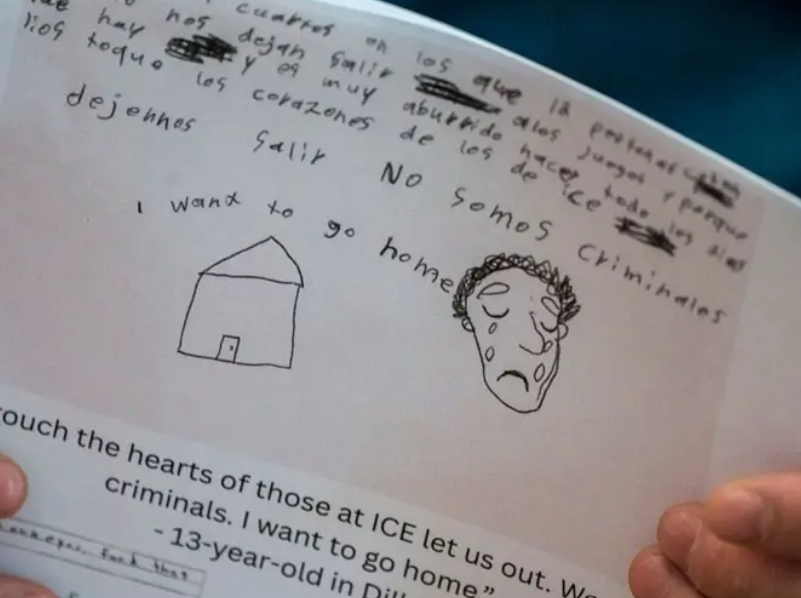
The private company that runs the Dilley detention center, CoreCivic, rejects the accusations regarding the conditions of detention.
Its spokesperson, Ryan Gustin, says that CoreCivic has been working with the U.S. federal government for 40 years, under both Democratic and Republican administrations, to ensure "safe and humane" care for the people entrusted to its care.
He clarifies that the company does not decide who is arrested or how long they are detained.
According to him, the Dilley center is subject to several levels of control and is under close surveillance by the American authorities, in order to ensure compliance with the rules and standards of detention.
CoreCivic also disputes criticisms about the quality of the water and food.
The company claims that independent analyses show the water is clean and filtered. It specifies that this is the same water consumed by the center's employees and local residents.
Regarding meals, CoreCivic states that detainees receive three "nutritious" meals per day, as well as snacks. The menus are approved by a dietician and are subject to checks to ensure their quality and freshness.
Regarding the prices of products sold in the center, the spokesperson believes they are comparable to those of supermarkets. He indicates that prices are reviewed every two years and that profits are paid into a "residents' welfare fund."
The US Department of Homeland Security, the DHS, also defends the conditions of detention.
In a response to BBC Mundo, a spokesperson stated that all detainees have three meals a day, drinking water, clothing, bedding, showers, soap and hygiene products.
He adds that undocumented people have access to phones to communicate with their relatives and lawyers, and that meals are assessed by registered dietitians.
The DHS also states that the Dilley facility meets federal detention standards and is regularly audited and inspected.
The department also reiterated the US administration's policy on voluntary departure. According to the department, undocumented migrants are offered $3,000 and a plane ticket to voluntarily leave the United States.
The DHS states that those who refuse this proposal face arrest and deportation, with a ban on returning to the United States.
Helping beyond detention

Luis Sánchez* insists that his experience in Dilley was different and that the sums paid by Revkin brought "great comfort" to his family.
This prompted him to talk about this aid to other detainees and explain that all they had to do was send an email, as he had done, providing their contact details so that the money could be paid into their account.
"I met many people who arrived with nothing, people who had been arrested just after crossing the border from Mexico and who had no one to help them," he says.
He and his four children left Dilley on July 1st, after being confined there for nearly three months. They are now under enhanced supervision as part of ISAP, a program of U.S. Immigration and Customs Enforcement (ICE) that provides an alternative to detention.
He explains that he set aside some of the money received from Revkin and used it to buy tickets allowing them to return to the city where they lived before their arrest.
But the help didn't stop there.
"With the detention, we had lost everything. I had lost my job. So they also helped us to be able to start over from scratch," he confides.
"The first week, they helped us with food. Now that the children have started school, they've bought them their school supplies. Those days, that help really saved our lives."
*Name changed at the request of the interviewee in order to protect their identity.






















Commentaires (3)
Participer à la Discussion
Règles de la communauté
💡 Astuce : Utilisez des emojis depuis votre téléphone ou le module emoji ci-dessous. Cliquez sur GIF pour ajouter un GIF animé. Collez un lien X/Twitter, TikTok ou Instagram pour l'afficher automatiquement.
Se connecter
Commentez avec votre profil, votre photo, et soyez averti des réponses.