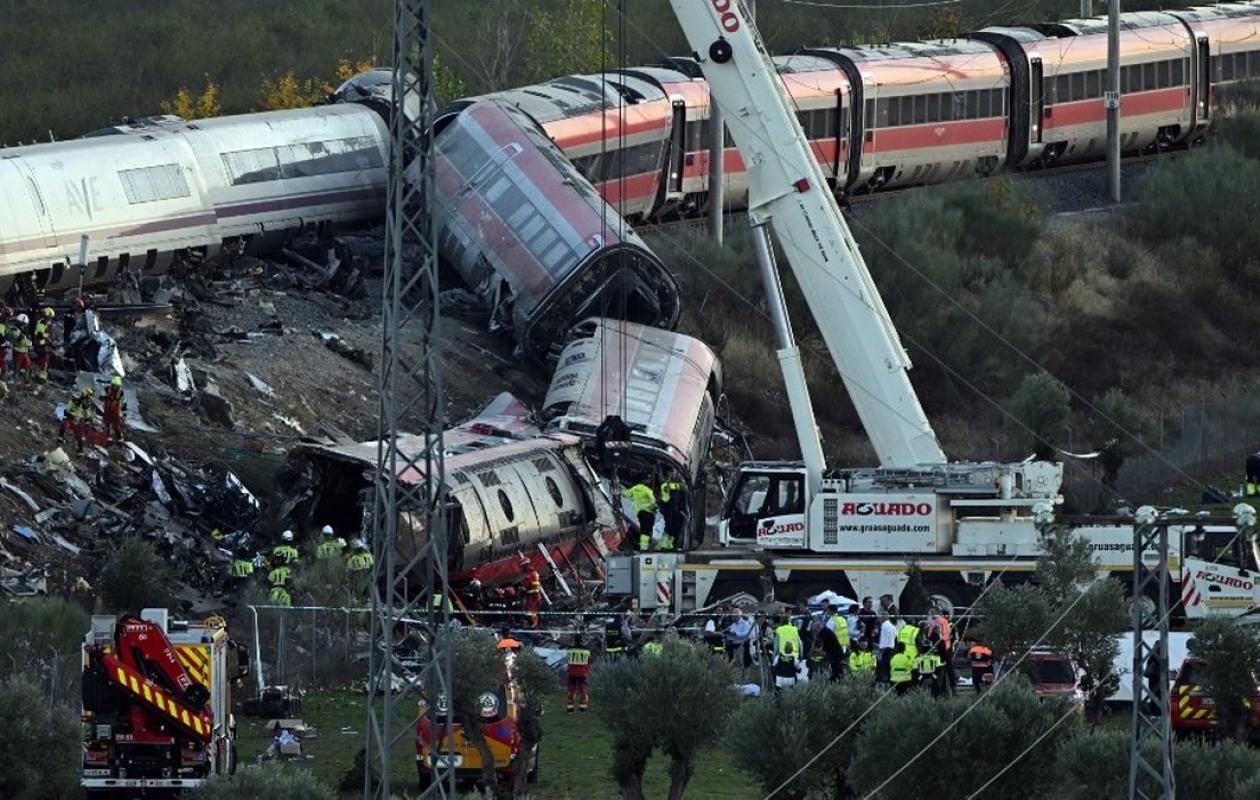
Collision de trains en Espagne : Panne, « erreur humaine »… Ce que l’on sait sur cette catastrophe ferroviaire
Two trains traveling from Madrid to Seville collided near Toledo, killing at least 68 people. The first train struck the rear of the second, which was stopped on the tracks. This is one of the worst rail disasters in Europe since 2013.
The death toll continues to rise. At 5 p.m., it stood at 68 dead and 108 injured. Two trains collided this Wednesday morning 150 km south of Madrid, in Urda, near Toledo. The human cost is very high. This is one of the worst train disasters in Europe in the last twenty years. It is the second in less than ten months in Spain, following the 46 deaths in Adamuz (Andalusia) on January 18.
What happened in Urda, south of Toledo?
The two trains involved in the collision were traveling the same route, from Madrid to Seville-Santa Justa. The Renfe train (AVE 2080), similar to a TGV in France, had departed Madrid-Puerta de Atocha at 8:00 AM and was scheduled to arrive at 10:39 AM. The Iryo train (service 6076) was also traveling towards the Andalusian capital and was ahead of the AVE at the time of the collision. It was due to arrive in Seville at 10:35 AM.
At 8:53 a.m., the AVE train rear-ended the other train, which was stopped on the track. Crushed, the first AVE car left the tracks and came to rest below. The last three cars of the Iryo train were propelled off the rails. The last two were completely destroyed in the images quickly released by the Guardia Civil.
Why is the minister referring to "human error"?
At 8:30 a.m., a failure of the LZB (Line Control and Signaling) system affected the rail network. This continuous speed control and in-cab signaling system is used on high-speed rail lines in Germany, Austria, and Spain. Six trains were brought to a standstill, including the two involved. After six minutes, however, the controller authorized the driver of AVE 2080 to depart.
However, according to Transport Minister Oscar Puente, "there was a red signal that should have prevented the train from resuming its journey." He stated that the AVE train traveled 25 kilometers at 200 km/h between 8:36 and 8:53 a.m. before colliding with the Iryo train. For 17 minutes, neither the conductor nor his superiors saw the catastrophe unfolding before their eyes. The minister described the decision as "inexplicable," given that the Iryo was still stopped on the same track. "No one can explain how he could have ordered all the stopped trains to resume normal service, especially since he had received a communication from the Iryo indicating that it was stopped."
What does the protocol recommend?
This switch from automatic to manual mode in the event of an automatic system failure is standard practice. The minister explains that "this happens in all transport systems, including road and air transport: when the computer system fails, we switch to manual mode." However, if the controller determines that the trains can resume operation, the drivers can then only do so at a limited speed.
However, Oscar Puente specifies that it was actually one of the six train drivers to whom this controller had given the order to depart "normally," that is, at full speed, who corrected him. He reminded him that the protocol, in such a situation, without a computerized safety system, required proceeding "by sight." That is to say, at a maximum speed of 40 km/h. When a train is traveling at 200 km/h, it takes between 1.6 and 2 kilometers to come to a complete stop in an emergency braking situation. This translates to a time of between 40 and 60 seconds (depending, in particular, on the weight of the train and the adhesion of the rails).
Who are the victims?
Twenty-four people died in the first AVE train car. The other victims were in the last Iryo train cars. There were 397 people on board the AVE and 147 on the Iryo. The provisional death toll at 5:00 PM stood at 68, with 108 injured, 58 of whom were hospitalized. Former Minister of Employment and Social Security (from 2011 to 2018) Fátima Báñez (People's Party) was reportedly among the victims, according to ABC and Democrata. Opposition leader Alberto Núñez Feijóo (PP) was more cautious. An hour after these announcements, he stated that he had "no news" of the former minister.
AVE train passenger Ignacio Relaño told Spanish television of "an extremely brutal braking, a deafening noise, a violent impact." He was in the third carriage. "The train seemed to tip over, then right itself before coming to a complete stop." His account is chilling. "The worst part was what I saw as I approached the front of the train: people trapped, some screaming, dead bodies, a man who had lost an arm, another person sitting in shock, as if they were in another world."


















Commentaires (1)
Participer à la Discussion
Règles de la communauté
💡 Astuce : Utilisez des emojis depuis votre téléphone ou le module emoji ci-dessous. Cliquez sur GIF pour ajouter un GIF animé. Collez un lien X/Twitter, TikTok ou Instagram pour l'afficher automatiquement.
Se connecter
Commentez avec votre profil, votre photo, et soyez averti des réponses.