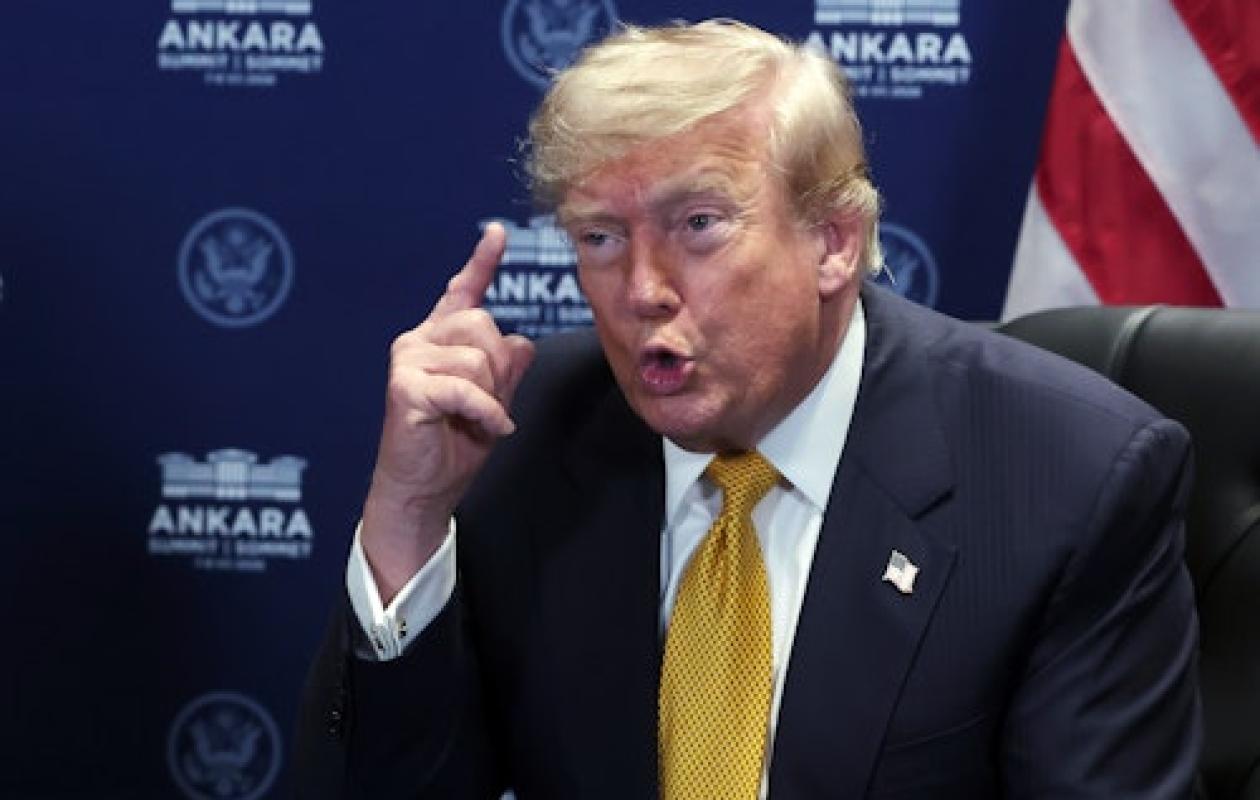
« Je suis très en colère contre l'Otan » : Donald Trump secoue ses alliés au sommet d'Ankara
"I am very angry with NATO": Donald Trump expressed his frustration with the Atlantic Alliance on Wednesday, the last day of the Ankara summit, denouncing, among other things, the attitude of the allies on Iran, Greenland and Spain.
Reiterating his oft-repeated criticisms, the American president reviewed his numerous grievances, seated alongside the Alliance's chief, Mark Rutte. The latter had, just hours earlier, attempted to reassure allies concerned about the American commitment to the organization. "I'm not happy with NATO because of what they did with Greenland, and I'm not happy with NATO because they refused to help us against the leading state sponsor of terrorism, namely Iran," declared the White House occupant.
Since the United States and Israel attacked Iran in late February, Donald Trump has repeatedly criticized his Western allies for distancing themselves from the conflict. He has also expressed his frustration at not having been able to seize Greenland, which he considers a "big problem." "Greenland is very important to the United States, but not important to Denmark," he added, referring to the autonomous Danish territory.
Spain described as a "lost cause"
The Atlantic Alliance went through serious turbulence at the beginning of the year when Donald Trump threatened to seize Greenland, possibly by force, deeming it essential to US security. He ultimately backed down after several weeks of extremely aggressive rhetoric.
Donald Trump also strongly criticized Spain, calling it a "lost cause," with which the United States will, according to him, "cease all trade," again accusing Madrid of not participating in NATO defense spending.
The 32 leaders of the Alliance countries then met for a working session. What will the tone be? Conciliatory, like in 2025 in The Hague — where Donald Trump celebrated a "monumental success" after the countries pledged to dedicate at least 5% of their gross domestic product to their security — or much more somber?
Mark Rutte tries to calm things down
When questioned about Trump's repeated criticisms of the Alliance, NATO Secretary General Mark Rutte, as usual, dismissed the idea that this endangered the Alliance. "There is a full commitment" from the United States to NATO, he insisted, praising the role played by Donald Trump since his return to power.
“Let’s be honest: President Trump’s encouragement of Canadians and Europeans to spend more really helped,” he argued. “It’s a big win for the American president,” he added, in a statement that should be music to the ears of the American head of state.
Armed with figures and graphs, and true to a strategy of persuasion from which he has never deviated, the NATO Secretary General is going to great lengths to demonstrate to the American president that member countries' commitments are being followed by action. And that his calls for a better sharing of the burden are not going unheeded. The consensus is there: the Alliance must become much more European and somewhat less American. But the task is immense and complex. And Washington's pressure tactics are creating a difficult atmosphere.
In mid-June, in Brussels, US Secretary of Defense Pete Hegseth announced a "review" within six months of the presence of US forces in Europe.
Highly anticipated one-on-one meeting with Zelensky
On Ukraine, the meeting between the American president and his Ukrainian counterpart will be closely watched, coming just days after a "very good conversation" with Russian President Vladimir Putin. "I think they both want to reach an agreement," Donald Trump stated on Tuesday, as he had done previously.
In the absence of any tangible indications to that effect, the Europeans currently want to reaffirm their commitment to Kyiv. They will pledge, along with Canada, to provide €70 billion in military aid to Ukraine in both 2026 and 2027, including €30 billion for each of those two years, already loaned to Kyiv by the European Union.
Aware that the doors of the Alliance were, for the time being, closed to his country due in particular to American opposition, Volodymyr Zelensky nevertheless recalled upon his arrival in Ankara Ukraine's spectacular progress in defense: "Do you really think it would be the right thing to do to leave outside of NATO a country and a people with this level of defense capabilities?", he asked.
















Commentaires (0)
Participer à la Discussion
Règles de la communauté
💡 Astuce : Utilisez des emojis depuis votre téléphone ou le module emoji ci-dessous. Cliquez sur GIF pour ajouter un GIF animé. Collez un lien X/Twitter, TikTok ou Instagram pour l'afficher automatiquement.
Se connecter
Commentez avec votre profil, votre photo, et soyez averti des réponses.