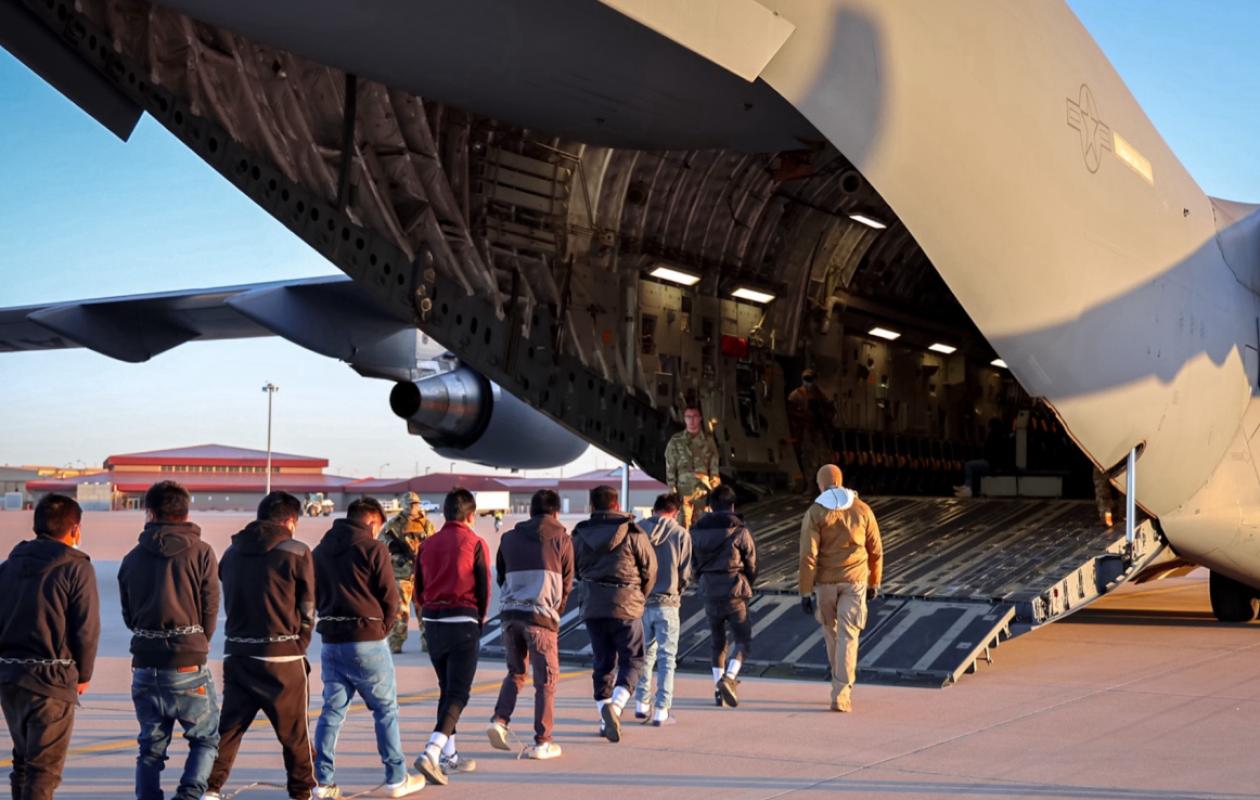
Les Etats-Unis ont expulsé plus de 25.000 étrangers dans des pays tiers
The US government has deported more than 25,000 people to third countries under secret agreements with 35 countries to take in people with no connection to them, a global journalistic investigation published Monday reveals.
Since US President Donald Trump returned to the White House in January 2025, Washington has signed agreements with countries in Latin America, Africa and the Pacific to send foreigners who cannot legally be returned to their own country.
This investigation, conducted by 72 journalists from 23 media outlets in 15 countries and published by the Forbidden Stories consortium, shows that the US government has allocated at least $410 million to be paid to host countries or UN agencies facilitating returns.
As of August 31, 2026, at least 25,447 people had already been transferred to 28 countries - including approximately 20,000 to neighboring Mexico alone - under these agreements, according to data compiled by Forbidden Stories.
The terms of the agreements vary, particularly with regard to the nationalities that can be admitted and individuals with a criminal record.
According to Forbidden Stories, 49 of the 54 African countries have been approached to take in deported citizens from third countries.
An AFP investigation in early 2026 highlighted pressure from Washington on African countries, such as threats of tariffs, suspension of visa issuance or reduction of aid, to force them to accept deportees.
Legal experts had told AFP that once there, these deportees fell "into a legal black hole", held without being charged in an unknown country, sometimes deprived of rights.
A little-known branch of the State Department called the Bureau of Remigration, created in May 2025, conducted most of the negotiations and payments, according to Forbidden Stories. It is headed by Christian Jové Ehrhardt, a 41-year-old diplomat who has worked as a security attaché at several embassies.
- Millions of dollars
Forbidden Stories notably reveals his visits to Cameroon, with which the United States signed a memorandum of understanding in December on the resettlement of deportees. A week later, Washington finalized a health aid program worth approximately $400 million over five years.
And in January, the US State Department released an additional $30 million to the UN High Commissioner for Refugees (UNHCR) in Cameroon, to "facilitate the voluntary return of refugees and combat illegal immigration".
On January 14, the first plane carrying deportees landed in Cameroon.
Other agreements have resulted in direct payments to governments. Palau, a Pacific archipelago with fewer than 18,000 inhabitants, signed an agreement in December to host 75 third-country nationals for $7.5 million.
However, only three people have been sent there so far.
In Eswatini, 32 people have arrived since July 2025, out of a possible total of 160 planned under a $5 million agreement. This southern African country has agreed to accept deportees with criminal records, according to this investigation.
Of the $410 million allocated for these agreements, internal State Department documents show that $81 million is earmarked for signatory governments, the remainder for international organizations, including $178 million for the International Organization for Migration (IOM) and $123 million for UNHCR.
These two UN agencies, meant to uphold human rights, have faced criticism on this issue, although UNHCR told Forbidden Stories that it was not a party to the agreements and was using US funds in accordance with its mandate to "strengthen asylum systems".
An IOM spokesperson indicated that the organization was aware that Washington was using its financial aid to further its own "priorities", but accepted American money to "improve the lives of affected migrants" and without this implying "approval" of the deportations.















Commentaires (5)
Alors le Sénégal qui a copié la démocratie de l'occident doit aussi copier leur politique anti-migratoire, xénophobie, pour se développer.
Notre nation d'abord.
Tous les pays développés ou en voie ont cette politique de contrôle du flux des étrangers.
A voir les pays du. Golfe, l'occident, France, USA, Maroc, etc.
Le Sénégal doit s'en inspirer pour maîtriser son développement et son économie.
Un pays sans contrôle des flux migratoires va subir crise économique, sociale, insécurité.
Économiste
- Chômage chez les jeunes
- Encombrement des centres de santé avec moins et des hôpitaux
- Surpopulation des Écoles primaires
- Manque de foncier et cherté location et immobilier pour les sénégalais
- insécurités
- insalubrité
- embouteillage
- dégradation de la ville
- perte identité sociale
- augmentation fraude et corruption pour État civil
- pollution augmentée
- augmentation CO2
- terrorisme en téléchargement
Participer à la Discussion
Règles de la communauté
💡 Astuce : Utilisez des emojis depuis votre téléphone ou le module emoji ci-dessous. Cliquez sur GIF pour ajouter un GIF animé. Collez un lien X/Twitter, TikTok ou Instagram pour l'afficher automatiquement.
Se connecter
Commentez avec votre profil, votre photo, et soyez averti des réponses.