Un mois après, ce que l'on sait de la crue meurtrière dans l'Himalaya
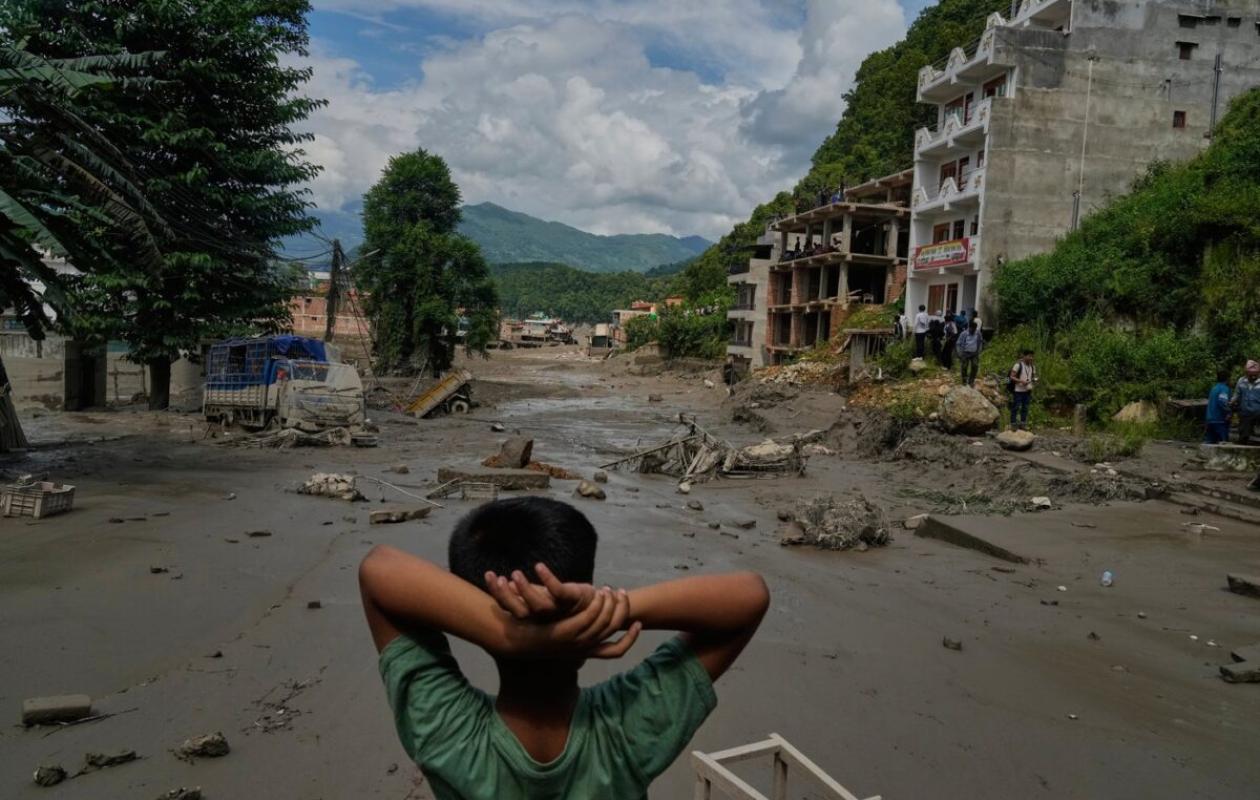
The massive flood that struck northern Nepal on August 26 is the deadliest natural disaster to hit the country since the 2015 earthquake. It also affected the Chinese territory of Tibet.
Here's what we know, one month after the disaster:
The wave
At 08:37 (02:52 GMT), a piece of ice and rock broke off from the north face of Mount Langtang Lirung (5,200 m altitude), according to observations and data collected since by scientists.
This enormous mass - with a volume increasing to over 140 million cubic meters - plunges several hundred meters below, momentarily obstructing the Lhende River.
As soon as it was released, the mass of water, ice and debris rushed "at the speed of a train", according to Nepalese geologist Soudan Bikash Maharjan, into the valley, overflowing into the Chinese territory of Tibet.
With incredible force, the wave swept away everything in its path for dozens of kilometers downstream, including houses, bridges, and hydroelectric power plants.
Nepalese authorities issued the alert at 09:15, too late for the threatened populations.
The human toll
One month later, it is very heavy, but still temporary.
According to the Nepalese emergency authority, a total of 1,451 bodies have been recovered from the slopes and mud, and 5,705 people remain missing.
Among those who disappeared were hundreds of workers or agents from hydroelectric sites swept away by the flood, and just as many foreigners, tourists or pilgrims.
Identifying the victims through DNA comparison has proven a major challenge for Nepalese authorities, whose morgues quickly became overwhelmed. To date, they have only been able to identify 112 bodies.
Lacking information about the fate of their loved ones and without the remains, many Hindu families organized virtual funeral ceremonies, burning effigies. On the Chinese side, where apocalyptic images of the submerged border post of Gyirong circulated worldwide, official media reported 43 dead and 519 missing.
The rescue team
Their operations are still ongoing on both sides of the border. For nearly a month, hundreds of rescuers have been digging through mud and ravines in the hope of finding survivors.
On the Nepalese side, three workers, two Nepalese and one Chinese, were extracted alive from tunnels under construction where they had been buried.
One of the survivors, 30-year-old Sanjay Sah, told AFP that he survived for ten days by drinking muddy water and praying. "I survived thanks to my deep faith and trust," he testified.
Relief efforts in Nepal have carried out nearly 14,000 evacuations, and continue to supply the populations of the most isolated areas by truck, helicopter or cargo drones.
The help
The disaster has caused more than 80,000 losses. Thousands of those affected, who have lost everything, are being housed in emergency shelters. Others have found refuge with relatives.
The UN has launched an urgent appeal to raise nearly $50 million for emergency aid.
Several countries and organizations have pledged financial support to Nepal, amounting to only a few million dollars, largely insignificant given the scale of the disaster.
The flood also reduced the country's electricity production capacity by 10%, 90% of which comes from hydroelectric facilities.
The government has estimated the cost of reconstruction at over $4.7 billion. A very heavy bill for a country whose fragile economy relies heavily on remittances from its migrant workers and tourism.
The causes
The first scientific studies confirmed that global warming temperatures, which accelerates the melting of glaciers and permafrost - the permanently frozen layer of soil - in the Himalayas, had fueled the geological instability of the region.
"There is no doubt that climate change is one of the drivers" of the disaster, summarizes Friederike Otto, a climatologist at Imperial College London.
Nepalese Prime Minister Balendra Shah and his ministers urged the world to recognize the dangers of climate change and to act quickly in the name of "climate justice".
Nepal is one of the countries that contributes the least to global warming but at the same time one of the most threatened by its effects, they argue.




















Commentaires (0)
Participer à la Discussion
Règles de la communauté
💡 Astuce : Utilisez des emojis depuis votre téléphone ou le module emoji ci-dessous. Cliquez sur GIF pour ajouter un GIF animé. Collez un lien X/Twitter, TikTok ou Instagram pour l'afficher automatiquement.
Se connecter
Commentez avec votre profil, votre photo, et soyez averti des réponses.