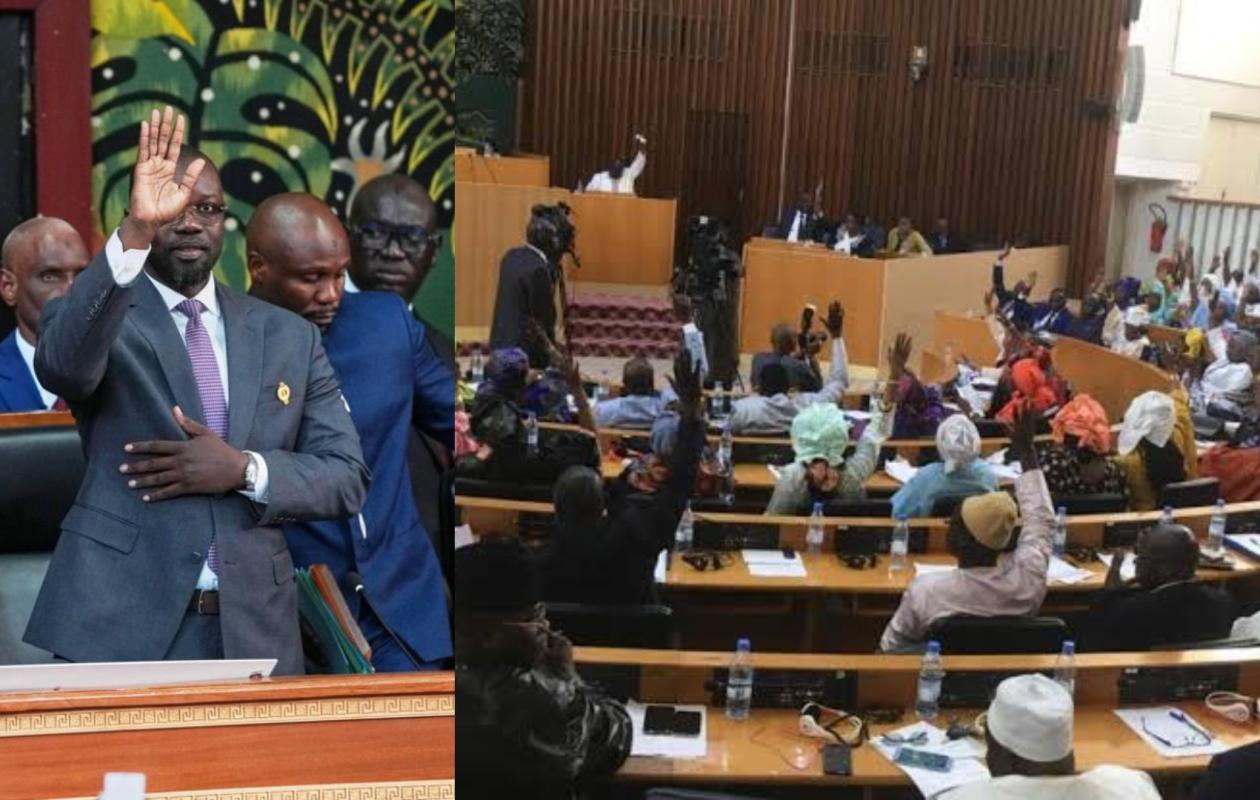
Charges publiques et vote bloqué : Les deux fautes de procédure qui ont condamné la révision de l'Assemblée
Meeting in session this Thursday, July 9, 2026, the Constitutional Council issued its ruling in case no. 6/C/26. Under the interim presidency of Ms. Aminata Ly Ndiaye, the judges declared law no. 18/2026, adopted by the National Assembly on June 29, 2026, contrary to the Constitution.
Although the President of the National Assembly had argued that the highest court lacked jurisdiction and that the referral was inadmissible, the Constitutional Council dismissed these objections. The ruling details precisely the reasons for this invalidation, which is based on the violation of two substantive rules of legislative procedure.
1. Lack of financial guarantees (Violation of Article 82, paragraph 2)
The first ground for censure upheld by the Constitutional Council concerns the financial inadmissibility of the amendments introduced by the members of parliament. The high court reiterates that, under Article 82, paragraph 2, of the Constitution, bills and amendments proposed by parliamentarians are inadmissible if their adoption leads to a reduction in public revenue, or the creation or increase of a public expenditure, unless they are accompanied by compensatory revenue.
However, the challenged constitutional law transferred the management of elections to a single body and modified the powers of the Constitutional Court. The judges noted that "the new powers imply an increase in human, material, and budgetary resources." This creation of public expenditures necessarily required a proposal for compensatory revenue. By failing to comply with this requirement, the National Assembly violated the fundamental charter.
2. The illegal refusal of the "blocked vote" (Violation of Article 82, paragraph 4)
The second ground for invalidation lies in the failure to respect the constitutional prerogatives of the executive branch within the assembly. Article 82, paragraph 4, of the Constitution allows the Government to demand a "blocked vote," that is, to ask the National Assembly to vote in a single vote on all or part of the text under discussion, retaining only the amendments proposed or accepted by the executive.
The examination of the documents submitted to the file proved that the Government had explicitly requested this procedure in order to exclude parliamentary amendments. By refusing to proceed in this manner and by disregarding it, "the National Assembly, by refusing to proceed in this manner, at the Government's request, disregarded the provisions of paragraph 4 of Article 82 of the Constitution."
According to the judges, the failure to comply with these combined provisions constitutes "substantial defects affecting the procedure for adopting the challenged law." The Constitutional Council concluded that these violations directly affected the validity of the revision law itself.
Therefore, the high court pronounced the total censure of Law No. 18/2026 and ordered the publication of this decision in the Official Gazette.



















Commentaires (50)
Participer à la Discussion
Règles de la communauté
💡 Astuce : Utilisez des emojis depuis votre téléphone ou le module emoji ci-dessous. Cliquez sur GIF pour ajouter un GIF animé. Collez un lien X/Twitter, TikTok ou Instagram pour l'afficher automatiquement.
Se connecter
Commentez avec votre profil, votre photo, et soyez averti des réponses.