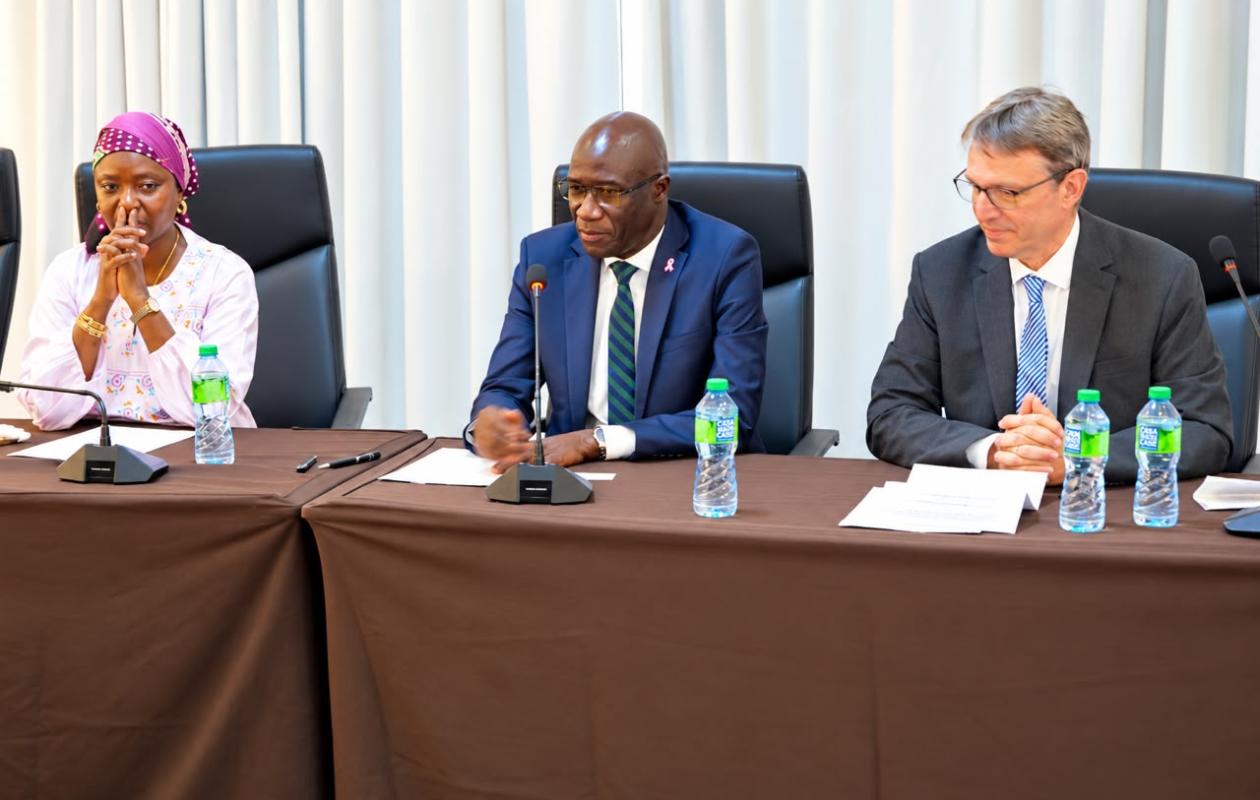
Réinsertion des jeunes en danger ou en conflit avec la loi : le ministre de la Justice appelle à une mobilisation nationale
The Minister of Justice, Keeper of the Seals, Mr. Moussa Sarr, presided over the opening ceremony of a high-level panel dedicated to the establishment of an operational mechanism and fund for the integration and reintegration of young people at risk or in conflict with the law.
Addressing in particular the Director General of Judicial and Social Protection, the representative of GIZ, the Directors General and Directors of ministerial departments, agencies and funds, the representatives of the United Nations System, technical and financial partners, the private sector and civil society, as well as the inspectors of Supervised Education and Social Protection, the directors of centers and the coordinators of open environment educational action services (AEMO), Mr. Sarr said he had accepted "with real pleasure" to preside over this ceremony.
Recalling that he was a lawyer before becoming Minister of Justice, he confided that he still harbored "this persistent concern for those who have no one to speak for them." According to him, there is no more vulnerable person, nor any nobler cause to plead, than a child, whether they are a victim of violence, in danger, a witness to what no child should ever see, or in conflict with the law. He posed the question the panel must answer: what becomes of a young person the day after their legal protection ends?
The minister explained that this department exists to ensure that children are always subjects of rights and never objects of legal proceedings. Each year, nearly seventeen thousand minors are entrusted to it by the judicial authorities: child victims, child witnesses, minors in conflict with the law, as well as young adults under the age of twenty-one in danger. He affirmed that the State owes each of them a tailored response, never simply punishment: reparation, support, and rehabilitation for child victims; protection before it is too late for children in danger; and education and a second chance for children in conflict with the law. "This is what the best interests of the child are all about," he declared.
Mr. Sarr praised and thanked the specialized educators, psychologists, social workers, trainers, inspectors, center directors, and coordinators of the AEMO services, who create this opportunity "every day, far from the cameras." They welcome children who have experienced violence, homelessness, fear, and sometimes shame. They listen to them, soothe them, reconnect them with their families when they can be a resource, help them catch up, and then train them.
Specific figures for 2025
This work, the minister emphasized, is bearing fruit: in 2025, more than 412 residents of the centers passed their professional exams, with 311 receiving certificates and 101 earning their CAP (vocational training certificate), particularly in carpentry, hairdressing, upholstery, electricity, refrigeration and air conditioning, and catering. Each of these figures, he said, represents a young person who once doubted themselves and now holds in their hands a trade and a restored sense of dignity.
The minister noted, however, that the diploma is not the end of the road, and that this is where the system's weakness lies. Upon graduation, these young people often hit a wall: no support for further training, no apprenticeships, no pathway to salaried employment, no microcredit, and no start-up kits to become self-employed. "We've taught them a trade, and we're leaving them at the workshop door without the key," he lamented. For a young woman who is a victim of violence, as for a young man in danger or in conflict with the law, economic independence is, in his view, the best protection against returning to the streets, exploitation, precariousness, and sometimes recidivism.
The Minister noted that the Government had already provided an initial response: through Decree No. 2024-792 of March 26, 2024, amending Decree No. 2023-679 of March 23, 2023, concerning the organization of the Ministry of Justice, the State established the Fund for the Reintegration of Vulnerable Minors and Young Adults. Its objective is to provide a pathway to independence and socio-professional integration, and to equip the Directorate General with a mechanism for financing and supporting initiatives led by the young people themselves.
“A fund alone is not enough,” cautioned Mr. Sarr, for whom the success of a reintegration policy depends on collective mobilization. He called on public institutions to include this category of young people among their priority targets, through the awarding of scholarships and the establishment of quotas. He asked private companies to open their doors to internships, apprenticeship contracts, and entry-level jobs, seeing these young people “not as risks, but as opportunities.” He asked national and international technical and financial partners to support the implementation of innovative and inclusive mechanisms. Reintegration, he summarized, is a national endeavor that requires solidarity from institutions, commitment from businesses, and the trust of civil society.
To illustrate his point, the minister invited the audience to imagine a sixteen-year-old girl, rescued from violence, taken in, cared for, and trained as a hairdresser, and a seventeen-year-old boy, sent to a center for a minor offense, who leaves with a vocational certificate in electrical work. If they find a master craftsman and a little capital to buy their first tools, they will become the hairdresser who employs staff and the electrician in high demand. If they find nothing, they will return to the streets and its dangers. "Between these two destinies, there is sometimes only a door, open or closed. It is up to all of us to open that door," he declared.
"Reintegration is not a favor, it's a right."
Speaking "as an advocate for rights and freedoms," Mr. Sarr asserted that reintegration is not a favor but a right. According to him, a young person who has been through the juvenile justice system should be neither a victim for life nor a delinquent for life: "they are a talent who has not yet had their chance."
The minister presented the panel as a crucial step, intended to build a coherent framework linking protection, rehabilitation, and reintegration. He urged participants to work rigorously and creatively, to overcome institutional silos, and to join forces so that every young person supported toward independence becomes a collective victory. He reaffirmed the government's commitment to leaving no young person behind and expressed his hope that the integration and reintegration of vulnerable youth would be "not a challenge, but a national success."














Commentaires (0)
Participer à la Discussion
Règles de la communauté
💡 Astuce : Utilisez des emojis depuis votre téléphone ou le module emoji ci-dessous. Cliquez sur GIF pour ajouter un GIF animé. Collez un lien X/Twitter, TikTok ou Instagram pour l'afficher automatiquement.
Se connecter
Commentez avec votre profil, votre photo, et soyez averti des réponses.