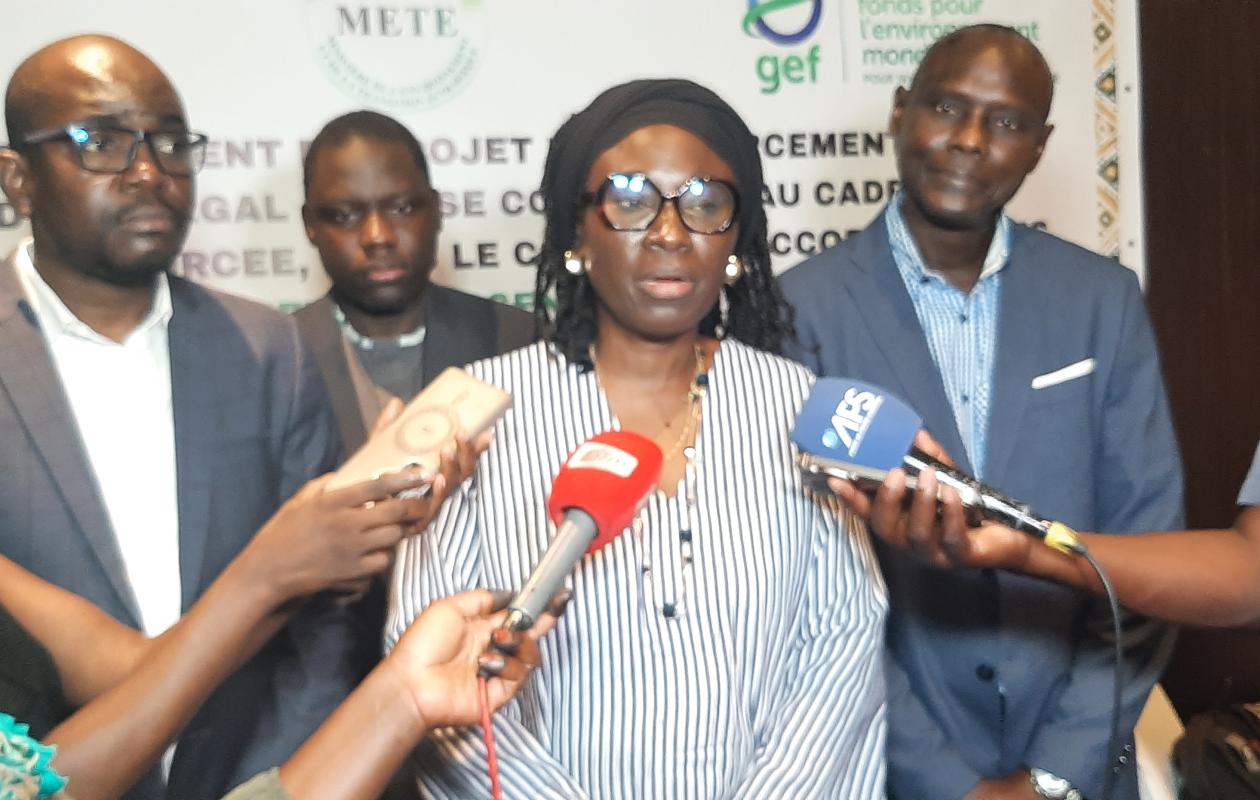
Données climatiques : Le ministère de l’Environnement lance le projet CBIT-Sénégal pour renforcer les capacités nationales
It's official! The Capacity Building Project for Senegal to comply with the Enhanced Transparency Framework (CBIT-Senegal) was launched this Wednesday in Dakar, on the sidelines of a workshop held for this purpose. This project will enable Senegal to sustainably strengthen its technical, institutional, and human capacities in order to fully meet the requirements of the enhanced transparency framework.
A major initiative funded by the Global Environment Facility
CBIT-Senegal, funded by the Global Environment Facility (GEF) with support from the United Nations Environment Programme (UNEP), is a major initiative aimed at strengthening national capacities in climate transparency, improving climate data collection and management systems and supporting the implementation of the Nationally Determined Contribution (NDC 3.0), in accordance with the requirements of the Paris Agreement.
It is part of the implementation of the commitments made by the State of Senegal under the Paris Agreement on climate change.
The project is structured around three major components. The first aims to establish an integrated national transparency platform, a true national infrastructure designed to centralize, harmonize, secure and disseminate climate data.
The second will enable the development of the various technical modules necessary for monitoring greenhouse gas emissions, adaptation, loss and damage, technological needs, capacity building and financial support.
Finally, the third component will promote the sustainable integration of this platform into national planning, monitoring and evaluation processes and international reporting, while strengthening the capacities of national institutions.
Senegal has ratified the United Nations Framework Convention on Climate Change, the Kyoto Protocol and the Paris Agreement, thus reflecting its willingness to contribute fully to the global effort to combat climate change.
He also prepared three national communications, an updated biennial report, submitted his Nationally Determined Contribution and recently carried out the technical validation of NDC 3.0, the result of a major participatory process that mobilized all relevant sectors.
These advances reflect the country's ongoing commitment to implementing climate action based on responsibility, transparency, and continuous improvement.
However, it is clear that today, effective climate policy cannot be implemented without reliable, harmonized, regularly updated, and accessible data. The CBIT-Senegal project is part of this dynamic.
“Climate data has become a true strategic asset.”
In this regard, the Chief of Staff to the Minister of the Environment and Ecological Transition, Dr. Bouré Diouf, presiding over the meeting on behalf of Minister Dr. Aliou Gori Diouf, reiterated the need to have this data.
“Climate data has become a true strategic asset. It allows us to measure national greenhouse gas emissions, assess progress in implementing our Nationally Determined Contribution, monitor adaptation actions, guide public and private investments, assess climate finance needs and report on results achieved,” he argued, in the presence of Madeleine Diouf Sarr, Director of Climate Change, Ecological Transition and Green Finance.
He adds: “However, despite the progress made, we still face several challenges related to the availability, quality, harmonization and sharing of data between different sectors. This situation limits our ability to produce consistent information, demonstrate the results of our public policies and mobilize more international financial resources.”
According to Dr. Diouf, in the current context, data is the true currency of climate credibility. "Without robust data, it becomes difficult to assess progress made, to convince donors, and to demonstrate the effectiveness of investments made," he insisted.
According to him, this project, over the next three years, will allow Senegal to sustainably strengthen its technical, institutional and human capacities in order to fully meet the requirements of the enhanced transparency framework.
The meeting was organised by the Ministry of the Environment and Ecological Transition, through the Directorate of Climate Change, Ecological Transition and Green Finance.
It brought together representatives from public administrations, technical and financial partners, local authorities, the private sector, universities, research centers and civil society organizations.






















Commentaires (0)
Participer à la Discussion
Règles de la communauté
💡 Astuce : Utilisez des emojis depuis votre téléphone ou le module emoji ci-dessous. Cliquez sur GIF pour ajouter un GIF animé. Collez un lien X/Twitter, TikTok ou Instagram pour l'afficher automatiquement.
Se connecter
Commentez avec votre profil, votre photo, et soyez averti des réponses.