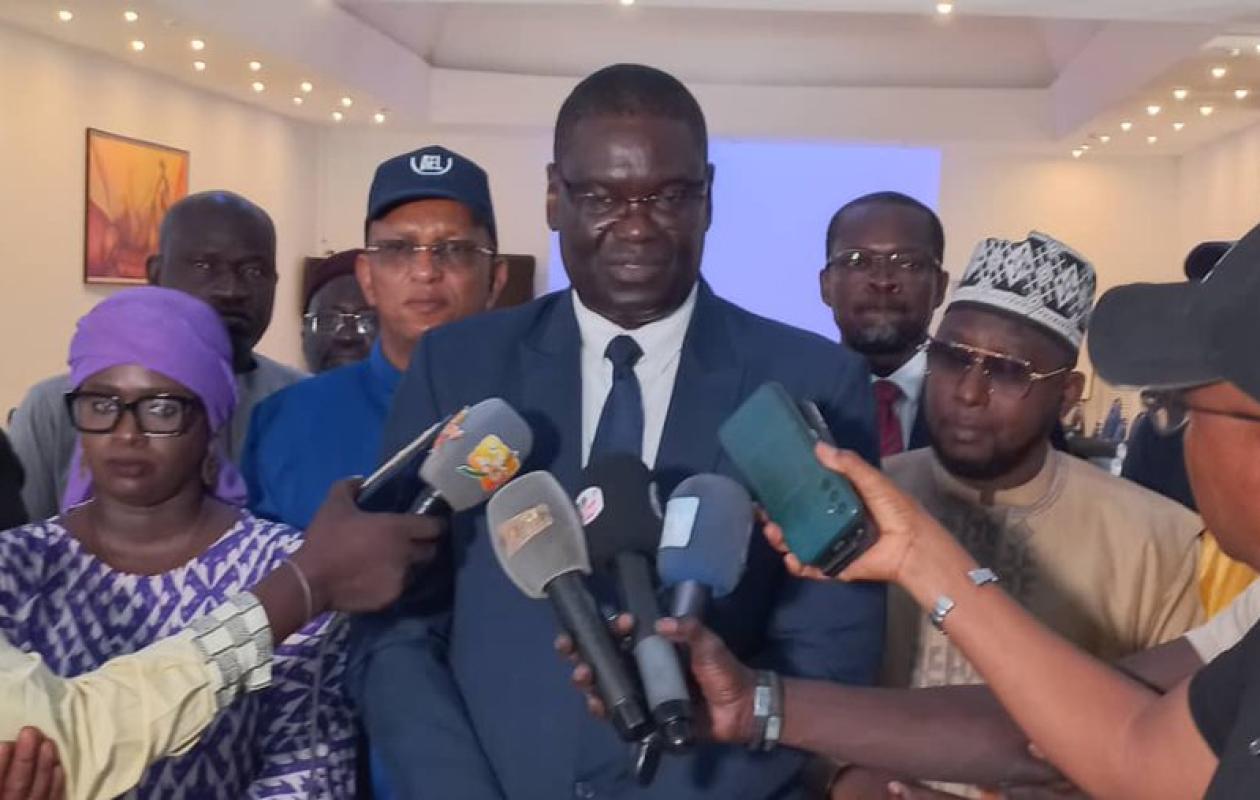
Agenda Sénégal 2050 : Le ministre Alain Diouf annonce une grande réforme foncière
Invited by the Union of Associations of Local Elected Officials of Senegal, Alain Diouf, Minister to the President of the Republic in charge of Monitoring and Evaluation of the Senegal 2050 Agenda, outlined the government's ambitions for territorial development. At the heart of his presentation were reducing disparities between regions, transferring resources, and land reform designed to enable landowners to better utilize their land.
Territorial development is one of the pillars of the implementation of the Senegal 2050 Agenda. This was the message delivered by Alain Diouf to local elected officials. According to the minister, local authorities must become the local extension of the policies and projects outlined in this national transformation framework.
Alain Diouf highlighted the significant imbalances that persist between different parts of the country. Economic development remains heavily concentrated on the western coast, while the central, eastern, and southern regions still lag considerably behind. To address this situation, the government intends to promote the transfer of resources and economic opportunities to the areas that have the least access to them. "Whether it be energy resources, water resources, or goods and services," the minister explained, mentioning the implementation of major transfer projects and river, road, and maritime corridors.
This territorial approach to development is part of the reform of the Territorial Hubs and the fourth phase of decentralization. In July, the Head of State had already called for accelerating the territorialization of public policies and strengthening the financial resources of local authorities. For Minister Alain Diouf, the Senegal 2050 Agenda should not be reduced to a mere succession of government projects. It constitutes a long-term vision intended to transcend political mandates and individual ambitions in order to set the country on a sustainable path.
But this long-term ambition must also produce immediate results. The minister cites road, healthcare, university, and agricultural infrastructure as responses to the daily needs of Senegalese citizens. The 2050 Agenda is based on both strategic investments and structural reforms. Official documents outlining the framework specifically identify decentralization and land reform as key transformations for a lasting change in the development model.
Land ownership, a strategic reform
The other major project mentioned by Alain Diouf remains land reform. The former technical coordinator of the Land Registry and Land Tenure Security Project (PROCASEF), appointed minister in June 2026, has particularly extensive experience in these matters. He indicated that significant fieldwork had already been carried out in local authorities and that discussions were continuing smoothly.
According to him, the aim is to enable landowners not only to cultivate their land, but above all to develop it. The objective is, in particular, to reduce the disparities between different land tenure systems, especially state-owned land, private property, and national land. This approach aligns with the objectives officially set by the government, namely to facilitate access to land ownership, secure the rights of legal holders, and enable land to become a genuine driver of financing and investment.
Through these various reforms, Alain Diouf advocates a new approach to territorial development: less focused on Dakar and the western coast, and more oriented towards the potential specific to each territory.















Commentaires (6)
Participer à la Discussion
Règles de la communauté
💡 Astuce : Utilisez des emojis depuis votre téléphone ou le module emoji ci-dessous. Cliquez sur GIF pour ajouter un GIF animé. Collez un lien X/Twitter, TikTok ou Instagram pour l'afficher automatiquement.
Se connecter
Commentez avec votre profil, votre photo, et soyez averti des réponses.