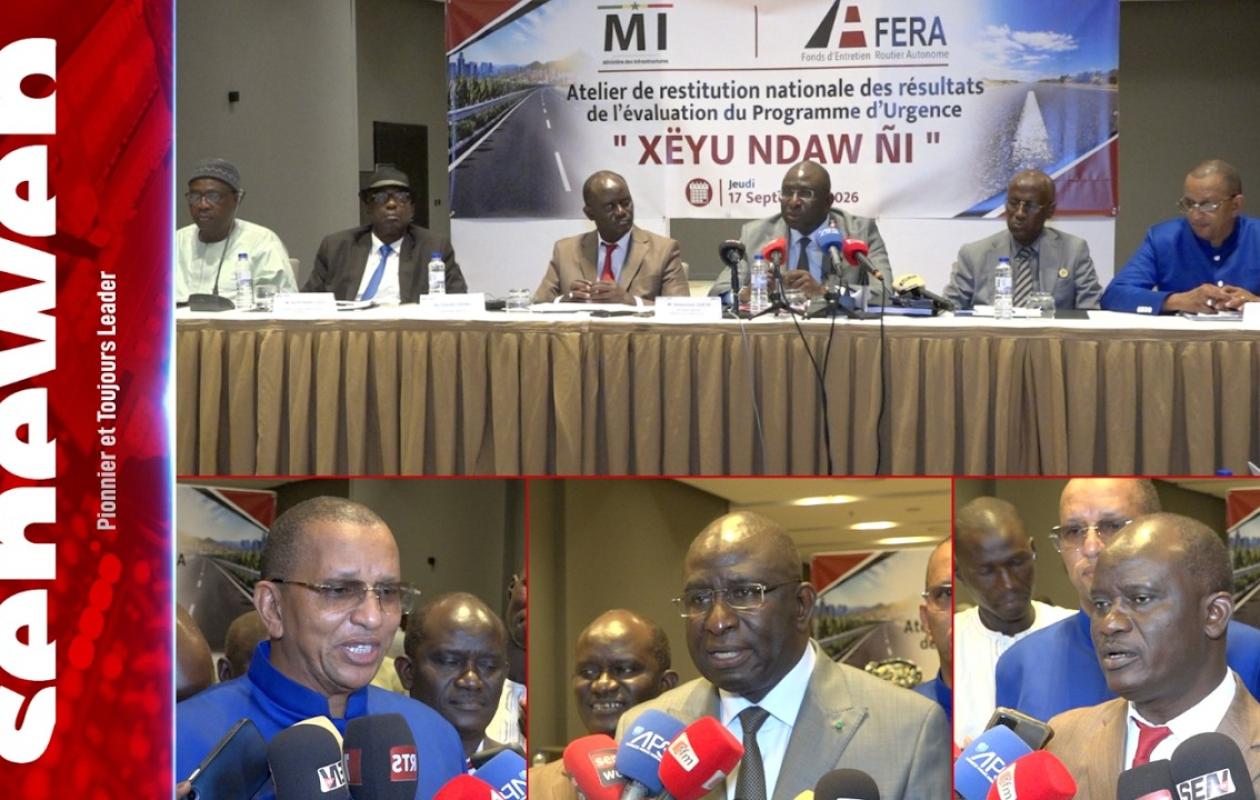
Évaluation du programme « Xëyu Ndaw Ñi » : Plus de 25 000 emplois créés et plus de 15 milliards injectés directement dans les économies locales
The Autonomous Road Maintenance Fund (FERA) convened all stakeholders in the infrastructure and decentralization sectors this Thursday to present the findings of the independent evaluation of the road component of the Emergency Program for Youth Employment and Socio-Economic Integration, "Xëyu Ndaw Ñi". This national meeting, held in Dakar, was chaired by the Secretary General of the Ministry of Infrastructure, Abdoulaye Guèye, in the presence of the Director General of FERA, Cheikh Dieng, and mayors from across the country.
A positive outcome
Launched in 2021 by the Senegalese government to address the employment crisis with an initial budget of 450 billion CFA francs (extended for one year with an additional 150 billion CFA francs), the "Xëyu Ndaw Ñi" program aimed to promote youth employment through public works projects. The component implemented by FERA financed the maintenance of the unclassified road network using a High-Intensity Labor (HIMO) approach, delegating project management directly to local authorities through financing agreements.
Conducted by MKD Vision Holding on a national sample covering 500 municipalities across the country's 46 departments and 14 regions, the evaluation demonstrated the effectiveness and strong socio-economic impact of the program. According to the results, 24.57 billion FCFA in public funding was mobilized by FERA between 2023 and 2024 (initial agreements and amendments); 25,570 local service providers were directly recruited at the municipal level; 15.67 billion FCFA in payroll was injected directly into household economies up to July 2024; there was strong social inclusion: 52.3% of beneficiaries are women; and the results were conclusive: 96.3% of beneficiaries reported an improvement in their income, and 95.2% of users observed easier access to schools, markets, and health centers.
A program with a strong positive impact
This independent evaluation, conducted with "rigor, transparency and objectivity," relied on a mixed methodology (quantitative and qualitative) combining OECD-DAC criteria. The survey involved 4,700 young beneficiaries, 2,683 users, 542 transport operators, 137 local authorities, and 221 direct observations of road sections.
Regarding the socio-economic impact on beneficiaries, the report reveals an increase in income: 96.3% of beneficiaries report a direct improvement in their economic situation thanks to the remuneration received. This income is primarily used to cover essential household needs (86.2%) and support the family (78.2%).
Regarding skills development, 76.1% of young people report having acquired technical and organizational skills in public works. The main aspiration expressed by post-program participants is access to permanent employment (84.2%).
Regarding gender inclusion, the program stands out for its high level of equity: 52.3% of beneficiaries are women, and 92.5% of respondents confirm that women had the same opportunities to access HIMO (High-Intensity Labor) projects. However, 17.2% report the persistence of socio-cultural barriers or difficulties in accessing equipment.
In relation to opening up and territorial mobility, users note a clear improvement in access to health centers (100%), markets (95.2%) and schools (95.2%), and 79.7% of transporters note an improvement in traffic conditions and 78.0% record an increase in their operating income.
Challenges identified and levers for improvement
The evaluation also highlighted major operational constraints that need to be addressed to ensure the program's sustainability. These include the targeting of young people: only 5.0% of beneficiaries are between 18 and 25 years old, while those over 35 represent 56.9% of the total; municipalities have often prioritized the overall vulnerability of households, to the detriment of prioritizing young first-time job seekers. While 77.8% of the roads observed remain passable year-round, 45.7% of the verges are in poor physical condition, threatening the road surface in the medium term without preventative maintenance.
For municipal governance, the audits revealed administrative weaknesses in some town halls (contractual archiving, accounting practices, lack of dedicated technical support).
Outlook to 2031
Beyond this positive assessment, the workshop of September 17, 2026 lays the groundwork for the strategic refocusing of the program for 2030. Aligned with the National Development Strategy (NDS 2025–2029), the new Action Plan introduces the revision of the FERA-Communes agreement model, the establishment of a charter for the employment of young people and women, the creation of municipal road maintenance brigades and the full digitalization of monitoring and evaluation.
Looking ahead to 2031, FERA, with the advent of the new National Development Strategy (SND), which places sovereignty, human capital, territorial equity, and good governance at the heart of Senegal's structural transformation, aims to develop this program further. For the Director General, the goal is no longer to "manage a one-off emergency mechanism, but to establish a permanent and professional system for municipal road maintenance."
To this end, Cheikh Dieng announced that the action plan for 2030, which will be validated during the meeting, is structured around 8 strategic axes and 30 priority actions. According to him, the first major innovation of this restructuring is the complete overhaul of the partnership framework. "I am pleased to present to you today the new revised FERA-Municipalities financing agreement," he announced.
This performance contract will now include: specific objectives in terms of employment, training and gender quotas (at least 30% women); enhanced technical support and the establishment of permanent municipal road maintenance brigades; the complete digitalization of monitoring and evaluation (via geolocation and the use of KoboCollect) to ensure total transparency and real-time feedback; official certification of the skills acquired by young people on construction sites so that their participation in the program serves as a springboard to sustainable jobs in the construction sector.


















Commentaires (7)
Participer à la Discussion
Règles de la communauté
💡 Astuce : Utilisez des emojis depuis votre téléphone ou le module emoji ci-dessous. Cliquez sur GIF pour ajouter un GIF animé. Collez un lien X/Twitter, TikTok ou Instagram pour l'afficher automatiquement.
Se connecter
Commentez avec votre profil, votre photo, et soyez averti des réponses.