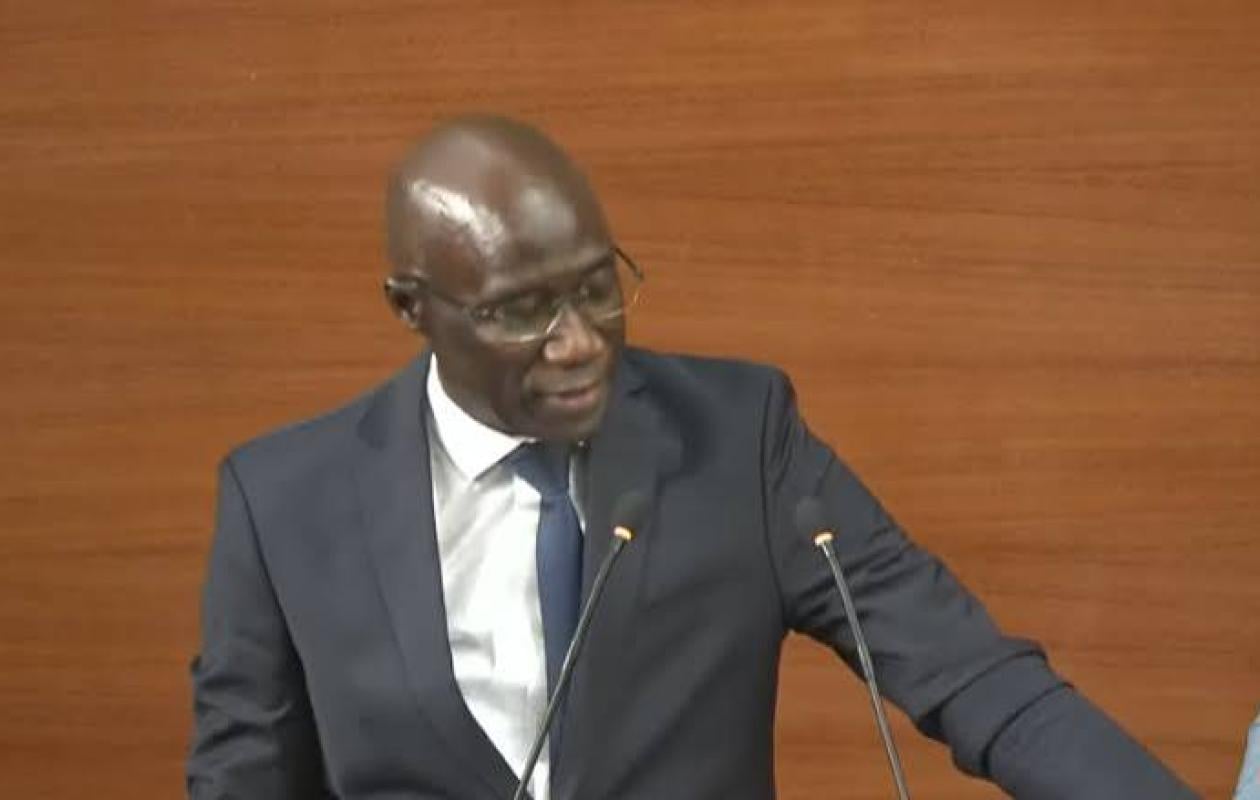
Fonds spéciaux : Me Moussa Sarr impose le vote bloqué et justifie la décision du gouvernement
The government has decided to use the procedure of a single, uncontested vote on the draft organic law concerning special appropriations or funds. Before the members of parliament on Thursday, October 1, 2026, the Minister of Justice, Keeper of the Seals, Moussa Sarr, formally requested a single vote on the entire text, incorporating only the amendments accepted or proposed by the executive branch.
"The government alone decides" on the appropriateness of the blocked vote
For Mr. Moussa Sarr, the use of this emergency mechanism is primarily aimed at ensuring the legal consistency of the text and the effectiveness of public action: "I formally request, for this proposed organic law, that a single vote be taken on the text under discussion, retaining only the two amendments proposed or accepted by the government," he declared before the assembly.
To support his argument, the minister relied on Article 82, paragraph 4 of the Constitution and Article 87, paragraph 2 of the Rules of Procedure of the National Assembly. He also cited Decision No. 6/C/2026 of the Constitutional Council, issued on July 9, 2026, which reiterated that this prerogative is a right and is binding on the national representation as soon as it is requested.
Presenting the blocked vote as "an instrument for rationalizing parliamentarism" enshrined in the Fundamental Law, Mr. Moussa Sarr insisted that the government intends to use it "solely in the interest of the legal coherence of the system and the effectiveness of state action" .
Two amendments to "secure" the text
The Minister of Justice then detailed the adjustments maintained by the executive branch. A first amendment, concerning the explanatory memorandum, was abandoned after the parliamentary committee took into account the formal observations of the Head of State.
Two substantive amendments remain to be voted on. The first concerns Article 14 and aims to remove the specific provision dedicated to special appropriations or funds, instead linking them to the overall budgets of the relevant constitutional institutions. According to the government, this amendment avoids a conflict of laws with Directive No. 06/2009/CM/UEMOA and the organic law relating to finance laws.
The second amendment concerns Article 70. It reintroduces the usual framework for control exercised by the Finance Committee and removes a provision deemed likely to encroach on the exclusive prerogatives of the Court of Auditors.
Preserve the hierarchy of standards
Speaking on the issue of oversight, the Minister of Justice asserted that these decisions do not distort the spirit of the reform: “These amendments in no way call into question the objective of transparency pursued by the proposed organic law. The government does not see transparency as a constraint, but as a lever for consolidating the rule of law and strengthening citizens' trust in our institutions.”
In concluding his speech, Mr. Moussa Sarr reaffirmed the government's commitment to maintaining enhanced parliamentary oversight, while ensuring respect for the hierarchy of norms, community legislation, and the distribution of powers between institutions.

















Commentaires (6)
Participer à la Discussion
Règles de la communauté
💡 Astuce : Utilisez des emojis depuis votre téléphone ou le module emoji ci-dessous. Cliquez sur GIF pour ajouter un GIF animé. Collez un lien X/Twitter, TikTok ou Instagram pour l'afficher automatiquement.
Se connecter
Commentez avec votre profil, votre photo, et soyez averti des réponses.