Panier de la ménagère, logement, ménages vulnérables… : « Comment l’État compte résoudre les difficultés des Sénégalais » (DPG)
Prime Minister Ahmadou Al Aminou Lo outlined the government's fourth commitment in parliament on Tuesday, September 8th. He described it as simple to state but demanding to fulfill: to "resolve the difficulties faced by our citizens and improve their quality of life, day after day."
He said he was aware of the will of the Senegalese people. "They want concrete changes. Our action will therefore be judged on the basis of directly perceptible indicators: cost of the basket of current consumption; weight of food, housing, energy, transport, health and education in household income; purchasing power available after essential expenses; decent jobs created and integration of trained young people; annual duration of productive and profitable activity, particularly in rural areas; effective access to water, sanitation, care and public services; reduction of delays and costs borne by users," he listed.
The head of government explained that the doctrine of the National Transformation Agenda consists precisely in linking each project, program, and reform to these measurable results, so that public action truly transforms people's lives. Here are the government's measures.
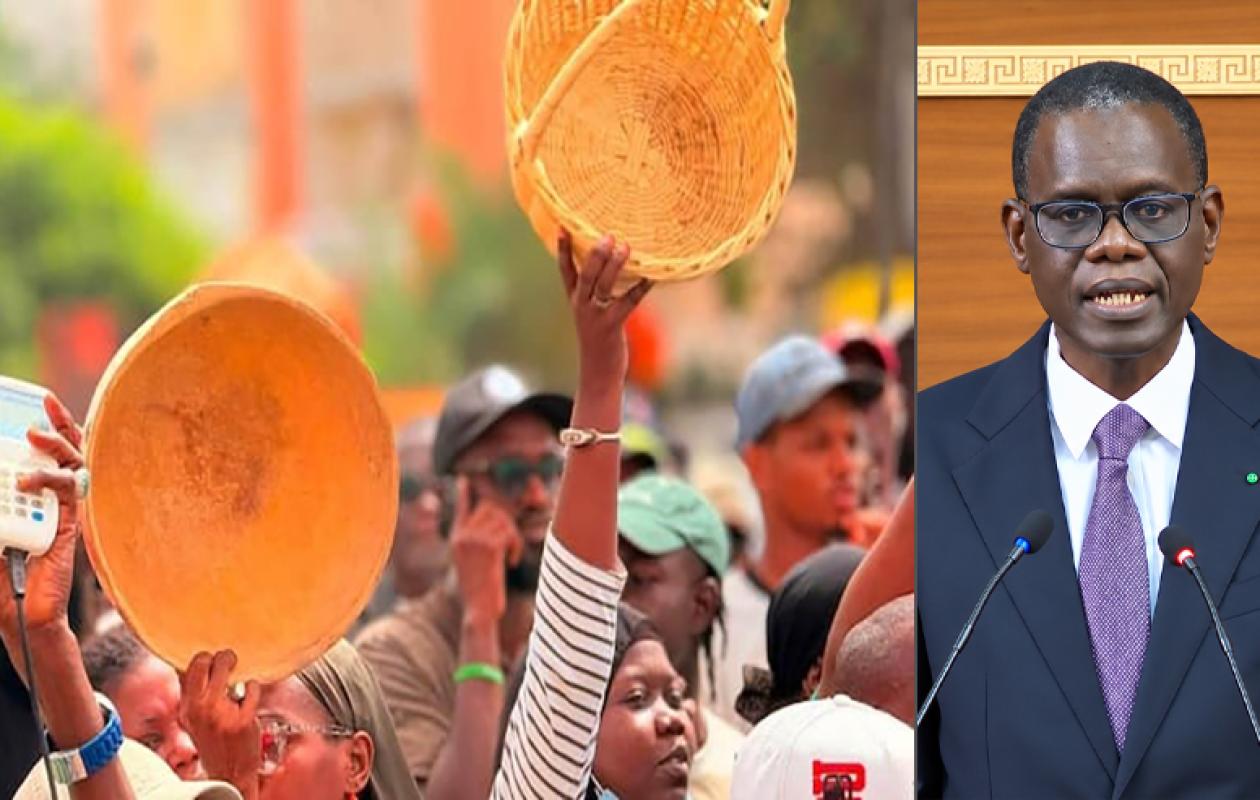
Lighten the load for the housewife
"Reducing the cost of food for the average household relies on two levers: producing what we eat; eating what we produce. In other words, food sovereignty in action."
The average household's shopping basket is particularly sensitive to price fluctuations in products that represent a significant portion of consumption, namely: unprocessed cereals, bread, beef, fresh fish, oils, sugar, fresh vegetables, and milk. This situation is exacerbated during the rainy season for meat, seafood, and fresh vegetables. All these products are grown, cultivated, and sold in Senegal. So, who is to blame : the government ? Producers, consumers, importers, traders? International markets?
My government is committed to tackling this situation head-on through public-private sector program contracts in order to diagnose, in minute detail, the weaknesses and propose a medium-term strategy. In the meantime, we will strengthen storage capacity and controls throughout the country.
Protecting vulnerable households and better targeting solidarity
Shared prosperity requires robust social safety nets. The ANSD (National Agency for Statistics and Demography) counts 1,000,649 vulnerable households, while only 355,013 poor households are actually covered: the shortfall reaches 645,636 households, or nearly five million Senegalese exposed to vulnerability or poverty. Our response will be based on four priorities:
(i) consolidate social protection and family resilience;
(ii) accelerate the economic empowerment of women;
(iii) strengthen child protection and the inclusion of persons with disabilities and vulnerable groups;
(iv) modernize the management of social action.
The goal is to provide a robust social safety net to one million poor and vulnerable households, representing 7.8 million Senegalese, by 2027. The budget, initially set at 70 billion CFA francs in September 2026, will be doubled to 140 billion in 2027.
The arrears of the National Family Security Grants will be cleared during September 2026. Savings resulting from more equitable targeting of energy subsidies will be redirected to the populations most in need. In this way, the efficiency of public spending becomes an instrument of social equity.
Making energy a lever for purchasing power
Addressing daily challenges means making energy available at a sustainable cost, as this impacts the entire production and consumption chain. Domestic gas will play an increasingly important role in electricity production: producing at home means paying less at home.
For the population, these transformations should translate into two visible results: a 30% decrease in the price of electricity per kWh by 2030 and a reduction in the gap in access between urban and rural areas. In this regard, the Universal Access Program will be intensified for the 6,471 localities still to be electrified.
To guarantee decent housing and living conditions
The housing deficit is estimated at 500,000 units and increases by 10,000 to 15,000 units each year. Our ambition is to deliver at least 30,000 occupied housing units annually and to progressively increase the proportion of Senegalese living in decent housing from 56% to 75%. Social and affordable housing programs will be revitalized; developed land will be mobilized; and a national construction materials sector will be supported to sustainably reduce costs. Public instruments (SICAP, SN-HLM, CDC Habitat, the Social Housing Fund, SAFRU, the Housing Bank of Senegal, and Kajom Capital) will be reorganized and better coordinated. The planning for Greater Dakar and the new city of Thiès must embody sustainable, inclusive, resilient, and territorially balanced urbanization.
Turn every investment into a platform for jobs and skills
Each project in the Senegal 2050 Agenda must become a platform for training, integration, and value creation. The Masterplan highlights an overall potential of 1,520,000 jobs by 2029. Key targets include: 113,500 jobs related to community agricultural cooperatives, 60,000 in artisanal fishing and the blue economy, 50,000 in affordable housing, 45,000 in agropoles, 33,000 in cultural and creative industries, 27,000 related to the Youth Olympic Games and their legacy, 22,000 in the dairy and poultry sectors, 18,000 in aquaculture, and 16,000 in renewable energy.
These projections must be translated into verifiable contributions, complete with trajectories, milestones, responsibilities, and integration rates. Our ambition is for every public or private investment in the Agenda to generate identifiable, sustainable skills, activities, and jobs.
Investing in education and research
This ambition requires commensurate infrastructure and educational reforms: the elimination of temporary shelters, the construction of 12 LYNAQE ( Digital Learning and Education Centers), 15,000 connected classrooms, and 45 open digital spaces; the completion of the universities in Matam, Eastern Senegal, and Sine-Saloum, as well as student residences. Curriculum reform, STEM (Science, Technology, Engineering, and Mathematics), bilingualism, national languages, digital transformation, and the integration of daaras (Koranic schools) will continue. Following the recruitment of 4,980 teachers in 2025, a special recruitment program for 2,527 new teachers will be launched no later than the fourth quarter of 2026. The National School Feeding Strategy will also enter its operational phase.
In higher education, we will implement the National Agenda for the Transformation of Higher Education, Research and Innovation (ANTESRI), which is based on three levers consistent with the national trajectory: correcting the system by stabilizing it; driving structural reforms; accelerating through levers of impact and sovereignty.
Making healthcare accessible everywhere and at all times
In healthcare, proximity, quality, and dignity will be the criteria for success. The situational analysis reveals that 80% of the infrastructural, material, and human resources of public and private healthcare services are concentrated in Dakar.
Such a situation is unacceptable. Therefore, we are committed to strengthening emergency services, maternity, pediatric, surgical, and telemedicine services, as well as healthcare coverage and staffing levels, throughout the country. Continuity of care must be guaranteed during any hospital renovation; water and electricity outages in healthcare facilities and the awarding of contracts to unsuitable operators are unacceptable. Upgrading technical facilities will be accelerated through the construction and renovation of hospitals, health centers, and clinics.
Over the period 2026-2034, the government will strengthen universal health coverage and compulsory health insurance, update the Health Map and deploy the computerized Patient Record as well as the Health Observatory."

















Commentaires (4)
Participer à la Discussion
Règles de la communauté
💡 Astuce : Utilisez des emojis depuis votre téléphone ou le module emoji ci-dessous. Cliquez sur GIF pour ajouter un GIF animé. Collez un lien X/Twitter, TikTok ou Instagram pour l'afficher automatiquement.
Se connecter
Commentez avec votre profil, votre photo, et soyez averti des réponses.