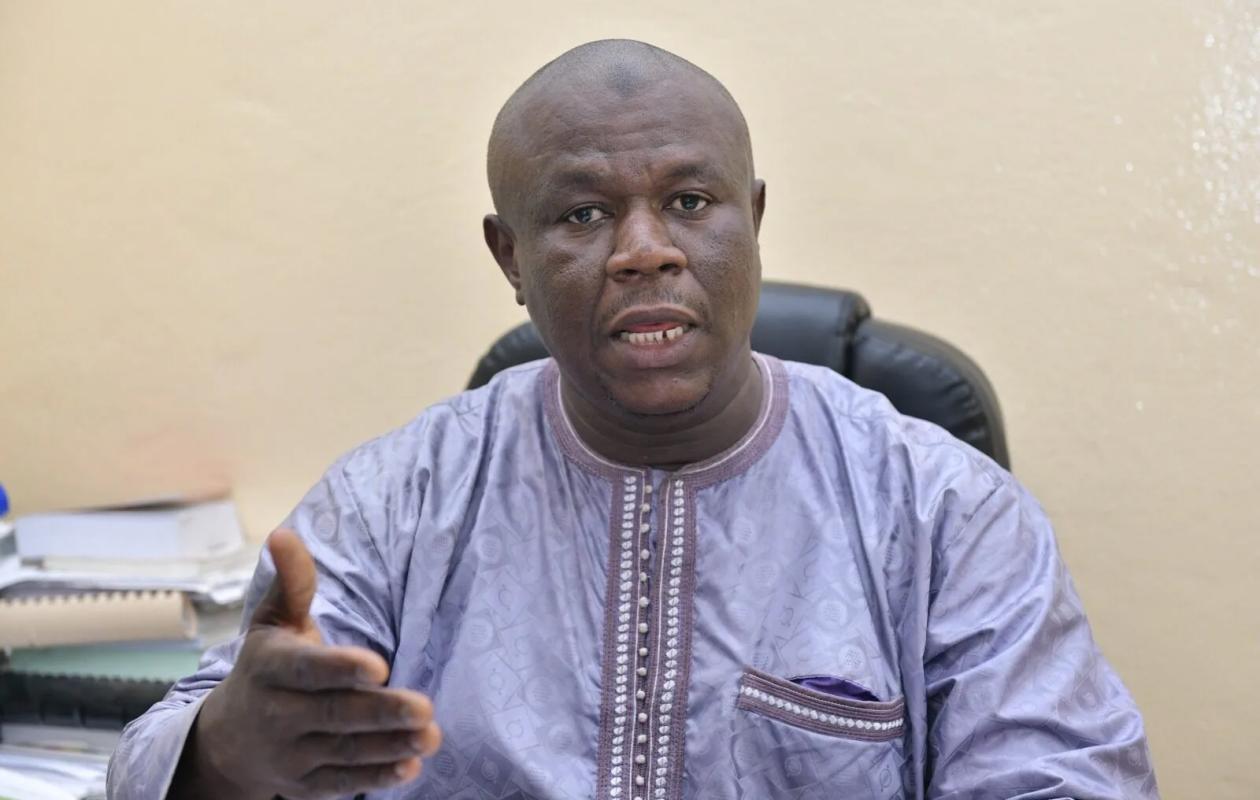
Pr Mamadou Yaya Diallo, (UCAD) : « L'Initiative pour la gouvernance mondiale propulse le Sud global vers la modernité »
At a time when the Global South intends to have more influence on major international decisions, Professor Mamadou Yaya Diallo, a professor of international law at UCAD, analyzes the first anniversary of the Global Governance Initiative, celebrated in September 2026.
He reflects on the leading role of Senegal, a founding member of the Group of Friends of Global Governance and the World Organisation for Cooperation in Artificial Intelligence (AI), and on Sino-African cooperation as a lever for modernization.
According to him, the Global Initiative for Global Governance (GIG) embodies a clear answer to the question, "Who does global governance serve?": it serves the Global South and the peoples of the world. Thus, the professor of international law argues for a more just and equitable international order. Here is his analysis.
“In September 2026, the Global Governance Initiative (GGI) celebrates its first anniversary. This year will be remembered as the year in which the Global South took the initiative to shape a new international order and structure. Senegal and China have actively strengthened their multilateral dialogue and cooperation: in December 2025, Senegal became a founding member of the Group of Friends of Global Governance; in July 2026, it became a founding member of the World Organisation for Cooperation on Artificial Intelligence (AI). These two “founding member” statuses perfectly illustrate how countries of the Global South are uniting and cooperating to advance their respective modernization, address global challenges, and practice genuine multilateralism.”
Promoting equality in governance, consolidating the foundations of sovereignty
Of the five core concepts of the Global Initiative on Management (GIM)—sovereign equality, the rule of international law, multilateralism, a human-centered approach, and an action-oriented approach—sovereign equality takes precedence. For a long time, the allocation of voting rights within international financial institutions, the sharing of responsibility for emissions reductions in climate negotiations, and the drafting of AI governance rules have often been dominated by a few developed countries. African countries represent nearly a third of UN member states, yet they remain the "silent majority" on many crucial issues.
The creation of the Group of Friends of Global Governance has built an inclusive platform to reform and improve the global governance system, bringing together collective wisdom and mobilizing joint efforts.
Uniting the strength of the global South, building the bridge of cooperation
The Forum on China-Africa Cooperation (FOCAC) serves as the key bridge that translates concepts into action. At the 2024 Beijing Summit, President Xi Jinping put forward six proposals to jointly advance China-Africa modernization and announced ten modernization partnership actions to be undertaken with Africa over the next three years. From roads and ports to cross-border e-commerce and space cooperation, China-Africa cooperation translates the spirit of sincerity, real results, friendship, and good faith into tangible outcomes for shared development. As a crossroads in West Africa and an important member of the African Union, Senegal is fully committed to this dynamic of cooperation. From full tariff exemptions and mobile medical teams to preparations for the Youth Olympic Games, every step forward in the accelerated cooperation between China and Senegal exemplifies the growing importance of China-Africa cooperation (GAC) taking root in Africa.
Staying ahead of AI, paving the way to the future
In July 2026, the Senegalese Minister of Telecommunications and Digital Affairs, Mr. Samba Diouf, traveled to Shanghai to attend the signing ceremony of the Agreement establishing the Global Organization for Cooperation on AI, and signed the agreement on behalf of the Government of Senegal, thus making Senegal one of the 29 founding member states of the organization. The profound significance of this agreement lies in the following: while Western countries attempt to "restrict AI governance to a small circle," countries of the Global South are uniting to bring AI governance back under the multilateral framework of the United Nations, adhering to the principle of a human-centered approach oriented towards progress and good, making AI a major driving force for shared prosperity and common security.
Faced with the contemporary question, "Whose interests does global governance serve?", the IGM's answer is clear and firm: it serves the Global South, developing countries, and the peoples of the world. Strengthened by its dual status as a founding member, Senegal is ready to work with China and other countries of the Global South to fully leverage the digital economy and build together a just and equitable international order, so that the light of modernization illuminates every inch of the Global South.
















Commentaires (6)
Le sud global ne renvoie à aucune notion géographique précise,aucun groupe politique,social et économique .
C un non sens de vouloir mettre dans un même groupe la Chine,l’Inde,le Sénégal ou d’autres pays qui rien n’unit.
C une notion utilisée pour mobiliser un occident en perte de vitesse et d’hégémonie.
Un instituteur ne participe pas au développement de son pays ? Un douanier ?
Et on mesure le développement ( notion discutable) au nombre d’ingénieurs dans un pays ?
Quel est ce raisonnement inculte ?
Participer à la Discussion
Règles de la communauté
💡 Astuce : Utilisez des emojis depuis votre téléphone ou le module emoji ci-dessous. Cliquez sur GIF pour ajouter un GIF animé. Collez un lien X/Twitter, TikTok ou Instagram pour l'afficher automatiquement.
Se connecter
Commentez avec votre profil, votre photo, et soyez averti des réponses.