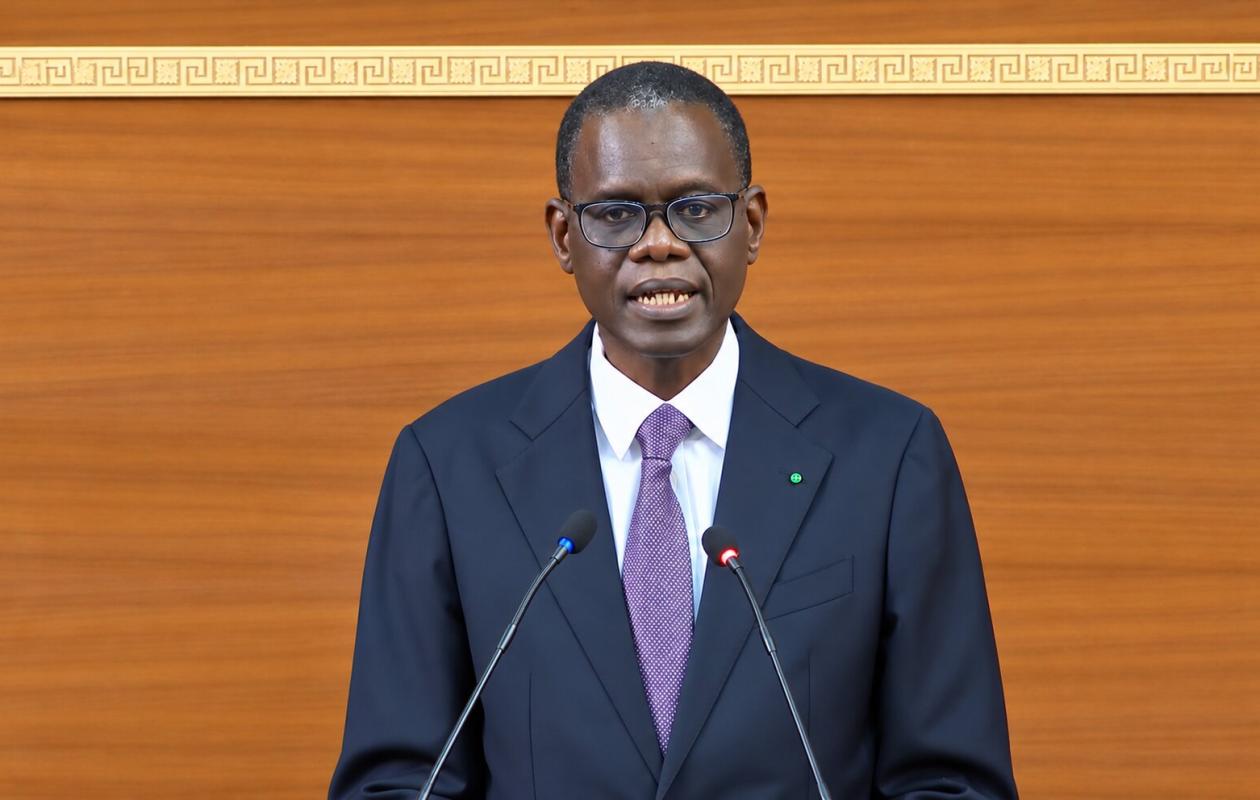
« Sobriété, gravité et risque technocratique » : un expert évalue la communication et la méthode d’Al Aminou Lô
In an interview with L'Observateur, institutional communication specialist Assane Niang analyzes Prime Minister Ahmadou Al Aminou Lô's General Policy Statement (DPG). In his view, Ousmane Sonko's successor has opted for a "sober, serious, and controlled" communication strategy, avoiding confrontation and theatricality. This approach helps to project an image of seriousness and stability, even if the overall message may sometimes appear overly uniform.
Continuity of direction and evolution of the method
Fundamentally, the expert first highlights a message of continuity. The Senegal 2050 framework remains the guiding principle for government action. But behind this continuity, he identifies an evolution in methodology: "The course remains the same, but the method is evolving." Ahmadou Al Aminou Lô intends to make "execution, monitoring, evaluation, and a results-oriented culture" his hallmark. He thus positions himself more as the manager and guarantor of public performance, without seeking to compete with the President on vision or to disavow the actions of his predecessor.
According to the analyst, the abundance of figures on employment, agriculture, education, health, energy, and housing contributes to this desire to make public action measurable. But it also constitutes a requirement for the government: "the more the government quantifies its actions, the more it will have to account, point by point, for what has actually been achieved."
Technocratic risk and unspoken aspects of discourse
The main weakness of this communication lies precisely in this accumulation of data. According to the consultant, it can give an impression of technical mastery while creating a risk of "technocratic saturation." The challenge will therefore be to translate the announcements into concrete and understandable results for citizens, while clearly distinguishing between diagnoses, objectives, projections, and firm commitments.
Assane Niang also points out several unspoken issues. The General Policy Document (DPG) seems to reaffirm a division of roles between the President, who sets the vision, the Government, responsible for implementation, and the National Assembly, which oversees it. The emphasis on monitoring, deadlines, and evaluation also suggests that the main challenge is no longer necessarily defining the vision, but rather its implementation. Finally, in a context of limited resources, the Government will have to prioritize its spending and specify what will be funded immediately and what will be deferred.
Ultimately, the expert judges the DPG (General Policy Statement) to be "consistent in its institutional communication." Its strength lies in its sobriety, stability, and commitment to making action measurable. Its weakness stems from the risk of "technocratic saturation" and the potential confusion between promises and projections. According to the interviewee for the Groupe Futurs Médias newspaper, the change therefore doesn't truly concern the direction, but rather the way of governing. By prioritizing "communication through figures, indicators, and evidence," the head of government has primarily established the criterion by which his government will now be judged: "execution."
















Commentaires (2)
C’est la pratique des « spécialistes » dans nos médias et quel que soit le domaine en cause
Participer à la Discussion
Règles de la communauté
💡 Astuce : Utilisez des emojis depuis votre téléphone ou le module emoji ci-dessous. Cliquez sur GIF pour ajouter un GIF animé. Collez un lien X/Twitter, TikTok ou Instagram pour l'afficher automatiquement.
Se connecter
Commentez avec votre profil, votre photo, et soyez averti des réponses.