400 corps ramassés à Freetown : Quand l'Inde nourrit discrètement la crise des opioïdes qui sévit en Afrique de l'Ouest
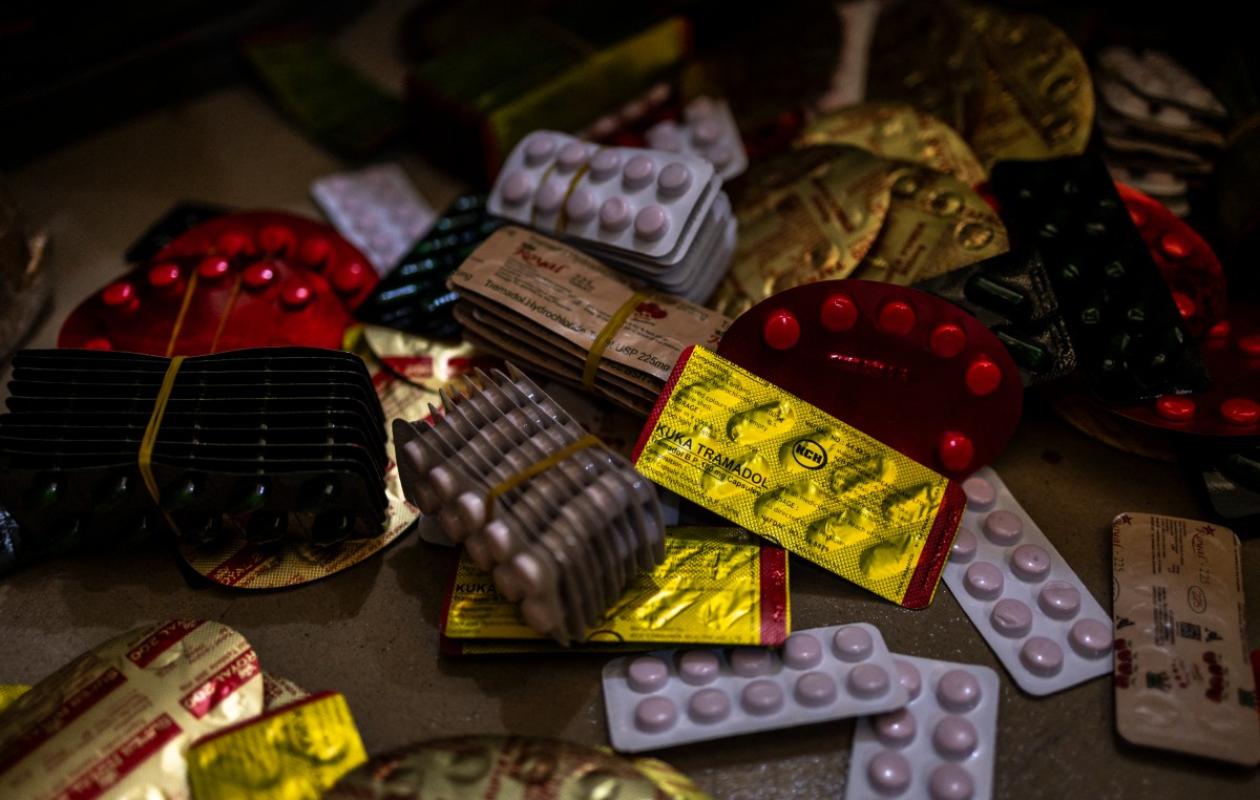
It's a small pill sold in packs of ten, like an ordinary painkiller, in street pharmacies throughout West Africa. But tapentadol is a formidable drug, an ultra-powerful and addictive opioid, silently fueling a deadly epidemic.
Sold for next to nothing, this drug has been flooding the West African market for over a year, at concentrations prohibited by all health authorities on the planet.
An AFP investigation has established that tapentadol was being exported discreetly to the continent by Indian pharmaceutical companies, sometimes under the label "medicines safe for health".
Indian customs statistics, consulted on the global export tracking platform Volza, reveal that these powerful painkillers are shipped monthly for millions of dollars to Nigeria, Sierra Leone or Ghana.
This is despite the fact that the authorities of these countries explicitly prohibit its consumption, either totally or in its most concentrated versions.
The vast majority of these tablets are so potent that they are banned in India, where their production is officially prohibited without special permission.
An aggravating circumstance is that this synthetic opioid from the tramadol family, whose unbridled prescription has caused nearly a million overdose deaths in the United States since 2000, is consumed in addition to "kush," local authorities and experts revealed to AFP.
Infamous for the rapid devastation it produces on its users, the "zombie drug" has been declared a national scourge in Liberia and Sierra Leone.
The deadly cocktail combining kush and tapentadol is "very worrying," warns Ansu Konneh, head of mental health at Sierra Leone's Ministry of Social Affairs, who says he picks up his victims "every day in the streets, markets and slums" of his country.
He claims that more than 400 bodies have been collected in the last three months in the capital, Freetown, alone.
Tapentadol is "very widely diverted from its intended use" to be "ground and mixed with kush," confirms local public health expert Abu Bangura.
In February 2025, New Delhi announced a "zero tolerance" policy against the illegal drug trade.
Indian authorities had banned the export of tablets combining tapentadol and carisoprodol, a muscle relaxant, after a BBC investigation that had followed the trail of a tapentadol-based drug cocktail being sold illegally in Ghana by a Bombay pharmaceutical laboratory ().
The Indian Drug Standards Control Organisation (CDSCO) had ordered the "immediate withdrawal" of export and manufacturing licenses for this mixture, before extending the ban to "all tapendatol cocktails not approved by importing countries".
AFP journalists in India and Africa were nevertheless able to match high-dose tapentadol tablets seized in at least four West African countries with Indian export records thanks to the license numbers of their manufacturers.
Based on trade shipment data, government seizure reports, interviews and documents obtained under the Indian Right to Information Act, it was also established that while the measures ordered by New Delhi halted exports of the formula targeted by the BBC, those of pure tapentadol continued, sometimes under the same brand.
Authorities in Sierra Leone reported seizures of 225 and 250 mg tapentadol tablets in December 2025.
Images of the seized boxes taken by an AFP photographer show that they bore the inscription "Made in India" and the manufacturing number of an Indian producer listed in the export documents, Gujarat Pharmaceuticals, based in Godhra (west).
"Made in India"
The company was listed in the Volza database as an exporter of tapentadol to West Africa. Its manufacturing license number appeared on tablets seized in Guinea in June.
On another part of the merchandise seized in Guinea during this operation was another manufacturing license number assigned to Merit Organics, an Indian laboratory also based in Gujarat and duly registered by customs.
The name of a third Indian manufacturer, McW Healthcare, based in the state of Madhya Pradesh (central India), appeared on 250 mg tapentadol tablets seized in Senegal in November. The Volza database shows that McW Healthcare shipped over one million dollars worth of the drug to Sierra Leone and Nigeria starting in April 2025.
A fourth company, PRG Pharma, made several shipments after the ban imposed by New Delhi, labeling them as "harmless." Its director, Manish Goyal, is a shareholder in Maiden Pharmaceuticals, controlled by his father, whose cough syrup is held responsible by Gambian authorities for the deaths of 69 children in 2023.
Kuwaiti customs officials also intercepted tapentadol 250 tablets in January, concealed in cosmetics boxes carried by a Beninese traveler arriving from the Ethiopian capital, Addis Ababa...
Photos of the seizure reveal that the merchandise was manufactured by Syncom Formulation, of which Benin is one of the declared destinations.
According to customs data, Syncom is the leading Indian exporter of tapentadol to West Africa, where it has sold over $15 million worth of tablets after February 2025.
When questioned by AFP, a spokesperson for the Indian Drug Manufacturers Association (IDMA) explained that "a licensed manufacturer who has followed all procedures cannot be held responsible for what happens in the rest of the supply chain." Viranchi Shah added that there is "a shared responsibility among all actors in the sector" to prevent the misuse of this drug.
For their part, the authorities of Nigeria and Sierra Leone have asserted that they have never authorized tapentadol in high concentrations, and those of Ghana have confirmed that they have totally banned the molecule.
"It's the boost that allows me to drive day and night." Tapentadol has become an indispensable companion for 20-year-old Sierra Leonean Abubakar Sesay, who earns a pittance at the handlebars of his motorcycle taxi in the narrow and dusty streets of Freetown.
"Without it, I can't survive. Sometimes I take up to four 225mg pills a day. And at night, I mix them with energy drinks to keep me going..."
Often, more than to get high, tapentadol "is used as a stimulant to be able to endure the long hours of hard work," explains medical anthropologist Axel Klein of the Global Initiative Against Transnational Organized Crime.
In Nigeria, where opioids are now the second most used narcotic after cannabis, "kidnappers, terrorists and bandits use these drugs to be able to carry out their nefarious activities", says Femi Babafemi of the Nigerian Drug Law Enforcement Administration (NDLEA).
According to the police, jihadist fighters like Boko Haram take them "to give themselves courage." The pills are also used as currency in kidnappings, Mr. Babafemi added.
A total of 2 billion high-dose tablets were seized in the country in 2023 and 2024, mainly from India, according to the NDLEA.
In the poor and dusty neighborhood of the capital Abuja, where Boluwatife Owoyemi of the NGO YouthRISE Nigeria works with drug addicts, a pill costs less than a meal.
In addition to "giving them a lot of energy," explains Ms. Owoyemi, "some use them as an appetite suppressant (...) until they have enough money to buy food."
Even though their prices have increased, opioids remain "cheaper than other drugs," adds Emmanuel Augustine, from the same NGO. Around 1,000 naira (less than one dollar) per pill, compared to 64,000 and 25,000 naira for a gram of cocaine and heroin.
With brands like TramaKing, Super Royal 200 and Tamol-X, the tablets "are presented as a medicine" in countries where there is little regulation, says Mr. Klein.
"Unscrupulous Indian companies see this as an opportunity to sell their products," adds Vanda Felbab-Brown, an opioid flow expert at the Brooking Institution. "Africa is an accessible and inexpensive market," the researcher continues, "which allows trafficking networks in India to easily get people hooked."
Nearly 90% of tramadol seizures in the last ten years worldwide have been made in West or Central Africa, the Global Initiative Against Transnational Organized Crime recently revealed.
Tramadol, which India classified as a controlled narcotic in 2018, is now "replaced or accompanied" there by tapentadol, which has often retained the same name as its predecessor, the organization adds in its report.
About fifteen years ago, "Indian pharmaceutical groups began exporting vast quantities of tramadol to West Africa, often in concentrations well above the threshold considered safe," notes Ms. Felbab-Brown.
"They couldn't sell it in India in such high doses, so they exported it without considering the disorder it could create."
This pattern is now being replicated with tapentadol, which is two to three times more potent, she continues, facilitated by "shortcomings in law enforcement and regulatory controls" and a "feeling of impunity".
Tapentadol's difficult-to-pronounce name and the confusion with tramadol have further facilitated its going undetected.
Nearly three-quarters of tapentadol exports to West Africa since the measures taken by New Delhi involve high-dose tablets of 225 mg and 250 mg, according to AFP analysis.
Professor of pharmacology at the University of Adelaide, Andrew Somogyi, told AFP that he was unaware of any country that had approved tapentadol tablets at such doses.
The Indian drug regulatory authority (CDSCO) indicated that it had "no information" nor "no record" of the issuance of authorizations for shipments of tapentadol in dosages of 225 mg and 250 mg.
Jaydip Patel, representative of Gujarat Pharmaceuticals, whose tapentadol tablets were seized in Sierra Leone, maintains that these exports were legal.
"The importer provided us with a letter of authorization," he said, "and we subsequently obtained permission" to export from India.
When AFP visited it at the end of January, the company's factory appeared deserted. Behind the building lay boxes of medicine discarded on the ground covered with fresh ash.
During the interview in a cafe in Ahmedabad, the capital of Gujarat, Jaydip Patel explained that the demand for tapentadol had increased "when tramadol sales were stopped".
"Tramadol became a drug, so nobody wanted to touch it anymore," he explains. "Tapentadol is much easier to export because it is not considered as such."
The Ghana Food and Drug Authority told AFP that it had "never issued a permit for the manufacture or importation of tapentadol, in any dose".
While the Nigerian National Agency for Food and Drug Administration and Control (NAFDAC) stated that tapentadol was neither registered nor approved in the country and that "any tapentadol-based product found in Nigeria is unauthorized and illegal".
Nigerian health authorities have confirmed that the Nigerian company listed in Indian customs data as an importer of McW Healthcare products does not have authorization to do so.
At his Nigerian address, AFP journalists stumbled upon a camera repair shop and a security equipment vendor's stall, but no laboratory in sight...
In Sierra Leone, only 50mg tramadol administered in recognized health facilities is legal; "anything outside of this framework is illegal," Sierra Leone's Health Minister, Austin Demby, told AFP.
Law enforcement continues to intercept large quantities of concentrated tapentadol. "We frequently seize tablets and cartons mixed with other pharmaceutical or chemical products in warehouses," Deputy Superintendent of Police Abass Bangura told AFP.
And "the suffering is enormous," notes Hassan Kamara, a traditional Sierra Leonean healer.
An hour's drive from Freetown, its informal detox center welcomes kush addicts, who suffer from the drug which damages vital organs, causes drowsiness, mental disorders and hallucinations.
Having fallen into drug use to treat the pain of his leg amputation following an accident, 31-year-old former motorcycle taxi driver Manso Koroma was lying on his bed with his ankles shackled by heavy iron chains during withdrawal when AFP met him last year. "When I arrived here, I was really violent," he confided.
Since then, in this country marked by the atrocities committed during a decade of civil war (1991-2002), the local police have reported an "unprecedented rise" in the consumption of tapentadol among young people, including schoolchildren and students.
"Primary school students are now taking these tablets," which they mix "with energy drinks to increase their strength," warns Ansu Konneh of the Sierra Leonean Ministry of Social Affairs.
"Without any awareness of the danger," the official added.
The fact that tapentadol looks like a medicine and is sold as such masks its danger, says Mr. Konneh. Drug addicts "tell us: 'I've stopped smoking kush, I'm just taking tapentadol tablets now.'"



















Commentaires (14)
Participer à la Discussion
Règles de la communauté
💡 Astuce : Utilisez des emojis depuis votre téléphone ou le module emoji ci-dessous. Cliquez sur GIF pour ajouter un GIF animé. Collez un lien X/Twitter, TikTok ou Instagram pour l'afficher automatiquement.
Se connecter
Commentez avec votre profil, votre photo, et soyez averti des réponses.