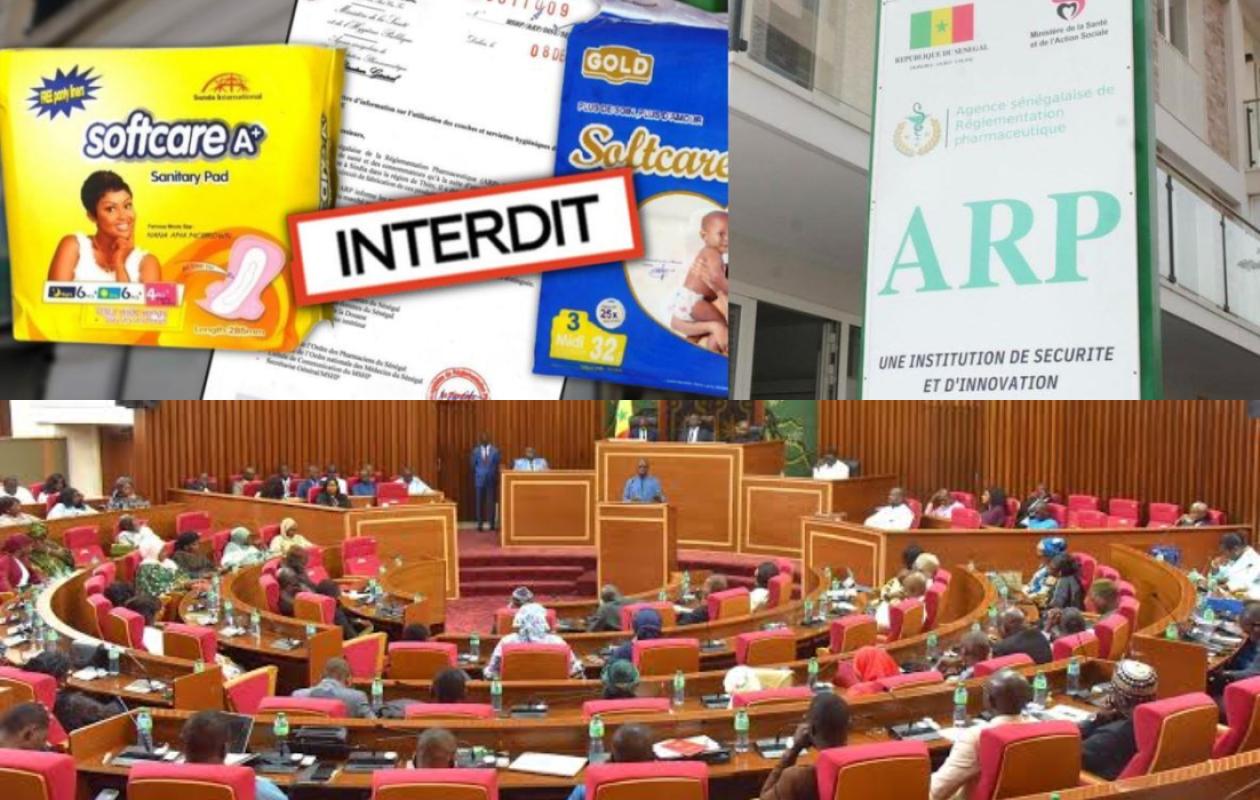
Affaire Softcare : voici les 10 recommandations des membres de la mission d’information parlementaire
The parliamentary inquiry into the marketing of Softcare brand products in Senegal is currently underway at the National Assembly. According to its 11 members, the inquiry stemmed from a series of administrative actions, inspection reports, and public communications issued between October and December 2025, following inspections conducted by the Senegalese Pharmaceutical Regulatory Agency (ARP) at the Softcare SN Company Limited factory in Sindia, Mbour Department. The members of parliament indicated that the documents submitted revealed critical non-conformities, including the presence of expired raw materials, the absence of a responsible pharmacist, inadequate quarantine facilities, and deficiencies in storage conditions. At the same time, they continued, a press release from the ARP's Communication and Public Relations Unit, dated December 16, 2025, announced the products' compliance and their return to the market, raising both questions and misunderstandings. This communication, issued even as inspectors supported maintaining the withdrawal, introduced a clear contradiction between the official institutional discourse and internal technical findings.
Thus, Khady Sarr and his colleagues formulated 10 priority recommendations. “We call for clarification of the scope of competence of the regulatory authorities and for the completion of the regulatory framework applicable to cosmetic and hygiene products, in particular by adopting the expected implementing decree of Law No. 2023-06 of June 13, 2023 relating to medicines, other health products and pharmacy; for strengthening the regulation of expired raw materials by explicitly prohibiting their unjustified possession in operational areas, by imposing their physical and traceable quarantine, and by setting regulatory deadlines for destruction; and for strengthening inspection powers, in particular by clarifying the powers of seizure and sealing, establishing a framework for the legal value of inspection reports and requiring periodic follow-up of critical inspections.” This, in addition to "formalizing the internal decision-making chain of the ARP, by precisely defining the respective responsibilities of the technical services, the administrative hierarchy and the communication bodies, in order to prevent disalignment, to subordinate all public communication in matters of health alert to prior technical validation, within the framework of a formalized crisis communication protocol, guaranteeing the unity of institutional speech, the coherence of messages and the legal security of decisions and to modernize traceability systems, through the implementation of a secure ERP (Enterprise resource planning), the mandatory time stamping of stock movements, the harmonization of stock sheets, the standardization of non-conformity registers and the secure and enforceable archiving of management documents.
The mission members also call for the strengthening of internal controls of industrial operators, in particular through mandatory periodic inventories, systematic internal audits, formalized procedures for the detection, isolation, treatment and destruction of non-compliant materials, as well as increased accountability of the responsible pharmacist, the establishment of a formal inter-institutional coordination mechanism, in the form of a permanent inter-ministerial committee that can be activated in the event of a health alert, supported by a real-time information sharing platform and by joint field control missions, the strengthening of technical and scientific capacities, including control laboratories, chemical and microbiological analysis tools, training of inspectors, industrialists and control services, as well as the development of an effective post-market surveillance system. Better still, they also call for structured parliamentary monitoring of the implementation of reforms, including the presentation of periodic reports to the National Assembly and the regular evaluation of the reforms undertaken, through the National Assembly's Public Policy Evaluation Committee.




















Commentaires (2)
Dans l'affaire Softcare, la mission parlementaire s’est limite à la mise en évidence ce que les sociologues appellent une "irresponsabilité organisée". Le rapport décrit un système où :
• Chaque entité a fait son travail à moitié ou selon les strictes limites de son texte de loi, sans vision d'ensemble.
• Les failles législatives ont servi de bouclier juridique, permettant à chacun de se dédouaner en affirmant avoir respecté les procédures en vigueur, aussi obsolètes soient-elles.
• L'absence d'une autorité unique de régulation a permis aux différents ministères de se rejeter la faute mutuellement.
Le résultat politique et social est souvent perçu comme un déni de justice et a juste titre : le bruit médiatique s'éteint, le système promet de se réformer (souvent très lentement), et l'opinion publique reste avec le sentiment amer que personne ne rendra de comptes pour les manquements constatés.
Le modèle et les normes Iso ou de certification Food/Pharma/Cosmeto existent incluent un système de traçabilité complet, de communication et de retrait en cas de risque.
Les entreprises doivent se conformer à leur obligation de mettre sur le marché des produits sûrs pour les consommateurs
Les pouvoir publics doivent mener les missions d'audit et de recommandation pour s'assurer que tous les produits circulant sur le marché national sont sûrs pour les sénégalais
Les consommateurs sensibilisés sur les risques sanitaires lies aux produits qu'ils achètent
Après ça devrait bien se passer
Pas besoin de ré-inventer la roue !
Participer à la Discussion
Règles de la communauté
💡 Astuce : Utilisez des emojis depuis votre téléphone ou le module emoji ci-dessous. Cliquez sur GIF pour ajouter un GIF animé. Collez un lien X/Twitter, TikTok ou Instagram pour l'afficher automatiquement.
Se connecter
Commentez avec votre profil, votre photo, et soyez averti des réponses.