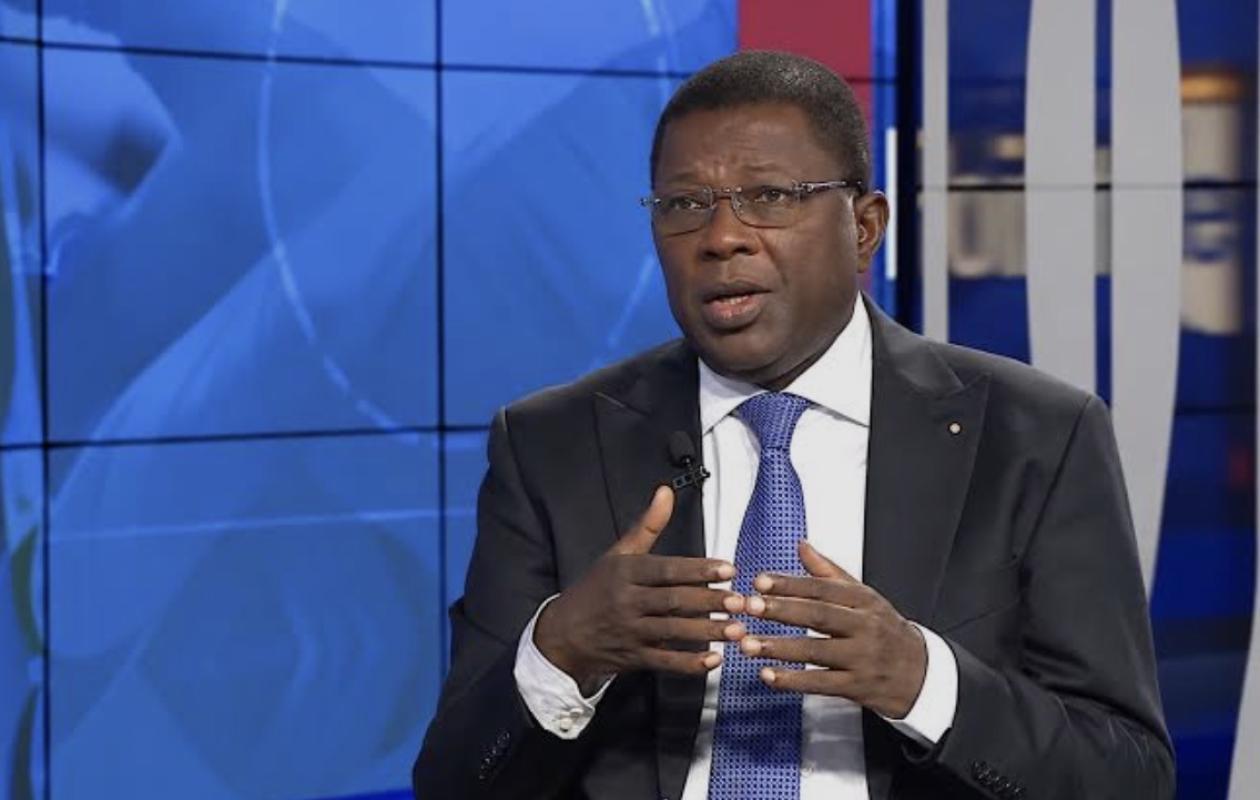
Cherté de la vie et dépendance économique : L’analyse d'El Hadji Aliou Diouf sur le piège du « marché mondial »
The rising cost of living and the instability of food prices in West Africa are not merely the consequences of temporary crises. They reveal a deeper fragility: that of economies still heavily dependent on external sources for a portion of their food, industrial products, and inputs.
This dependence raises even more questions given that the global market is often presented as a mechanism capable of naturally balancing supply and demand. However, in reality, international trade is also influenced by national agricultural policies, subsidies, the strategies of large corporations, transportation costs, stock levels, and geopolitical tensions. This is essentially the analysis developed by El Hadji Aliou Diouf, an economist and guest on the program "Jury du dimanche" on iRadio. According to him, African countries heavily reliant on food imports remain particularly vulnerable when international prices fluctuate significantly.
The global market is not always a balanced market
According to El Hadji Aliou Diouf, major agricultural powers generally do not allow their food security to depend entirely on the international market. They support their producers, protect certain strategic sectors, and seek to secure their supply. Conversely, African economies often remain much more exposed to external fluctuations. "When the prices of wheat, rice, vegetable oils, fertilizers, or energy rise, the consequences are quickly transmitted to local markets," explains the economist.
A geopolitical crisis, a poor harvest in a major producing region, or a disruption to supply chains can all lead to price increases for bread, oil, transportation, and other essential goods. Speculation on raw materials can also exacerbate certain fluctuations. However, it would be simplistic to attribute all price increases to speculation. International markets are subject to a combination of agricultural, economic, financial, energy, and geopolitical factors. For El Hadji Aliou Diouf, the real issue lies in the level of dependence: the more an economy relies on external sources for essential goods, the more vulnerable it becomes to events occurring beyond its borders.
The problem of "all-raw"
This vulnerability is compounded by another paradox: many African countries continue to export a large portion of their resources as raw materials before importing processed products. Cotton is a prime example. Producing cotton is one thing; transforming it into yarn, fabric, clothing, and finished goods is quite another. At each stage of processing, jobs, skills, and greater economic value can be created. The same reasoning applies to peanuts.
In Senegal, peanuts play a significant role in agriculture and the rural economy. However, their potential extends beyond seed and oil production. Processing can lead to the development of a much wider range of food and industrial products: peanut paste, flour, confectionery, animal feed, cosmetics, and other derivatives. Cashews present a similar challenge. Exporting raw nuts generates revenue, but processing, packaging, and marketing them as finished products allows a much larger share of the value to remain within the country. The challenge, therefore, is not simply to increase production. It also involves processing more and selling more finished products from the African continent.
Transforming locally to create wealth
Local transformation, however, is not an automatic solution. For a genuine industrial policy to work, efficient roads and ports, reliable electricity, access to finance, technical skills, quality standards, and market opportunities are necessary.
It also requires a coherent, multi-year policy. A farmer will hesitate to increase production if they don't know who will buy it. A factory cannot operate consistently without a sufficient supply of raw materials. And a local company will struggle to compete with imported products if its production costs are too high. Therefore, it's essential to consider the entire chain: production, storage, transport, processing, distribution, and marketing. This coherence is what can enable industrialization to become a true engine of development.
Towards a pragmatic economic sovereignty
For El Hadji Aliou Diouf, the issue is not about cutting Africa off from the rest of the world. No modern country can function completely in isolation. The challenge is rather to reduce the dependencies that weaken national economies. This requires more productive agriculture, competitive processing industries, better crop preservation, appropriate infrastructure, and, where justified, trade policies capable of temporarily supporting certain developing sectors.
Protectionism, however, can be risky if poorly designed. Long-term protection of an industry without improving its productivity can ultimately lead to higher prices for consumers and reduced incentives to innovate. Economic sovereignty, therefore, does not necessarily mean closing borders. It primarily involves having sufficient productive capacity to prevent every external shock from becoming a national crisis.
To generate more value on the continent
The issue of the cost of living cannot be resolved solely through emergency measures or temporary price controls. In the long term, the structural causes must be addressed: weak industrial processing, dependence on certain imports, agricultural losses, inadequate infrastructure, and difficulties in accessing financing. Africa possesses considerable agricultural, mineral, and human resources. But possessing these resources is not enough. Wealth is also built on the capacity to transform and add value to them, and to develop businesses, jobs, and skills around them.
The challenge for the coming years is therefore to gradually shift from an economy that primarily exports what it extracts or harvests to one that processes more, consumes more of its own production, and exports more value-added products. Part of the answer to the continent's economic vulnerability lies in this transformation. As El Hadji Aliou Diouf points out, the fundamental question is ultimately not whether to participate in the global market, but under what conditions Africa can participate without remaining trapped in a position of dependency. The answer lies less in rejecting international trade than in strengthening local productive capacities. Producing, processing, and creating value locally: this is the price African economies must pay to gradually better withstand the upheavals of the international market and offer greater stability to their populations.















Commentaires (1)
Participer à la Discussion
Règles de la communauté
💡 Astuce : Utilisez des emojis depuis votre téléphone ou le module emoji ci-dessous. Cliquez sur GIF pour ajouter un GIF animé. Collez un lien X/Twitter, TikTok ou Instagram pour l'afficher automatiquement.
Se connecter
Commentez avec votre profil, votre photo, et soyez averti des réponses.