
Jeux d'argent : ce qu'un dépôt minimum décide, et ce qu'il ne décidera jamais
On Canadian websites that compare real money gambling sites, one number appears more often than any other: $1. It's the smallest deposit a casino cashier will accept. The amount is displayed, precise, and easy to verify, giving it an authority it doesn't actually possess. It dictates the size of a transfer. It dictates nothing else.
A small body of advice has sprung up around him. Depositing small amounts is seen as a method, a way to last longer, sometimes even to outmaneuver the house. The financial aspect of this idea holds water. The rest falls apart for a simple arithmetic reason: the deposited amount doesn't appear anywhere in the calculation of a game's return on investment.
French-speaking Canada offers a textbook case, because almost everything is published there: provincial regulations, verified return rates, and operators' minimum trading thresholds. This text describes this foreign market and nothing else. It does not recommend any site and does not invite anyone to open an account.
The minimum deposit amount answers a single question: what is the smallest transfer the credit union will accept? The answer lies with the operator. No Canadian law sets this threshold, which is determined by the cost of processing a transaction and the value of an open account.
A displayed threshold is therefore primarily a commercial advertisement. What the authorities monitor in an advertisement is its honesty, not its level. The Alcohol and Gaming Commission of Ontario states that gambling sites are prohibited from engaging in false advertising, and that the public must be protected against any misleading presentation of a product.
The principle extends far beyond this sector. The WAEMU Commission presented its community competition policy this week to the press gathered in Ouagadougou. The head of competition investigations, Tangambori Marius Konssabo Yargo, detailed the scale of sanctions, which can reach up to 10% of turnover for an offending company.
The Commission recalled on this occasion that All companies, public or private, are subject to the Treaty's competition rules . The reasoning applies everywhere: a price quoted is binding on the person who quotes it, and nothing more.
An advertisement can therefore be penalized if it is false. It cannot be penalized simply because it is low. The floor remains what it is: an accurate selling point.
In Quebec, the Régie des alcools, des courses et des jeux (Liquor, Racing and Gaming Authority) approves the laboratories responsible for certifying the equipment in state-run casinos. It ensures that their operation is based solely on chance.
It then checks, through statistical verification, that the return rate of devices in service corresponds to that announced to the players. This rate must not be less than 83% .
This is what a floor that binds someone looks like. It's based on performance, controlled by a third party, and it applies before a single dollar has been deposited. The Cabinet authorized the first two state-run casinos in December 1992, and the rule was built around the machine, never around the player's account.
In Ontario, the same logic is expressed differently. The Alcohol and Gaming Commission states that a player registered on a regulated site Players can know their chances of winning, how the game works, the prizes, and the payouts before playing . This information precedes the bet and is independent of the amount wagered.
The two floor systems are completely different. One sets a minimum output limit for a machine and requires a public operator to adhere to it under supervision. The other sets a minimum amount for a transfer and doesn't obligate anyone to anything other than accept the money.
A return rate is a long-term average, not a one-night-only promise. It describes what a game pays out over millions of spins. It remains the same whether the count is one dollar or one thousand.
The numbers a Canadian player encounters come from different sources and don't dictate the same things. Sorting them is better than adding them up.
The comparison site gambling.com lists its Canadian entries in this category under the heading online casino minimum deposit $1 , a page signed Dean Ryan and updated on September 4, 2026. Next to each brand are the minimum deposit required to be eligible for the sign-up offer, the accepted payment methods and a column of theoretical return rates.
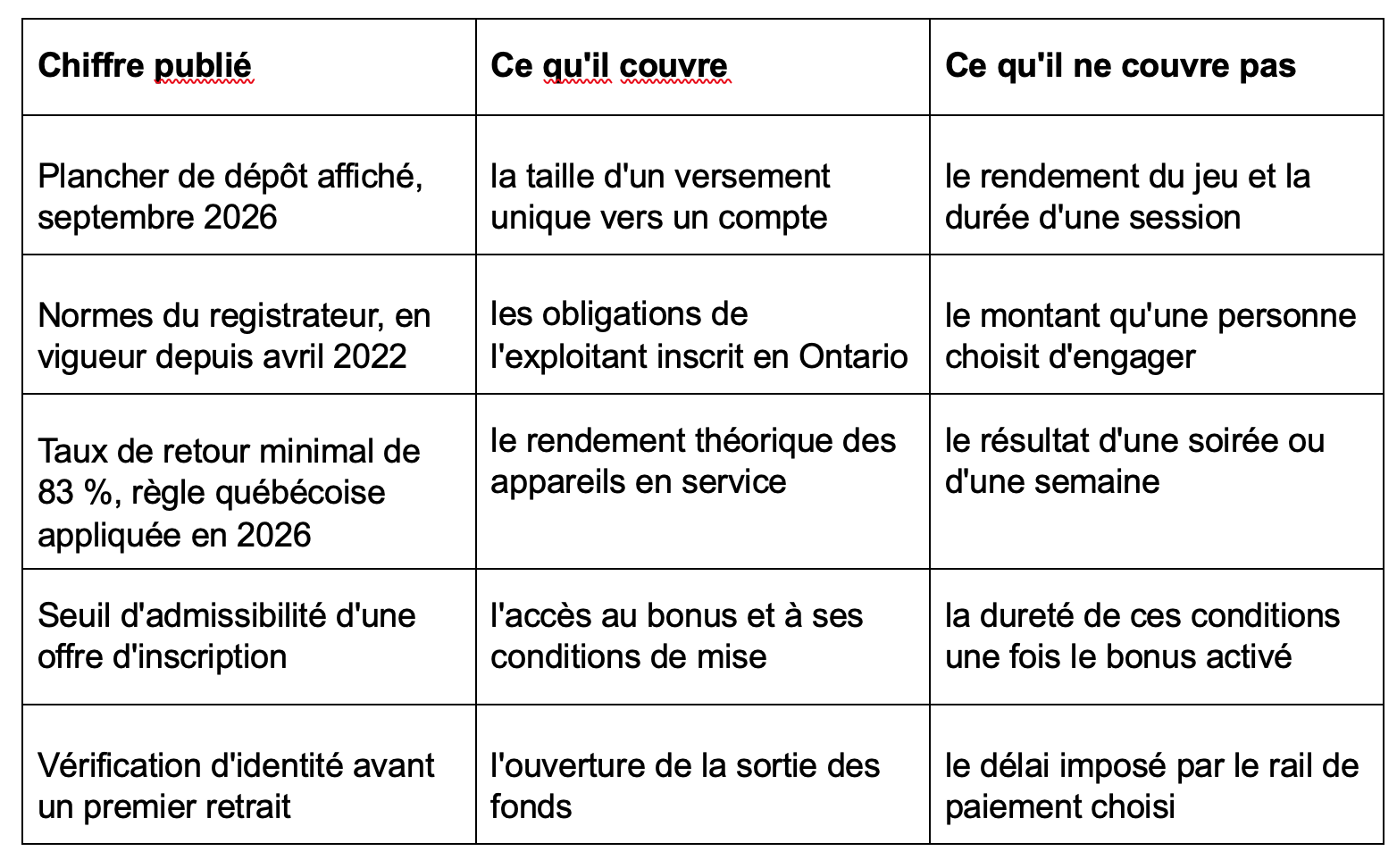
Two lines in this table are read together. The minimum deposit is the only number the player sets themselves. It is also the only one whose variation does not affect any other line.
The comparison page even acknowledges this in its own list of advantages, noting that the payout rate of a game remains unchanged on a site with a low entry threshold. This statement is accurate and single-handedly refutes the rest of the argument.
The regulated Ontario market opened on April 4, 2022, the date the Registrar's Standards for Internet Gaming came into effect, with the latest update dated May 14, 2026. These standards impose obligations on registered operators. They do not set any entry fees.
The Ontario regulator summarizes what players gain: responsible gambling controls to ensure compliance with spending and time limits, a history of deposits and transactions accessible in case of a dispute, and account opening restricted to eligible individuals. The minimum age is 19.
Alberta followed suit on July 13, 2026, by opening its own competitive market, with deposit limits, spending limits, and time limits required from day one. The other provinces retain their public monopolies and each write their own rules. There is no single Canadian system, and no rule applies from coast to coast.
None of these instruments are floors. They are ceilings, exclusions, and disclosure requirements. A minimum threshold protects no one; a maximum threshold protects no one. In Ontario, ConnexOntario provides 24/7 helpline support at 1-866-531-2600.
Three things are regularly marketed as tips for making small deposits. None of the three relate to the amount deposited.
The first factor is the choice of game. The differences are real: the page mentioned above shows rates ranging from 88.12% for a progressive jackpot title like Mega Moolah to 96.33% for Amazing Link Zeus. Over time, the former retains 11.88% of each bet and the latter 3.67%. This difference is inherent to the game itself; it existed before the deposit, and neither figure describes a single evening.
The second is the sign-up offer. A bonus comes with wagering requirements and an expiry date, set by the operator and announced with the offer. The deposit determines eligibility, but never the stringency of these requirements. A small deposit does not ease them in the slightest.
The third point is the payment method. The comparison page itself warns that network fees for a cryptocurrency deposit can exceed the dollar transferred. This is true for the payment system, not for the game itself: it tells you what it costs to move the money, not what happens to that money afterward.
One effect remains, and it is real. A low floor reduces the size of the only irreversible action in the operation: the payment itself. It also allows for testing a fund before entrusting it with more funds. These two sentences refer to budget and procedure. Neither mentions expected profit.
The exit process, however, is not symmetrical. Identity verification occurs before the first withdrawal on a site holding a recognized license, and the minimum withdrawal amount is set separately, often far above the entry threshold. A dollar goes in easily; it doesn't come out in the same form.
The figures that matter will only change when a rule is modified: a minimum return rate is raised, a limit becomes mandatory, or a disclosure requirement is expanded. These decisions are made by a regulator and apply to everyone on the same day. The amount entered in the deposit box, however, will continue to determine its own outcome.



















Commentaires (2)
Participer à la Discussion
Règles de la communauté
💡 Astuce : Utilisez des emojis depuis votre téléphone ou le module emoji ci-dessous. Cliquez sur GIF pour ajouter un GIF animé. Collez un lien X/Twitter, TikTok ou Instagram pour l'afficher automatiquement.
Se connecter
Commentez avec votre profil, votre photo, et soyez averti des réponses.