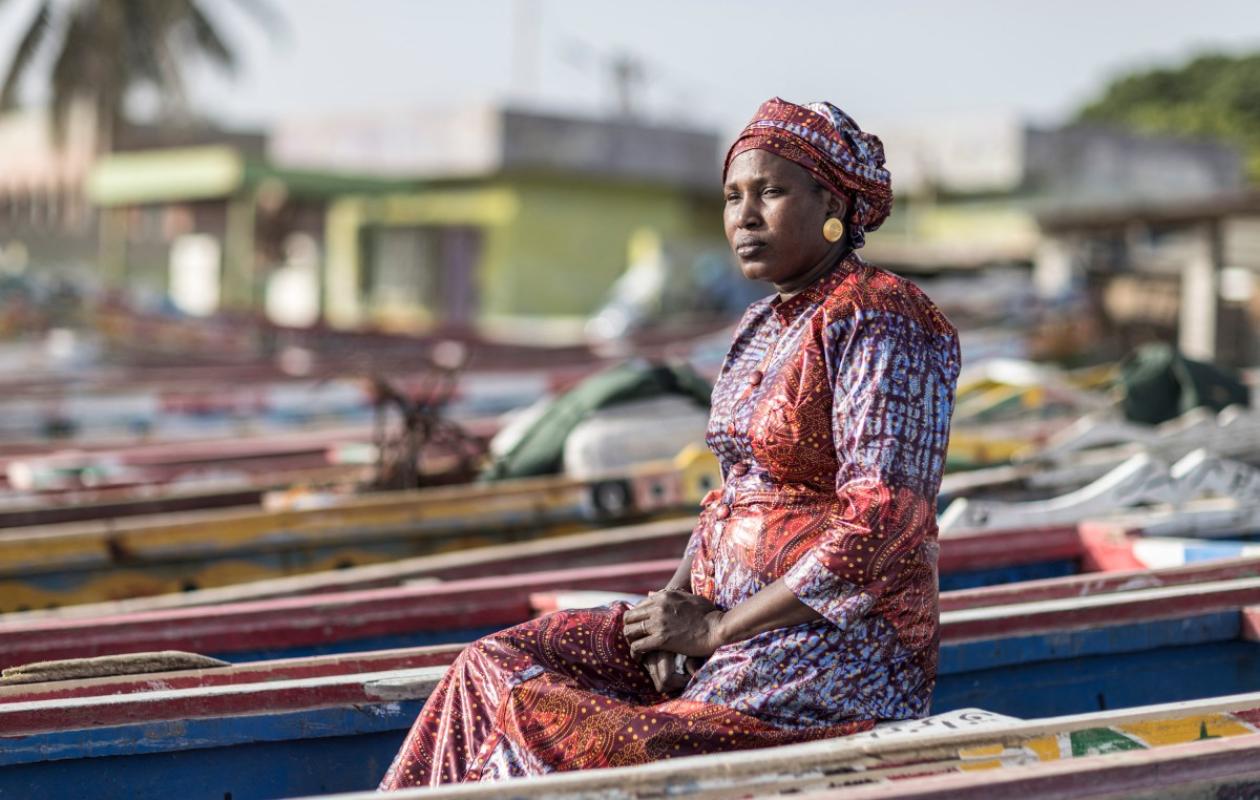
Mbour : Le combat d'Aminata Boye, mère de disparu et porte-voix des victimes de la migration
From her pain, she made a fight: Aminata Boye, whose eldest son disappeared after a shipwreck, became the pillar and the voice of the families of Senegalese migrants who disappeared at sea and of their ordeal, still taboo in her country.
On that day, she came, as she regularly did, to visit bereaved families in the Tefees district of Mbour, on the Senegalese coast.
Tefees is emblematic of these tragedies of clandestine migration in which thousands of Africans have been dying or disappearing for years, particularly in Senegal, one of the starting points of this very perilous Atlantic route to Europe.
The atmosphere there is heavy: about one in three houses has lost someone in migration, mostly young people.
"They took the soul of the neighborhood with them..." laments Anna Diop, 43, to AFP, whose condition Aminata had checked on. On Anna's street alone, 43 people have disappeared.
In a poignant account, Anna recounts her ordeal: in 2024, she lost her two sons, Gora and Mame Doudou, aged 17 and 15. "They were courageous children, not delinquents; they were hardworking and they were the joy of the neighborhood," she says.
His sons had told him that they were going to Gambia for a few days to do some trading because "fishing wasn't going very well".
But the canoe—which was actually carrying them to Europe—was found adrift, and its 34 passengers were dead. A family tragedy: Anna also lost two brothers and two nephews.
Overcome with emotion, 48-year-old Aminata Boye comforts Anna. She knows this distress all too well: in 2020, she experienced the same tragedy and the grief that initially shattered her.
That year, two of his sons embarked in Senegal in clandestine canoes, three days apart: one, aged only 14, arrived in Spain where he is studying, but his eldest son Waly, who was 19, has been missing ever since.
In the courtyard of her house in a fishing district of Mbour, where Aminata raises her five other children alone, portraits of Waly and his conquering smile are displayed right at the entrance.
Waly, a young fisherman, had decided to migrate in the face of the crisis in the sector.
"Waly hid his departure from me," confides Aminata. "I don't feel anger towards him, he didn't leave to die but to help his family..."
After a week without news, she began searching and learned that he had taken a pirogue, spotted in distress off the coast of Mauritania. "I immediately became ill... I didn't want to go out anymore, or hear people talking about pirogues."
She even sent relatives living in Mauritania to hospitals to search for her son. In vain.
Aminata, a shopkeeper already involved in social work before her son's disappearance, has since developed a thick skin. What "gave her the strength to get back on her feet" was her decision to act to honor Waly's memory and "for all the other mothers."
In Senegal, where the authorities have a predominantly repressive approach to illegal migration and where the suffering of relatives of the disappeared remains a taboo, she has embarked on pioneering work.
The year her son disappeared, she founded the Collective of Victims of Irregular Emigration in Senegal (Coves), after observing that these families "were left to their own devices and received no support from the authorities".
The association currently assists over 100 women who have lost their children or husbands during migration. It organizes collections for holidays, the start of the school year, and sewing workshops, providing these women with income.
"Sometimes I go to see Aminata who gives me rice so that I can prepare something for my children...", explains Fatou Ngom, mother of three, whose husband disappeared at sea in 2022, to AFP.
Aminata has become the resource person for organizations such as the International Committee of the Red Cross (ICRC), the Diocesan Delegation of Migrations of Senegal, which has a rare program of bereavement support and psychological follow-up for orphans of missing persons, and the Senegalese association "Boza Fii".
She also travels abroad, searching for missing persons, working with the migrant aid network "Alarm Phone".
Now, "families come to me bringing photos of their children so that I can start searching," she says.
Aminata says that by getting closer to widows and mothers "to raise awareness and help them through these difficult times", she realized that she was able to "calm them down".
"Aminata called me at home to talk and bring me back to my senses," testifies Ndeye Ndiaye, a resident of Mbour whose daughter Awa, aged around thirty, lost her life in Morocco in 2024 after a pirogue capsized, leaving two young orphans.
"It's thanks to Aminata that I'm still here talking to you, because I had almost lost my mind...", says Mrs. Ndiaye. Despite the loss of her son, Aminata "forgot herself and started helping us," she emphasizes.
Aminata's character, whose often serious face sometimes lets out a bright, communicative smile, was forged from childhood: until she was 20, she was one of the only girls in her region to practice fishing.
Her brother having been sent to Koranic school, she was the only child left. "I was very close to my father, so he introduced me to fishing, against my mother's wishes."
After years of commitment, she has an uncompromising message: "The State must work to raise awareness among young people and offer them opportunities to keep them in Senegal!"
She criticizes the restrictive visa and border closure policies in Europe, arguing that "this partly explains why young people take to the sea and why today, many are dead..."
The subject of migration is omnipresent in his life, extending even to his immediate surroundings: his street overlooks a beach known to be a departure point, to the point that the neighborhood has been nicknamed "the airport".
Returning home after visiting Anna, Aminata encounters a young relative, his eyes fixed on the sea. A lively discussion ensues: two days earlier, he had taken a pirogue but due to engine trouble, he and his companions had to return.
"When they want to leave, it's hard to stop them... Her brother tried three times and I was the one who went to get him in the canoes each time," says Aminata, her eyes darkened by distress.



















Commentaires (14)
Qu'Allah swt lui donne la force de surmonter l'épreuve qu'elle endure et trouver les mots pour apaiser les autres
Amine
Le théorème de mon gourou
Le paysage politique sénégalais subit une mutation inédite et profondément inquiétante. Pour la première fois depuis l’indépendance en 1960, l'arène politique n’est plus occupée par des militants guidés par un programme, mais par les membres d'une secte d'un genre nouveau. Ce que beaucoup s’entêtent à appeler le « Pastef » n'est plus un parti politique : c'est une confrérie mystico-politique exclusive, une structure calquée sur le modèle des cultes les plus aliénants. À sa tête ne se trouve pas un homme d'État, mais un véritable gourou : Ousmane Sonko. Autour de lui, les partisans ont abandonné tout esprit critique pour se transformer en talibés dociles et fanatiques.
Le fonctionnement financier de cette organisation frise le délire collectif. Des milliers de jeunes chômeurs, sans avenir ni emploi, ainsi qu'une diaspora aveuglée, se saignent quotidiennement pour cotiser. Mais cet argent ne sert jamais à financer le développement local, à construire des infrastructures communes, à créer des supermarchés pour employer la jeunesse ou à investir dans l'agriculture. Tout comme les dérives des confréries traditionnelles, les fonds récoltés servent uniquement à enrichir, entretenir et sacraliser une seule et unique personne : leur gourou. C'est un système de transfert de richesse absurde où les pauvres se dépouillent pour un homme déjà puissant.
La dérive la plus abjecte de cette confrérie politique réside dans son ingratitude et son cannibalisme envers ses propres enfants. Des hommes et des femmes qui étaient au premier rang des combats les plus violents, qui ont sacrifié leur vie, saboté leur propre carrière et risqué la prison pour porter ce projet, sont aujourd'hui jetés aux chiens. Il suffit qu'ils expriment le moindre désaccord ou refusent de s'agenouiller devant une décision du gourou pour être immédiatement lynchés sur la place publique. Des figures héroïques du mouvement, à l'image du capitaine Touré qui a brisé son avenir professionnel pour ce parti, sont désormais traînées dans la boue. Les talibés de Sonko les insultent de tous les noms d'oiseaux et les qualifient de traîtres sans le moindre état d'âme. Dans cette secte, le sacrifice passé ne vaut rien si l'obéissance présente n'est pas totale.
Ce phénomène met en lumière le véritable drame du Sénégal : la paralysie cérébrale d'une partie de sa population. Le sous-développement du pays n'est pas économique, il est mental. Le changement du Sénégal doit impérativement passer par une décolonisation des esprits, car actuellement, le cerveau de ces militants est totalement passif, déconnecté et plongé dans un sommeil profond. En remplaçant la logique, le travail et l'analyse par une foi aveugle envers un homme, cette jeunesse s'interdit de réfléchir. Tant que les cerveaux seront en mode pause et que la dévotion politique remplacera l'intelligence collective, le Sénégal restera condamné à la stagnation. La vérité est amère, mais le constat est indiscutable.
Participer à la Discussion
Règles de la communauté
💡 Astuce : Utilisez des emojis depuis votre téléphone ou le module emoji ci-dessous. Cliquez sur GIF pour ajouter un GIF animé. Collez un lien X/Twitter, TikTok ou Instagram pour l'afficher automatiquement.
Se connecter
Commentez avec votre profil, votre photo, et soyez averti des réponses.