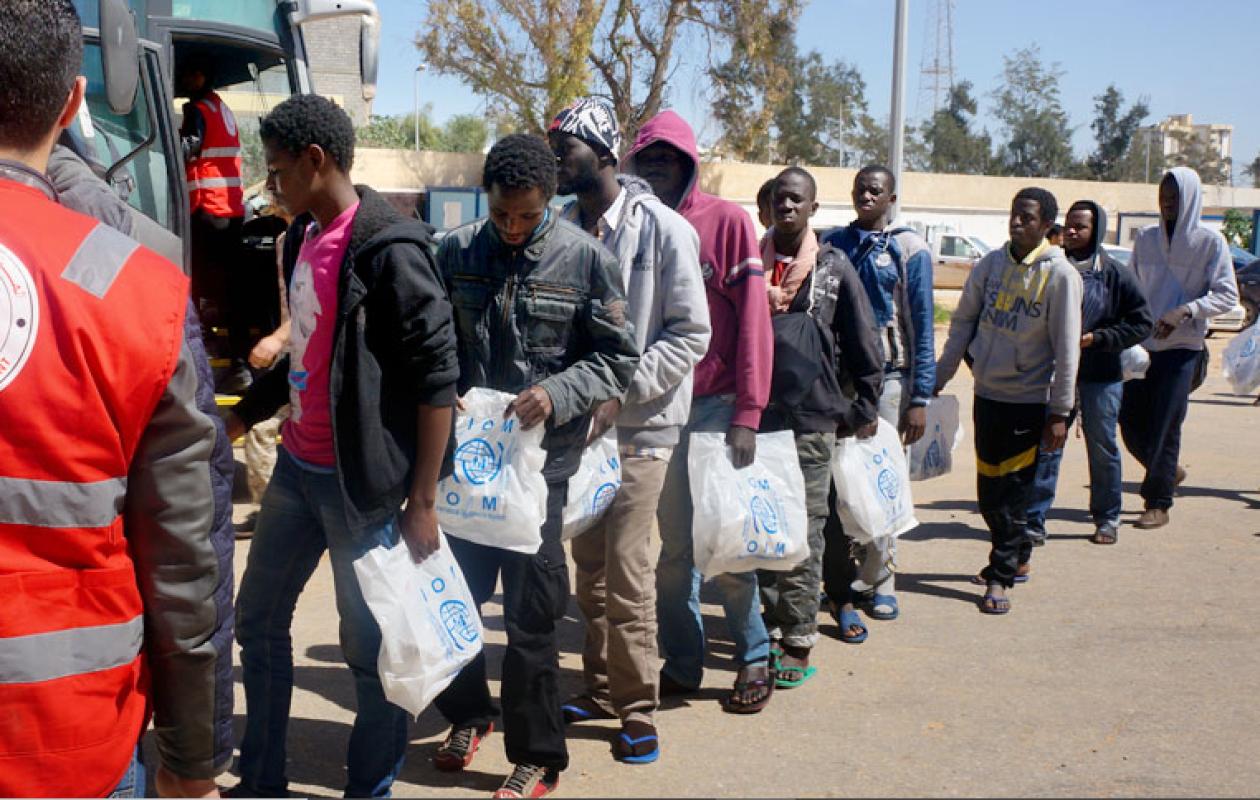
MIGRANTS DE RETOUR AU SÉNÉGAL : APRÈS L’ACCUEIL, LE DÉFI DE LA RÉINTÉGRATION DURABLE
Returning to Senegal does not always mean being able to rebuild one's life there. Economic hardship, psychosocial needs, and access to employment can jeopardize reintegration prospects. To prevent a return from being followed by another departure, the State intends to make the National Orientation Mechanism (MNO) permanent. This undertaking raises a central question: how to guarantee continuity of support when external funding dries up?
Between August 2022 and April 2026, the International Organization for Migration (IOM), in collaboration with national authorities, facilitated the voluntary return of more than 4,740 Senegalese. Among them, 4,050 benefited from at least one form of direct reintegration support, particularly in trade, transport, livestock farming, agriculture, money transfer services, and tailoring.
Behind these figures, the needs remain numerous. "When a Senegalese person returns, they can face several types of difficulties: economic, social, mental health and psychosocial. Therefore, the intervention must be multifaceted," emphasizes El Hadj Abdoul Karim Cissé, director of Senegalese abroad.
The National Reception Mechanism (MNO) was established to better coordinate responses. This mechanism aims to coordinate the interventions of various stakeholders, from the host country to arrival in Senegal and reintegration. The objective is to prevent returnees from facing fragmented processes or support that is abruptly interrupted.
For El Hadj Abdoul Karim Cissé, the need for sustained monitoring is beyond doubt. "Because if reintegration is not sustainable, we are likely to witness what is called re-immigration," he warns.
This is one of the key issues addressed at the workshop organized by the IOM in Dakar on October 21 and 22, 2026, with the participation of some fifty state and non-state actors. Discussions will focus on the presentation, consultation, and finalization of the MNO's sustainability plan, structured around four dimensions: institutional, financial, operational, and partnership-based.
Beyond finalizing the program, the challenge is to ensure its long-term sustainability. El Hadj Abdoul Karim Cissé indicates that his department is already allocating a portion of its budget to this support. He also hopes that other relevant organizations will integrate this approach into their intervention strategies and budget forecasts.
However, the commitment of a single leadership is not enough to guarantee the sustainability of the entire mechanism. This requires ownership by the institutions involved, available resources, and a clear distribution of responsibilities.
For Aïssata Kane, IOM's head of mission in Senegal, technical partners cannot replace the State. "As a technical and expertise partner, we can come. But what makes the difference in this mechanism is that it is driven by the government, driven by a state will to have a state response to a problem that is national," she insists.
The sustainability of the mechanism will also be measured by its ability to meet the needs of returning migrants, wherever they are in the country. Support cannot be limited to economic assistance: it may also include psychosocial support, access to healthcare, professional retraining, project funding, or assistance with reintegration into the community.
“The return must be supported and these people must have the social fabric that is there behind them, but also the economic fabric,” recalls Aïssata Kane.
This approach requires coordination between ministries, decentralized services, local authorities, civil society organizations, migrant associations, and the migrants themselves. The latter must be able to express their needs and be directed to appropriate services.
El Hadj Abdoul Karim Cissé also emphasizes the link between the national level and local areas. While regional representatives exist, their actions must be part of a coherent system with defined roles and shared referral procedures.
The finalization of the sustainability plan is a step in structuring the MNO. The next step is to translate the chosen guidelines into concrete institutional, financial, and operational commitments.
The sustainability of the mechanism will therefore not only be measured by the existence of procedures or the mobilization of partners, but by its ability to provide effective support over the long term.
For returning migrants, the challenge is to rebuild their lives in Senegal without seeing the support services disappear along with the funding that sustains them. It is through this test, far more than the mere completion of a plan, that the sustainability of the MNO will be measured.













Commentaires (5)
Et nous, qui restons sagement chez nous, respectons la loi et faisons de notre mieux pour contribuer à l'essor du pays, nous ne pouvons même pas obtenir un petit prêt garanti par l'État pour créer notre propre entreprise. Nous ne demandons rien de gratuit ; nous demandons simplement un traitement équitable !
Participer à la Discussion
Règles de la communauté
💡 Astuce : Utilisez des emojis depuis votre téléphone ou le module emoji ci-dessous. Cliquez sur GIF pour ajouter un GIF animé. Collez un lien X/Twitter, TikTok ou Instagram pour l'afficher automatiquement.
Se connecter
Commentez avec votre profil, votre photo, et soyez averti des réponses.